4.02 Adjusted EBITDA adds back venue exit costs described as non-recurring although a similar charge arose in each of the last two years
Company A · a US-listed consumer leisure company · Compliance or disclosure gap
In brief
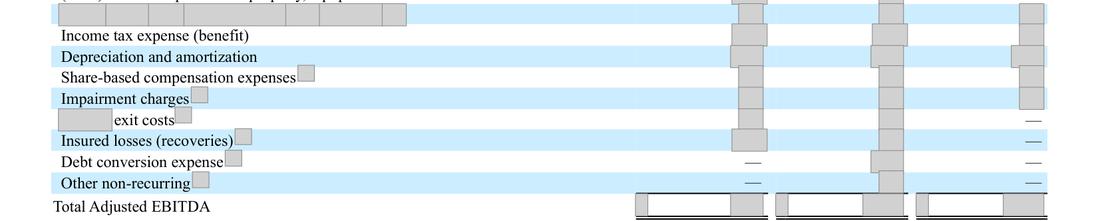
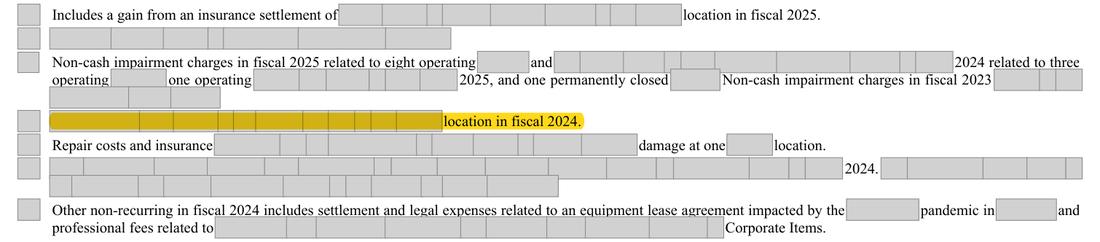
The reconciliation of net earnings to Adjusted EBITDA (earnings before interest, taxes, depreciation and amortization, as adjusted) adds back venue exit costs of [amount] in fiscal 2025 and again in fiscal 2024. Footnote (4) calls them 'Non-recurring costs' of a venue closure in fiscal 2024. The management's discussion and analysis (MD&A) records one venue closed in fiscal 2024 and another in fiscal 2025, and Regulation S-K Item 10(e) bars the non-recurring description when a similar charge arose within the prior two years.
The evidence, as filed
3 further page extracts: screenshot withheld to protect the company’s identity. The rows below say what each shows.
What the filing shows, and what the rule requires
| What the filing shows | What the rule requires |
|---|---|
Venue exit costs added back in both years ([n] and [n]; [n] and [n] in the earnings release), footnoted as 'non-recurring costs of closing one venue location in fiscal 2024'. | The add-back may stay, but without the word non-recurring; the footnote should say what each year's charge is (the fiscal 2024 and fiscal 2025 closures). |
The rule
Regulation S-K Item 10(e)(1)(ii)(B)
Adjust a non-GAAP performance measure to eliminate or smooth items identified as non-recurring, infrequent or unusual, when the nature of the charge or gain is such that it is reasonably likely to recur within two years or there was a similar charge or gain within the prior two years
Version: Text in force at the date of this review · Source: 17 CFR 229.10(e), Regulation S-K Item 10(e) (eCFR, as amended to 2026)
Why it applies here. the fiscal 2025 add-back is a charge of the same nature as the fiscal 2024 one, so a similar charge arose within the prior two years; Item 10(e)(1)(ii)(B) then forbids identifying it as non-recurring. The Securities and Exchange Commission (SEC) staff's non-GAAP Compliance and Disclosure Interpretations (CFI) read the prohibition as one on the description, not the adjustment: the company may keep adjusting for the charge if it stops calling it non-recurring. The footnote is also inaccurate for fiscal 2025, because it attributes both years' amounts to a fiscal 2024 closure.
Why it matters
A staff comment asking the company to drop the description in future filings, and a future-filings undertaking; no reported figure changes.
Exposure
Staff comment letter and a future-filings undertaking under the non-GAAP rules; no fine attaches.
Our workings
the reconciliation on p.40 adds back 'Venue exit costs' of [n] for fiscal 2025 and [n] for fiscal 2024; footnote (4) on p.41 describes the line as 'non-recurring costs of closing one venue location in fiscal 2024'. The fourth-quarter earnings release gives the same add-backs in thousands ([n] for fiscal 2025, [n] for fiscal 2024). The venues discussion on p.36 records a closure in each year ([state] in fiscal 2024, a [brand] in [state] in fiscal 2025), and the first-quarter 2026 earnings release ties the fiscal 2025 charge to a closure in the first quarter of fiscal 2025.
the fiscal 2025 add-back is 1.55% of pre-tax income (workings).
| Item | Fiscal 2025 | Fiscal 2024 | Where |
|---|---|---|---|
| Venue exit costs added back ($ million) | [n] | [n] | 10-K reconciliation, p.40 |
| Venue exit costs added back ($ thousand) | [n] | [n] | Fourth-quarter 2025 earnings release |
| Venue closures in the year | 1 ([state]) | 1 ([state]) | Venues discussion, p.36 |
| Add-back against pre-tax income | [n] / [n] = 1.55% | pre-tax income [amount] |
Management’s best defense, and our reply
Each closure is a discrete decision about one leased location, the amounts are about [amount] a year, and the Adjusted EBITDA section already warns that similar expenses will be incurred in the future. The staff reviewed this 10-K in [date] and raised no non-GAAP comment, so the description has in effect been accepted.
The fix
- Keep the add-back but relabel footnote (4): 'Costs to close and exit underperforming venue locations (one location in fiscal 2025 and one in fiscal 2024)', with no 'non-recurring', in the 10-K, the [n]-Qs and the earnings releases.
Evidence relied on
| # | What it shows | Type | Where |
|---|---|---|---|
| 1 | The reconciliation adds back venue exit costs in fiscal 2025 and in fiscal 2024 | Document | Form 10-K 2025, page 40 |
| 2 | Footnote (4) describes the add-back as non-recurring and ties it only to a fiscal 2024 closure | Document | Form 10-K 2025, page 41 |
| 3 | A venue was closed in each of the two years | Document | Form 10-K 2025, page 36 |
| 4 | The general caveat in the Adjusted EBITDA section; it does not withdraw the specific non-recurring description | Document | Form 10-K 2025, page 39 |
| 5 | The fourth-quarter 2025 earnings release gives the add-backs in thousands: [n] for fiscal 2025 and [n] for fiscal 2024 | Document | |
| 6 | The first-quarter 2026 earnings release ties the fiscal 2025 charge to a closure in the first quarter of fiscal 2025 | Document |
Prepared by Pramanex from the company’s public SEC filings, without the company’s involvement, to show how a 10-K Pre-filing Check reads. The company is not named, and nothing on this page is a statement about any identifiable company. Observations are not an audit, review or other attestation or assurance engagement, and not legal advice. An SEC-style question is a question, not a conclusion.
Want this on your own 10-K, before you file?
Start with three free findings on your latest 10-K, or book a fixed-price 10-K Pre-filing Check.
Your next 10-K will be in draft before the audit is done.
Have it read before you file.
Start with three free findings on your latest 10-K, or book a fixed-price 10-K check. Drafts only under NDA, inside your insider trading policy.