4.01 The repurchase table footnote gives no announcement date for the share repurchase authorizations, including the one added in [date]
Company A · a US-listed consumer leisure company · Compliance or disclosure gap
In brief
The fourth-quarter repurchase table shows [n] shares still available at the end of [date]. That figure includes [n] shares added by a Board authorization announced on [date], but the footnote gives only the cumulative total of [n] shares and no announcement dates. The rule on issuer repurchases asks the footnote to give the date each plan or program was announced.
The evidence, as filed
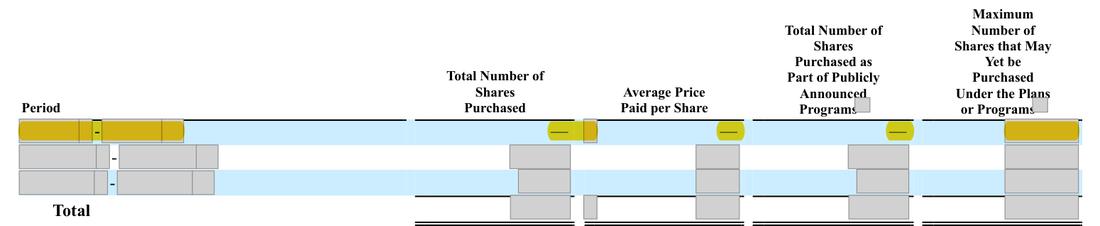
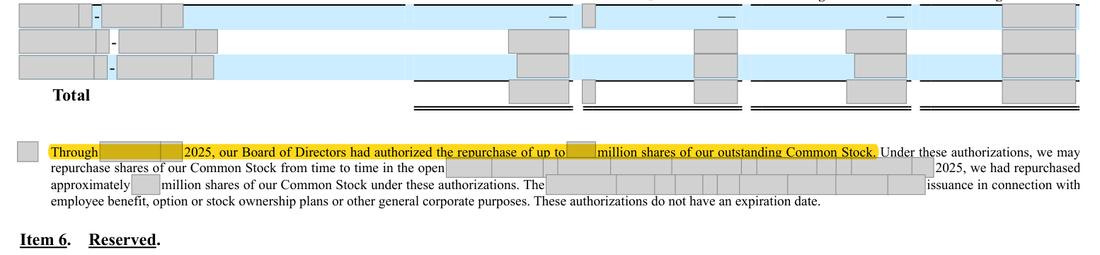
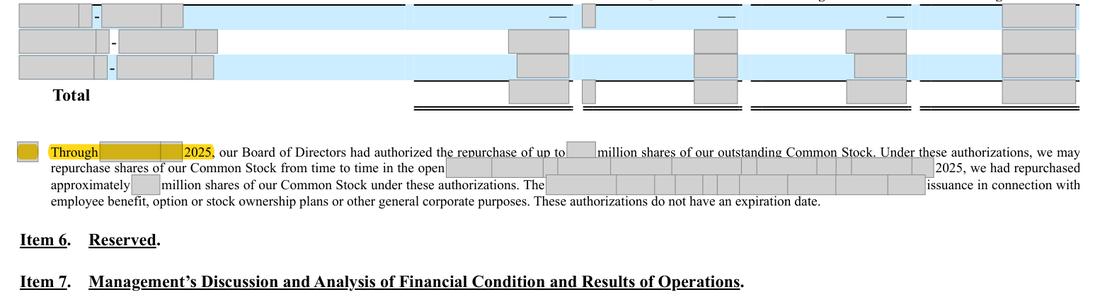
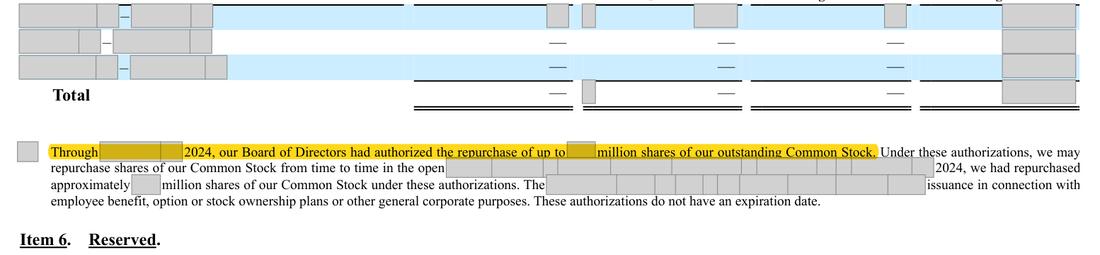
1 further page extract: screenshot withheld to protect the company’s identity. The rows below say what each shows.
What the filing shows, and what the rule requires
| What the filing shows | What the rule requires |
|---|---|
Footnote (1) gives a cumulative authorization of [n] shares and says the authorizations do not expire; it gives no announcement date for any authorization, including the [n]-share increase announced on [date], and the equity note is silent on dates too. | The footnote states the date each plan or program (and each increase) was announced, the number of shares approved, and the expiration date (none). |
| What we checked. Item 5 table and footnote, the equity note, the MD&A overview of repurchases, the prior-year footnote, the third-quarter earnings release and the first-quarter 2026 report | |
The rule
Regulation S-K Item 703, instruction 2.a to paragraphs (b)(3) and (b)(4) (to be given by footnote to the table)
a. The date each plan or program was announced;
Version: Text in force at the date of this review · Source: Regulation S-K, 17 CFR 229.703 (Purchases of equity securities by the issuer and affiliated purchasers), current eCFR text
Why it applies here. the footnote gives the amount element of the instruction (shares approved, in total) and the expiration element, but not the date element for any authorization, and a reader of the Form 10-K alone cannot see that remaining capacity rose by [n] shares in the period because of a new Board approval. Architecture: Item 703(b) requires the monthly table with four columns; the instructions to columns (b)(3) and (b)(4) require a footnote giving (a) the date each plan or program was announced, (b) the amount approved, (c) the expiration date, (d) plans that expired and (e) plans terminated. Grey area: the company treats the [date] approval as an increase to a long-standing program rather than a new program; even on that reading the date the program was announced is not given, and the increase is the event that changed the last column in the period, so its date is the information the instruction is aimed at.
Why it matters
A reader of the annual report cannot see when the authorizations were given, or that the capacity shown rose by [n] shares in [date] because of a new Board approval.
Exposure
A staff comment asking for the dates in future filings is the realistic outcome; there is no fine.
Our workings
the October row of the table shows no purchases but [n] shares still available, and the footnote says only that the Board had authorized up to [n] shares in total with no expiration date. The third-quarter earnings release furnished on [date] says the Board authorized up to [n] additional shares, adding to about [n] shares then remaining, for [n] available. The prior-year footnote gave a cumulative [n] shares.
[n] + [n] = [n], which is the [n] in the October row; and [n] - [n] = [n], the year's new authorization.
| Step | Figure | Source |
|---|---|---|
| Remaining at [date] | [n] | third-quarter earnings release |
| New authorization announced [date] | [n] | third-quarter earnings release |
| [n] + [n] = [n] | [n] | agrees with the October row, [n] |
| [n] - [n] = [n] | [n] | current footnote less prior-year footnote |
Management’s best defense, and our reply
The company would say the [date] approval was an increase to a single, long-standing program, announced the same day in an earnings release furnished on Form 8-K and described in the third-quarter quarterly report, so investors were told. It would add that the footnote already gives the total shares approved and states there is no expiration date, and that the omission is immaterial. However, the instruction asks the footnote itself to give the date each plan or program was announced, and the table's October row jumps to [n] shares available without the footnote saying why; the annual report is read on its own, and the cure is one line.
The fix
- Add to footnote (1): 'The Board first announced the repurchase program on [date] and increased it by [n] shares on [date] (announced [date]); the authorizations total [n] shares and have no expiration date.'
Evidence relied on
| # | What it shows | Type | Where |
|---|---|---|---|
| 1 | No purchases in October, but [n] shares shown as still available | Document | Form 10-K 2025, page 24 |
| 2 | Footnote gives only the cumulative authorization, with no announcement dates | Document | Form 10-K 2025, page 24 |
| 3 | The equity note gives the total approved, again without dates | Document | Form 10-K 2025, page 72 |
| 4 | The new [n]-share authorization was announced on [date], inside the period the table covers | Document | |
| 5 | Shows that the October remaining capacity is the old balance plus the new authorization | Document |
Absence check
- Document
- Form 10-K 2025
- Where it would appear
- (1) Through [date]
- What is missing
- the date each repurchase plan or authorization was announced, including the [date] increase
- Pages looked at
- p.24 (Item 5 table and footnote), p.31 (MD&A note on repurchases), p.72 (equity note)
- Result
- The term announced hits p.22 (an officer's retirement), p.24 (the column heading Publicly Announced Programs) and p.28 (a promotion); [n] hits p.33 (income tax benefit) and p.45 (capital expenditure variance); [date], [date] and additional shares have no hits. None gives the date of a repurchase authorization.
Prepared by Pramanex from the company’s public SEC filings, without the company’s involvement, to show how a 10-K Pre-filing Check reads. The company is not named, and nothing on this page is a statement about any identifiable company. Observations are not an audit, review or other attestation or assurance engagement, and not legal advice. An SEC-style question is a question, not a conclusion.
Want this on your own 10-K, before you file?
Start with three free findings on your latest 10-K, or book a fixed-price 10-K Pre-filing Check.
Your next 10-K will be in draft before the audit is done.
Have it read before you file.
Start with three free findings on your latest 10-K, or book a fixed-price 10-K check. Drafts only under NDA, inside your insider trading policy.