3.01 No related party note, although the company manages two equity-method joint-venture lodging properties, guarantees their mortgage loans and transacts with director-related entities; the guarantee disclosures also omit the Joint venture 2 maximum, the terms and any carrying amount
Company A · a US-listed consumer leisure company · SEC-style question
In brief
The company holds [n]% of the Joint venture 1 joint venture and 10% of the Joint venture 2 joint venture, manages both lodging properties and has guaranteed both mortgage loans: the Joint venture 1 guaranty is capped at [amount], while the Joint venture 2 carve-out guaranty states no maximum. Item 2 itself lists two lodging properties as managed for related parties, yet the notes give no management fees, reimbursed costs or balances with the joint ventures, and the proxy statement separately reports [amount] paid to a director's vehicle-leasing company and [amount] of licensing fees to an entity owned by a family investment company. In both years the 10-K has no related party note, and in fiscal 2025 the guarantee paragraphs give neither guarantee's term nor any liability carried, so it cannot be seen whether these items were assessed as immaterial.
The evidence, as filed

5 further page extracts: screenshot withheld to protect the company’s identity. The rows below say what each shows.
What the filing shows, and what the rule requires
| What the filing shows | What the rule requires |
|---|---|
No related party note in either year. Note 11 describes the two joint ventures, the management agreements and the guarantees but gives no transaction amounts or balances; the Joint venture 1 guaranty is capped at [amount], the Joint venture 2 guaranty has no stated maximum, and neither guarantee's term or carrying amount is given (fiscal 2025, consolidated). Item 2 counts two lodging properties as managed for related parties. Director-related transactions of [amounts] appear only in the proxy statement. | Either a related party note giving the nature, amounts and balances of material related party transactions (ASC 850-10-50-1), or confirmation that the aggregate was assessed and is immaterial; and, for each guarantee of the joint ventures' loans, its approximate term, the maximum potential future payments (or why none can be estimated) and the carrying amount of any liability (ASC 460-10-50-4). |
Why it matters
If the aggregate is material, the notes omit a required disclosure and readers cannot see the economics of the company's dealings with the joint ventures it manages and guarantees.
Exposure
A question for management; if the amounts prove material, the realistic consequence is a staff comment asking for the disclosure in future filings.
Our workings
Note 11 states that the company holds [n]% of the Joint venture 1 joint venture and 10% of the Joint venture 2 joint venture, accounts for both under the equity method, has management agreements with both lodging properties, gave a payment guaranty of up to [amount] on the Joint venture 1 mortgage, and gave a carve-out guaranty on the Joint venture 2 mortgage under which the lender can recover losses for certain bad acts of the joint venture, with the partner indemnifying the company except for its own bad acts. No maximum is stated for the Joint venture 2 guaranty, and neither guarantee's term nor any liability recognized for it is given. The Item 2 property table counts two lodging properties in a column headed 'Managed for Related Parties'.
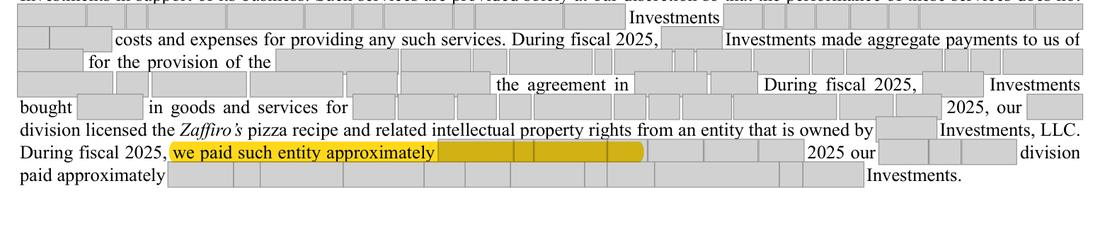
the exhibit index lists an administrative services agreement with the Company Investments, LLC; the proxy statement reports [amount] paid to a leasing company of which a director is chief executive and sole shareholder, and about [amount] of licensing fees paid to an entity owned by the Company Investments.
a search of the whole 10-K finds no related party note, in this year or the prior year.
equity-method investees and entities controlled by directors or their families are related parties under the ASC related party Topic, and the company's own property table treats the joint-venture lodging properties that way; management fees and reimbursed costs from those lodging properties, any balances due, and the guarantees are related party transactions. The guarantees Topic separately asks a guarantor to give each guarantee's approximate term, the maximum potential future payments (or why they cannot be estimated) and the carrying amount of any liability, even when payment is remote. The grey area is the Joint venture 2 guaranty: because the partner indemnifies everything except losses from the company's own bad acts, management may regard the residual exposure as a guarantee of its own performance, which falls outside that Topic. Whether the related party items are material in aggregate, quantitatively and qualitatively, is a judgment the report does not show. The point is put as a question because the known director-related amounts are small against revenue and the joint-venture amounts are not disclosed.
| Counterparty | Relationship | Amount disclosed | Where |
|---|---|---|---|
| Joint venture 1 joint venture | equity-method investee, [n]%; managed lodging property | guaranty up to [amount]; term, carrying amount and fees not given | Note 11 |
| Joint venture 2 joint venture | equity-method investee, 10%; managed lodging property | carve-out guaranty with no maximum; term, carrying amount and fees not given | Note 11 |
| Vehicle-leasing company | owned by a director | [amount] paid in fiscal 2025 | Proxy statement |
| Entity owned by the Company Investments | family investment company | [amount] licensing fees in fiscal 2025 | Proxy statement |
Management’s best defense, and our reply
The director-related amounts in the proxy statement are small against the company's revenue, ASC 850 requires disclosure only of material transactions, and the joint ventures, their management agreements and the guarantees are already described in Note 11; the director transactions are disclosed under Item 404 through Part III. Management may also see the management fees as ordinary-course lodging property management revenue, and the Joint venture 2 guaranty as covering only losses from its own bad acts once the partner's indemnity is taken into account, which is a guarantee of its own performance outside the guarantees Topic. However, ASC 850 materiality is qualitative as well as quantitative, the company's own property table calls the joint-venture lodging properties related parties, the joint-venture fees, reimbursed costs and balances are given nowhere in the 10-K, the lender's recourse under the Joint venture 2 guaranty runs to the company first whatever the indemnity, and the audited statements have no related party note at all, so only management can confirm that the aggregate is immaterial and how it reads the guaranty.
The fix
- Add a related party note, e.g. 'The Company earns management fees and receives reimbursement of costs from the lodging properties owned by its two equity-method joint ventures (fiscal 2025: $[x] and $[y]; amounts receivable $[z]) and has guaranteed ...', with each guarantee's term, maximum potential payments (or why none can be estimated) and carrying amount; or document the materiality assessment.
Question for the company
Has management assessed, for ASC 850, the aggregate of its transactions with the Joint venture 1 and Joint venture 2 joint ventures (management fees, reimbursed costs, balances due and the guarantees) and with director- and family-related entities, and what were those amounts for fiscal 2025 and fiscal 2024? For the two mortgage guarantees, what are their terms, the maximum potential payments under the Joint venture 2 guaranty, and any liability carried?
Evidence relied on
| # | What it shows | Type | Where |
|---|---|---|---|
| 1 | Joint venture 1 joint venture: [n]% interest, equity method, so a related party | Document | Form 10-K 2025, page 81 |
| 2 | Management agreement with the Joint venture 1 joint venture lodging property | Document | Form 10-K 2025, page 81 |
| 3 | Guaranty of the joint venture's mortgage up to [amount] | Document | Form 10-K 2025, page 81 |
| 4 | Joint venture 2 joint venture: equity interest and management agreement | Document | Form 10-K 2025, page 81 |
| 5 | Exhibit 10.[n]: agreement with the Company Investments | Document | Form 10-K 2025, page 90 |
| 6 | Proxy statement: payments to a director's leasing company | Document | |
| 7 | Proxy statement: licensing fees to an entity owned by the Company Investments | Document | |
| 8 | Item 2 property table: a column headed 'Managed for Related Parties' shows two lodging properties, the joint-venture lodging properties | Document | Form 10-K 2025, page 21 |
| 9 | Joint venture 2 guaranty: no maximum amount or term is stated | Document | Form 10-K 2025, page 81 |
| 10 | Joint venture 1 mortgage guarantee: a maximum is stated | Document | Form 10-K 2025, page 81 |
| 11 | Joint venture 2 mortgage guarantee: no maximum and no statement that it is unlimited | Document | Form 10-K 2025, page 81 |
Absence check
- Document
- Form 10-K 2025
- Where it would appear
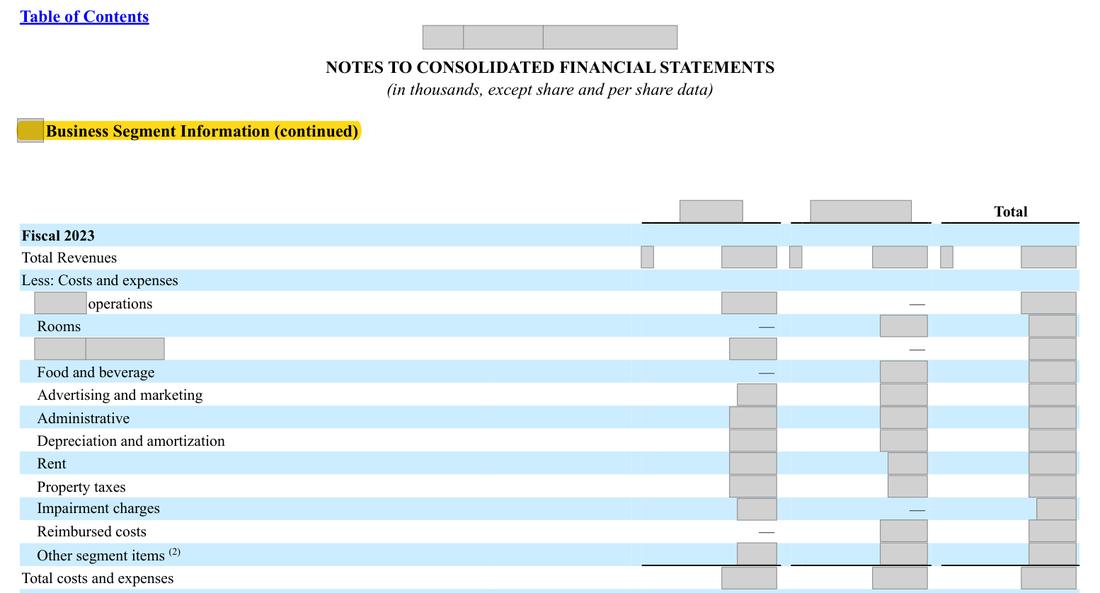
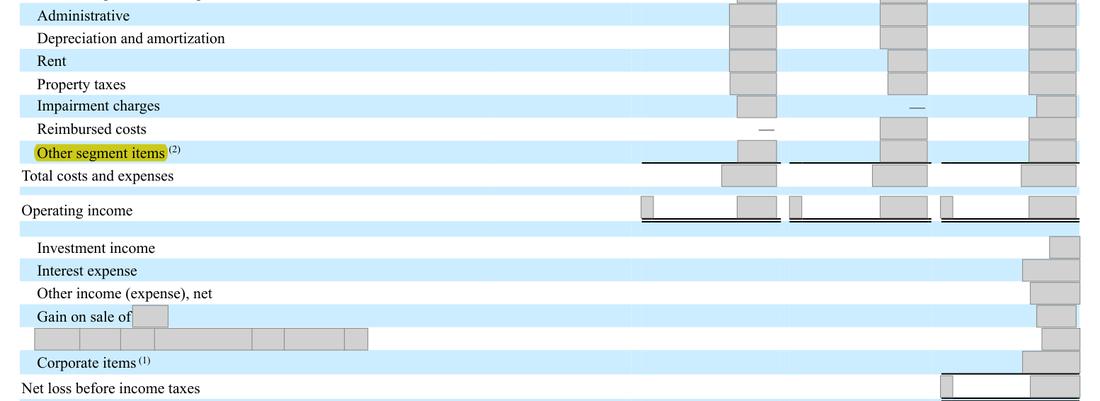
- [n]. Business Segment Information (continued)
- What is missing
- a related party note giving amounts and balances of transactions with the equity-method joint ventures and with director- and family-related entities
- Pages looked at
- p.59-84 (all notes), p.81 (Note 11), p.86 (Item 13), p.90 (exhibits)
- Result
- 'related part' hits only p.21, in the Item 2 property table: the column heading 'Managed for Related Parties' (two lodging properties, the joint-venture lodging properties) and the 'unrelated parties' columns and footnotes; it is not a related party note. 'related person' hits only p.86, the Item 13 incorporation by reference of the proxy caption; 'the Company Investments' hits only p.90, the Exhibit 10.[n] title; 'management fee' hits p.7, 9, [n] (business description, MD&A and the revenue policy) with no amounts for the joint ventures; '[related company]' has no hit.
Absence check
- Document
- Form 10-K 2025
- Where it would appear
- [n]. Joint Venture Transactions
- What is missing
- the carrying amount of any liability recognized for the two guarantees, their term, and for the Joint venture 2 guarantee the maximum potential payments or a statement that no maximum exists
- Pages looked at
- p.81 (Note 11), p.68-70 (Note 5), p.46-47 (MD&A liquidity) - images
- Result
- 'maximum potential', 'guarantee liability' and 'fair value of the guarant' have no hit. 'carrying amount of' hits p.48, [n] and [n], all about impaired assets or goodwill, not a guarantee. 'term of the' hits only pages on lease terms, debt agreements or plan terms, none about either guarantee.
Prepared by Pramanex from the company’s public SEC filings, without the company’s involvement, to show how a 10-K Pre-filing Check reads. The company is not named, and nothing on this page is a statement about any identifiable company. Observations are not an audit, review or other attestation or assurance engagement, and not legal advice. An SEC-style question is a question, not a conclusion.
Want this on your own 10-K, before you file?
Start with three free findings on your latest 10-K, or book a fixed-price 10-K Pre-filing Check.
Your next 10-K will be in draft before the audit is done.
Have it read before you file.
Start with three free findings on your latest 10-K, or book a fixed-price 10-K check. Drafts only under NDA, inside your insider trading policy.