6.05 Typing slips in the liquidity and critical accounting estimates text of the MD&A
Company H · a US-listed aerospace services company · Drafting slip
In brief
Three typing slips sit in Item 7 of the Form 10-K: a repayment amount printed as [amount] with no unit, the words 'Most of the our arrangements', and 'include in the following'. None changes a figure or a conclusion. The prior-year Form 10-K's MD&A already printed 'the reliability of the installed based' and called the IPO shares 'ordinary shares', '[amount] on the Prior Senior Notes' with no unit (page 63) and 'include in the following' (page 64), while its covenant table showed the same [n] for 2024 correctly headed '(in millions)'.
The evidence, as filed
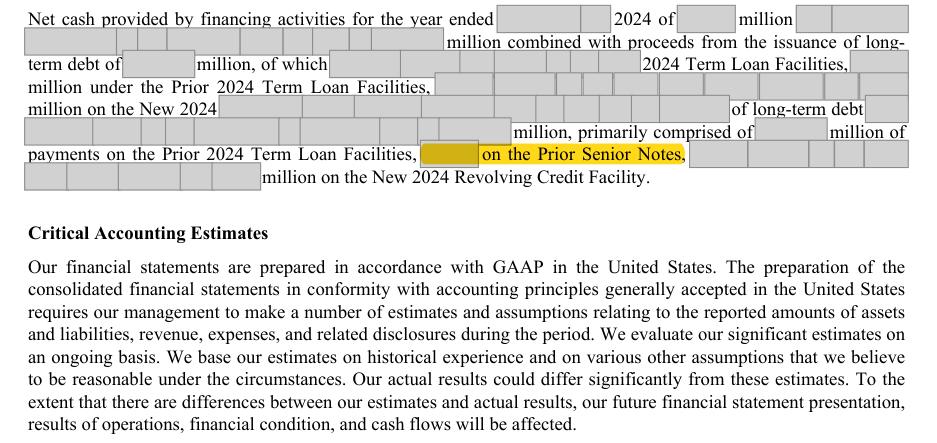
3 further page extracts: screenshot withheld to protect the company’s identity. The rows below say what each shows.
What the filing shows, and what the rule requires
| What the filing shows | What the rule requires |
|---|---|
'[amount] on the Prior Senior Notes'; 'Most of the our arrangements with customers'; 'The key assumptions by contract type include in the following' | '[amount] on the Prior Senior Notes'; 'Most of our arrangements with customers'; 'The key assumptions by contract type include the following' |
Why it matters
None beyond presentation; a careful reader may pause on the missing unit.
Exposure
No regulatory exposure; presentation only.
Our workings
the 2024 financing cash-flow paragraph prints '[amount] on the Prior Senior Notes' while every other amount in the sentence carries 'million'; the revenue recognition estimate prints 'Most of the our arrangements' and 'include in the following'. The missing unit and 'include in the following' were carried forward from the prior-year Form 10-K, which printed the same words; the prior year read 'Most of the Company's arrangements', so the duplicated article is new.
proof-reading slips only.
Management’s best defense, and our reply
Management would say these are obvious slips that no reader could misunderstand, since the other amounts in the sentence are in millions. It would add that they change no figure in the audited statements. That is right, and is why they are listed only as drafting slips to correct.
The fix
- Correct the three phrases as in the should-be column when the text is carried into the next Form 10-K.
Evidence relied on
| # | What it shows | Type | Where |
|---|---|---|---|
| 1 | Repayment amount printed without the unit 'million' | Document | Form 10-K 2025, page 64 |
| 2 | Duplicated article 'the our' | Document | Form 10-K 2025, page 65 |
| 3 | Stray 'in' before 'the following' | Document | Form 10-K 2025, page 65 |
| 4 | Prior-year MD&A: 'installed based' for 'installed base', the same slip as in the fiscal 2025 report | Document | Form 10-K 2024 (prior year), unnumbered page |
| 5 | Prior-year MD&A: the [state] company's common stock described as 'ordinary shares', the same wording as in the fiscal 2025 report | Document | Form 10-K 2024 (prior year), unnumbered page |
| 6 | Prior-year MD&A: the Prior Senior Notes repayment printed without its unit, the same slip as in the fiscal 2025 report | Document | Form 10-K 2024 (prior year), page 63 |
| 7 | Prior-year critical accounting estimates: the stray 'in' before 'the following', the same slip as in the fiscal 2025 report | Document | Form 10-K 2024 (prior year), page 64 |
| 8 | Prior-year covenant table: the same [n] for 2024, under a column headed '(in millions)'; the fiscal 2025 report heads the column '(in thousands)' | Document | Form 10-K 2024 (prior year), unnumbered page |
| 9 | the annual statements are called 'condensed' in footnote (4) to the Adjusted EBITDA reconciliation | Document | Form 10-K 2025, page 57 |
| 10 | the annual statements are called 'condensed' again in Segment Results | Document | Form 10-K 2025, page 61 |
| 11 | footnote (3) reads 'planned completed acquisitions' (a word missing, e.g. 'planned and completed') | Document | Form 10-K 2025, page 57 |
| 12 | the Consolidated EBITDA difference table is headed '(in thousands)' but its amounts ([n] and [n]) read as $ million | Document | Form 10-K 2025, page 63 |
| 13 | 'installed based' for 'installed base' | Document | Form 10-K 2025, page 54 |
| 14 | the IPO is described as an offering of 'ordinary shares'; the registrant has common stock, as the same sentence goes on to say | Document | Form 10-K 2025, page 55 |
| 15 | the covenant reconciliation table is headed '(in thousands)' | Document | Form 10-K 2025, page 63 |
| 16 | the 2025 difference is printed as [amount] in a table stated in thousands, i.e. [amount], where the context indicates [amount] | Document | Form 10-K 2025, page 63 |
Prepared by Pramanex from the company’s public SEC filings, without the company’s involvement, to show how a 10-K Pre-filing Check reads. The company is not named, and nothing on this page is a statement about any identifiable company. Observations are not an audit, review or other attestation or assurance engagement, and not legal advice. An SEC-style question is a question, not a conclusion.
Want this on your own 10-K, before you file?
Start with three free findings on your latest 10-K, or book a fixed-price 10-K Pre-filing Check.
Your next 10-K will be in draft before the audit is done.
Have it read before you file.
Start with three free findings on your latest 10-K, or book a fixed-price 10-K check. Drafts only under NDA, inside your insider trading policy.