6.03 Rental engine income, which the notes treat as lease income, is tagged in Inline XBRL as revenue from contracts with customers
Company H · a US-listed aerospace services company · Drafting slip
In brief
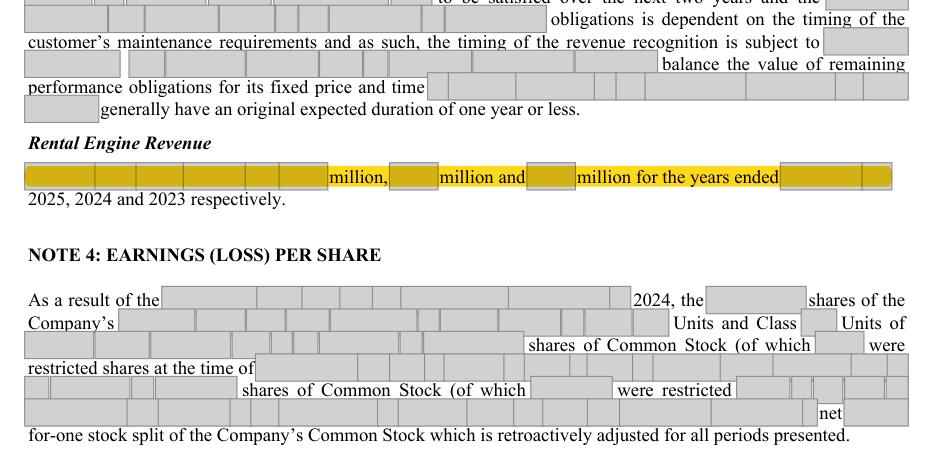
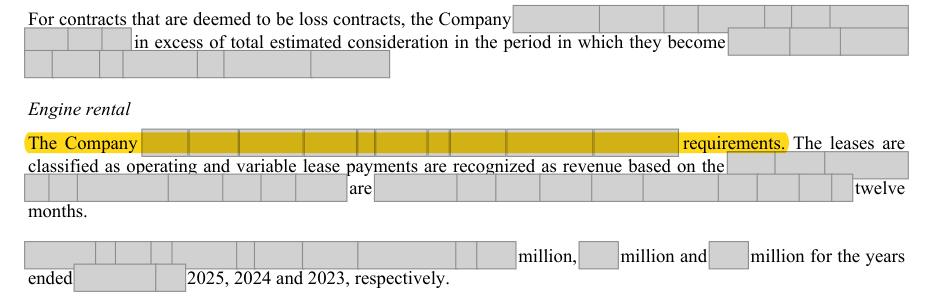
Note 3 states that revenue from rental engines was [amount]. The notes describe these as leases of the company's own engines, but the Inline XBRL tags this figure, and the whole revenue total, with the element for revenue from contracts with customers. No lease-income element is used, so data users read all revenue as contract revenue. The printed statements are not affected.
The evidence, as filed
What the filing shows, and what the rule requires
| What the filing shows | What the rule requires |
|---|---|
Rental engine revenue of [amount] (Note 3) tagged with the contract-with-customers revenue element; no operating lease income element in the filing. | The rental engine figure tagged with a lease-income element (for example operating lease income), and the revenue total tagged so that contract revenue and lease income can be told apart. |
| What we checked. The Inline XBRL source of this 10-K and the SEC company facts for this filing; Note 2 engine rental policy and Note 3 rental engine revenue. | |
Why it matters
XBRL users and data vendors see all [amount] of revenue as contract revenue and no lease income.
Exposure
No penalty; the fix is to the tagging in the next filings.
Our workings
Note 3 reports rental engine revenue for 2025, 2024 and 2023, and the accounting policy says [wording masked] customers.
in the filing's Inline XBRL the rental engine figure carries the element for revenue from contracts with customers excluding assessed tax, and the company facts for this filing contain no lease-income element.
lease income under the leases standard has been labelled as contract revenue in the machine-readable data; the printed figures are unchanged, so this is a tagging slip.
Management’s best defense, and our reply
Management would say rental engines are delivered with repair work under the same customer contracts, and the figure appears in the revenue-recognition note, so the contract-revenue element was a reasonable choice. However, the company's own policy note describes the rental engines as leases, and a lease-income element exists for exactly this, so the label should change; the point is recorded only as a drafting slip.
The fix
- Tag rental engine revenue with an operating lease income element and review the revenue-total tagging in the next Form 10-Q.
Evidence relied on
| # | What it shows | Type | Where |
|---|---|---|---|
| 1 | The figure tagged with the contract-revenue element | Document | Form 10-K 2025, page 92 |
| 2 | The notes treat rental engines as leases | Document | Form 10-K 2025, page 84 |
Prepared by Pramanex from the company’s public SEC filings, without the company’s involvement, to show how a 10-K Pre-filing Check reads. The company is not named, and nothing on this page is a statement about any identifiable company. Observations are not an audit, review or other attestation or assurance engagement, and not legal advice. An SEC-style question is a question, not a conclusion.
Want this on your own 10-K, before you file?
Start with three free findings on your latest 10-K, or book a fixed-price 10-K Pre-filing Check.
Your next 10-K will be in draft before the audit is done.
Have it read before you file.
Start with three free findings on your latest 10-K, or book a fixed-price 10-K check. Drafts only under NDA, inside your insider trading policy.