4.03 The liquidity discussion describes historical uses of cash but not the company's material cash requirements at year end
Company H · a US-listed aerospace services company · Compliance or disclosure gap
In brief
Item 303(b)(1)(ii)(A) of Regulation S-K requires the management's discussion and analysis (MD&A) to describe the company's material cash requirements, including commitments for capital expenditures, as of the end of the year, with the expected source of funds. The liquidity section describes the principal historical uses of cash and the term-loan principal of [amount] due in 2031, but gives no account of the other known obligations: operating lease payments of [amount] in the lease note, interest that cost [amount] in cash in 2025, or planned capital expenditure; the capital commitments of [amount] appear only in the commitments note, with no reference from the MD&A. The prior-year Form 10-K used the same wording.
The evidence, as filed
What the filing shows, and what the rule requires
| What the filing shows | What the rule requires |
|---|---|
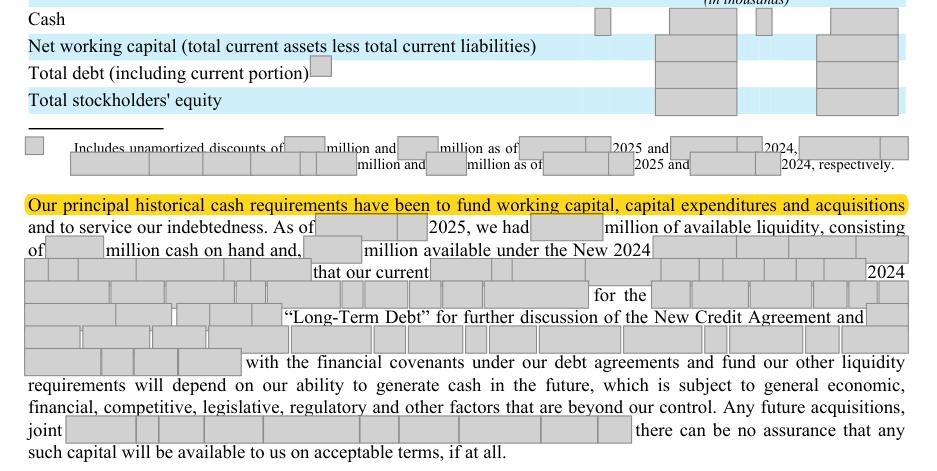
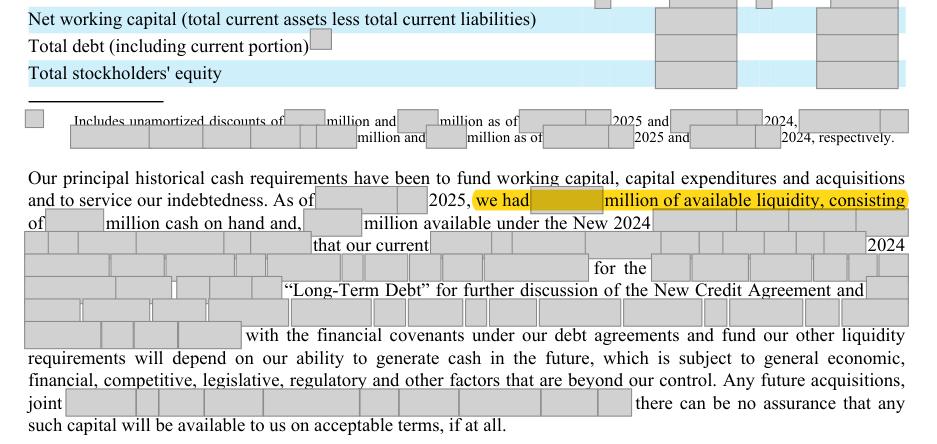
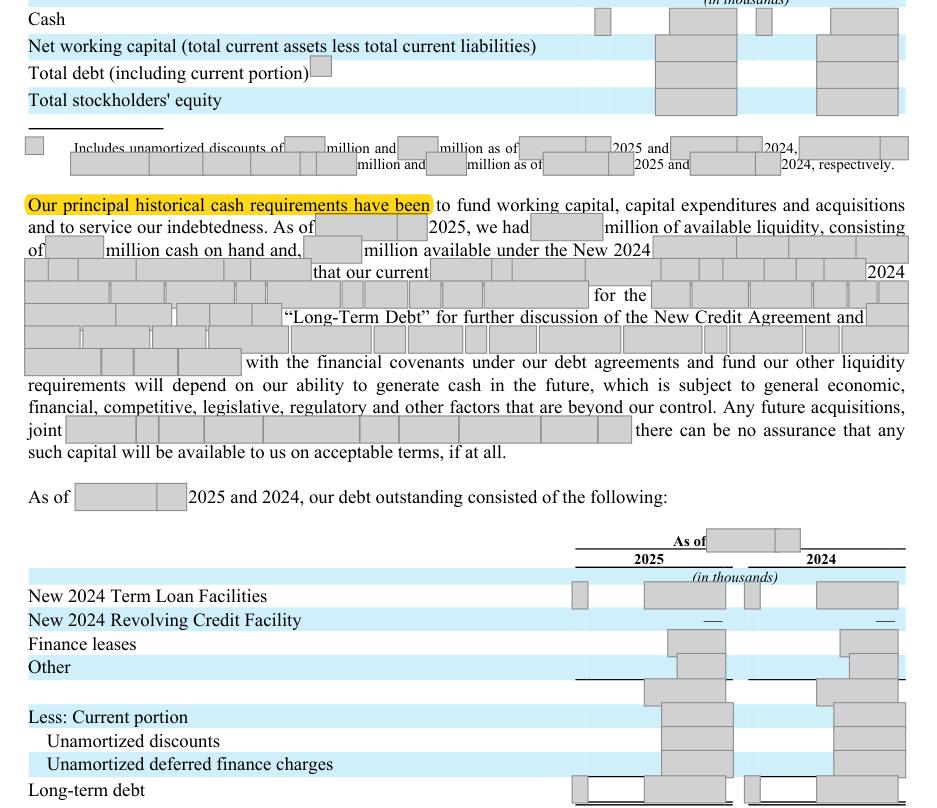
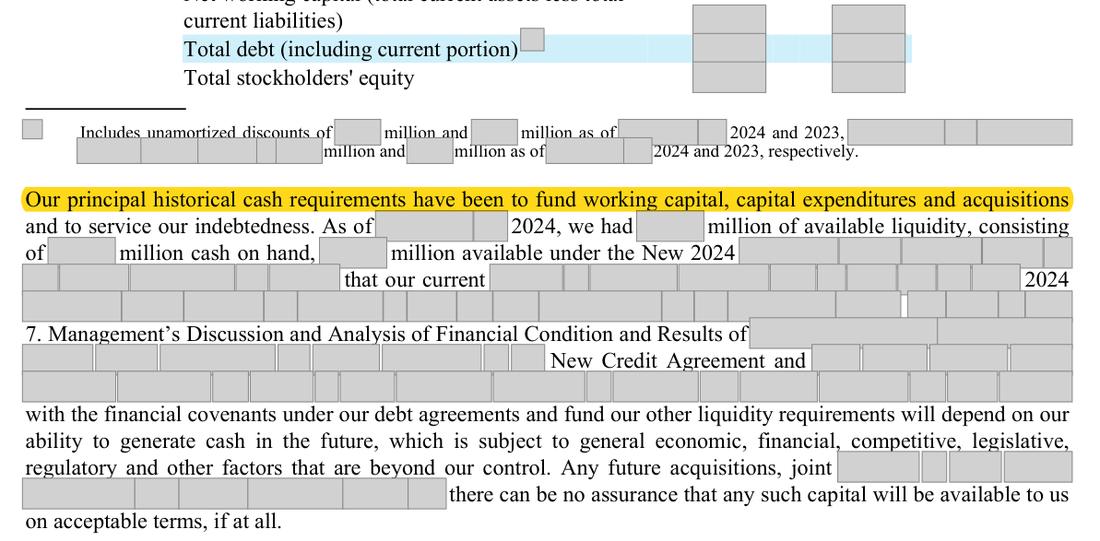
MD&A liquidity: 'Our principal historical cash requirements have been to fund working capital, capital expenditures and acquisitions and to service our indebtedness', available liquidity of [amount], the debt table and the term loans of [amount] maturing on [date]. No discussion of lease payments, interest payments, capital expenditure commitments (given only in Note 15 as [amount]) or purchase obligations as cash requirements, or of their timing. | A material cash requirements discussion as of [date]: term-loan principal and amortization, expected interest payments on floating-rate debt, operating lease payments ([amount] due in 2026; [amount] in total), planned capital expenditure and the [amount] of capital commitments, any material purchase obligations, split between the next twelve months and beyond, and the source of funds for each. |
The rule
Regulation S-K Item 303(b)(1)(ii)(A)
Describe the registrant's material cash requirements, including commitments for capital expenditures, as of the end of the latest fiscal period, the anticipated source of funds needed to satisfy such cash requirements and the general purpose of such requirements.
Version: Text in force at the date of this review · Source: 17 CFR 229.303 (Regulation S-K Item 303), as amended by Release 33-10890
Regulation S-K Item 303, Instruction 4 to paragraph (b)
For the liquidity and capital resources disclosure, discussion of material cash requirements from known contractual obligations may include, for example, lease obligations, purchase obligations, or other liabilities reflected on the registrant's balance sheet.
Version: Text in force at the date of this review · Source: 17 CFR 229.303 (Regulation S-K Item 303), as amended by Release 33-10890
Why it applies here. The lease payments equal 99.3% of 2025 pre-tax income and interest paid 44.3%. The 2020 amendments removed the contractual obligations table but kept the duty to describe these requirements. A reader learns the sources of liquidity but not what the company is committed to pay, when, or from what source.
Why it matters
- Investors cannot see the scale and timing of committed cash outflows against [amount] of available liquidity.
- Material cash requirements are a frequent staff comment on liquidity sections; a comment and an undertaking for future filings is the realistic outcome. No fine applies.
How often the SEC staff raises this. In 1,100 SEC staff comment letters on fiscal 2023 and 2024 Forms 10-K, released January 2025 to October 2026, MD&A liquidity and capital resources drew 47 of the 1,774 numbered comments (2.6%): topic 12 of 25 by frequency.
Exposure
A staff comment asking for a material cash requirements discussion in future filings; no monetary penalty.
Our workings
Item 303(b)(1) requires the liquidity and capital resources analysis to cover short-term (next twelve months) and long-term cash requirements, and paragraph (ii)(A) requires a description of material cash requirements, including commitments for capital expenditures, as of the end of the latest fiscal period, with the anticipated source of funds and the general purpose. Instruction 4 to paragraph (b) says that material cash requirements from known contractual obligations may include lease obligations, purchase obligations or other liabilities on the balance sheet.
the liquidity section speaks of historical cash requirements, available liquidity and the debt table; the only forward obligation it quantifies is the term-loan principal and its 2031 maturity.
the lease note shows total future minimum operating lease payments of [amount], of which [amount] falls in 2026; the cash-flow statement supplement shows interest paid of [amount] in 2025; capital expenditure was [amount] in 2025. Note 15 discloses future contractual commitments of [amount] for capital commitments at year end, but the MD&A neither repeats nor cross-refers to them and gives no capital expenditure plan. None of these appears in the MD&A as a cash requirement.
the omitted lease payments are [n] / [n] = 99.3% of pre-tax income; interest paid is [n] / [n] = 44.3% of pre-tax income (workings).
the 2020 amendments removed the contractual obligations table but kept the duty to describe material cash requirements; a reader learns the company's sources of liquidity but not what it is committed to pay, when, or from what source, which is the analysis the requirement asks for.
| Known cash requirement at [date] | Amount (USD thousand) | Where in the report | Discussed in MD&A liquidity? |
|---|---|---|---|
| Term loans: principal, maturing [date] | [n] | p.62 | Yes |
| Operating leases: total future minimum payments (2026: [n]) | [n] | Lease note p.103 | No |
| Interest paid in 2025 (indicator of the annual interest requirement) | [n] | Supplemental cash flow p.79 | No |
| Capital commitments at year end (2025 capital spend [n], p.64) | [n] | Note 15 p.108 only | No |
| Lease payments as share of pre-tax income | [n] / [n] = 99.3% | ||
| Interest paid as share of pre-tax income | [n] / [n] = 44.3% | ||
| Amounts in millions | [n] / [n] = [n]; [n] / [n] = [n]; [n] / [n] = [n]; [n] / [n] = [n] |
Management’s best defense, and our reply
Management would say Instruction 1 to paragraph (b) lets it use any presentation that enhances understanding, and that the debt table, the cross-reference to the long-term debt note, the lease note and the commitments note together give every contractual obligation; the term loans are by far the largest obligation and are described with their maturity. It would add that the capital commitments of [amount] are disclosed in Note 15 and are small against available liquidity of [amount]. The answer: the capital-commitment point has some force, but the requirement is to describe the material cash requirements in the MD&A, with their timing and the source of funds, and the MD&A neither mentions leases or interest nor cross-refers to the lease or commitments notes; interest paid of [amount] and lease payments of [amount] are plainly material against pre-tax income of [amount].
The fix
- Add a 'Material Cash Requirements' paragraph: 'As of [date] our material cash requirements were term-loan principal of [amount] (with scheduled amortization within twelve months), interest on variable-rate debt (about $[x] million in 2026 at current rates), operating lease payments of [amount] ([amount] in 2026), capital commitments of [amount] and capital expenditure of about $[x] million planned for 2026, which we expect to fund from operating cash flow and the revolving credit facility.'
Evidence relied on
| # | What it shows | Type | Where |
|---|---|---|---|
| 1 | the liquidity section describes historical uses of cash | Document | Form 10-K 2025, page 62 |
| 2 | available liquidity at year end | Document | Form 10-K 2025, page 62 |
| 3 | the only forward obligation quantified: term-loan principal and maturity | Document | Form 10-K 2025, page 62 |
| 4 | lease note: undiscounted operating lease payments | Document | Form 10-K 2025, page 103 |
| 5 | lease note: operating lease payments due in 2026 | Document | Form 10-K 2025, page 103 |
| 6 | cash paid for interest in 2025 and 2024 | Document | Form 10-K 2025, page 79 |
| 7 | 2025 capital expenditure; the MD&A gives no capital expenditure plan for 2026 | Document | Form 10-K 2025, page 64 |
| 8 | capital commitments are disclosed in Note 15 only; the MD&A liquidity section does not mention or cross-refer to them | Document | Form 10-K 2025, page 108 |
Absence check
- Document
- Form 10-K 2025
- Where it would appear
- Our principal historical cash requirements have been
- What is missing
- a description of material cash requirements at year end (leases, interest, capital expenditure commitments, purchase obligations) with timing and source of funds
- Pages looked at
- p.62-64 (Liquidity and Capital Resources), p.79 (cash flows), p.103 (leases), p.108 (Note 15 commitments)
- Result
- 'cash requirements' hits p.51 (dividend policy) and p.62 (historical cash requirements; liquidity adequate for twelve months), neither of which describes the requirements; 'interest payments' hits p.39-40 (risk factors on swaps and debt service) and p.89 (hedge accounting policy), none quantifying a requirement; 'capital commitments' hits p.108 only (Note 15, [amount], outside the MD&A and not cross-referred from it); 'material cash requirements', 'lease obligations', 'purchase obligations' and 'commitments for capital expenditures' have no hits.
Prepared by Pramanex from the company’s public SEC filings, without the company’s involvement, to show how a 10-K Pre-filing Check reads. The company is not named, and nothing on this page is a statement about any identifiable company. Observations are not an audit, review or other attestation or assurance engagement, and not legal advice. An SEC-style question is a question, not a conclusion.
Want this on your own 10-K, before you file?
Start with three free findings on your latest 10-K, or book a fixed-price 10-K Pre-filing Check.
Your next 10-K will be in draft before the audit is done.
Have it read before you file.
Start with three free findings on your latest 10-K, or book a fixed-price 10-K check. Drafts only under NDA, inside your insider trading policy.