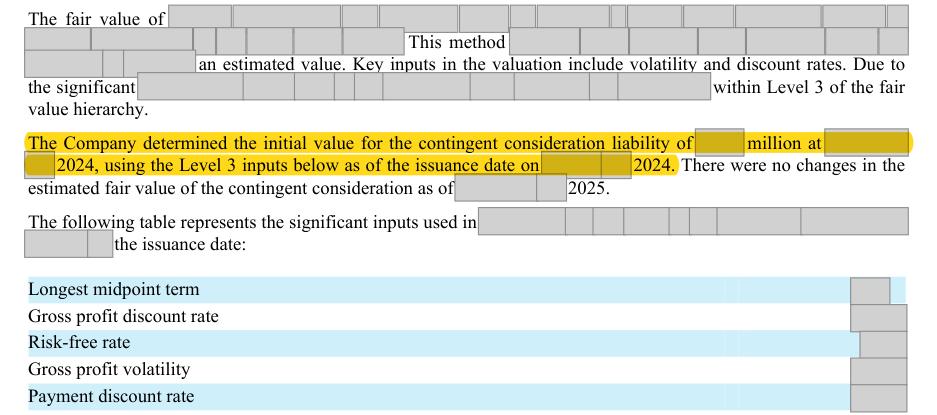
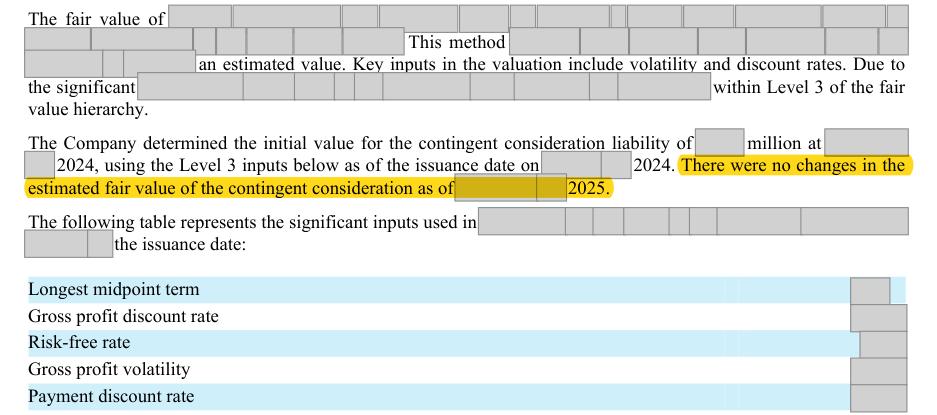
1.10 [acquired business] earn-out: Level 3 inputs are given at the [date] acquisition date and the fair value is said not to have changed
Company H · a US-listed aerospace services company · SEC-style question
In brief
The [acquired business] earn-out is a Level 3 liability that US GAAP requires to be remeasured at fair value at each reporting date, with the significant unobservable inputs disclosed at that date. Note 20 gives the inputs 'as of the issuance date on [date]' and says there were no changes in fair value by [date]: the liability fell from [n] to [n] only by the [n] paid. With a payment discount rate of [n]%, a full year's unwinding alone would be about [n].
The evidence, as filed
2 further page extracts: screenshot withheld to protect the company’s identity. The rows below say what each shows.
What the filing shows, and what the rule requires
| What the filing shows | What the rule requires |
|---|---|
Contingent consideration [n] at [date] ([n] current, [n] non-current); inputs shown at [date] (the table is introduced as the inputs used 'on the issuance date'); 'no changes in the estimated fair value'. | The liability remeasured at [date] with the significant unobservable inputs at that date (and any change in fair value recognized in earnings), or an explanation of why the 2024 inputs still apply. |
| What we checked. Note 20 fair value table and earn-out narrative, Note 5 acquisition terms, Note 11 accrued liabilities; the prior-year Form 10-K. | |
The rule
FASB ASC 820-10-50-2(bbb) and (c) (Level 3 inputs and changes), with ASC 805-30-35-1 (remeasurement of contingent consideration), paraphrase
Summary; FASB/IFRS text is copyrighted Disclose fair values by hierarchy level, Level 3 techniques and significant unobservable inputs with ranges and weighted averages, Level 3 changes and measurement uncertainty.
Version: Text in force at the date of this review · Source: FASB Accounting Standards Codification, ASC 820-10-50-2 (as amended by ASU 2018-13), paraphrase
Why it applies here. either the liability was remeasured and offsetting changes netted to nil, or it was not remeasured; in either case the inputs disclosed should be those used at the balance-sheet date. The amount is small (2.16% of pre-tax income for the whole liability), so this is a question, not a finding.
Why it matters
A Level 3 liability carried at acquisition-date inputs for 16 months may not be at fair value, and readers cannot judge the remaining earn-out exposure up to the [amount] maximum.
Exposure
A question for management; any remeasurement difference would be small and corrected prospectively.
Our workings
Note 5 says up to [amount] is payable if gross profit targets for [date] to [date] are met, with an initial fair value of [amount]. Note 20 says the initial value was determined with inputs as of [date] (including a payment discount rate of [n]%), that 'there were no changes in the estimated fair value' as of [date], and that the liability fell after a [amount] payment; the table shows [n] current and [n] non-current.
[n] less [n] paid leaves exactly [n], so no remeasurement gain or loss was recorded; one year's discount unwinding at [n]% on the closing balance alone would be [n].
| Step | Arithmetic | Result |
|---|---|---|
| Liability at [date] | [n] + [n] = [n] | [n] |
| Less 2025 payment | [n] - [n] = [n] | [n] |
| Liability at [date] per table | [n] + [n] = [n] | [n] |
| Illustrative one-year unwinding at [n]% | [n] x [n]% = [n] | [n] |
| Liability as share of pre-tax income | [n] / [n] = 2.16% | 2.16% |
Management’s best defense, and our reply
The company may say that it did remeasure the earn-out at [date], that higher expected gross profit and the passage of time were offset by other changes, and that the inputs did not move enough to be worth restating. It may add that the remaining liability of [n] is immaterial. The answer: the note says the inputs are those of the issuance date and that fair value did not change at all, which is unusual for a discounted Level 3 measurement over 16 months; showing the year-end inputs would settle the point.
The fix
- Remeasure the earn-out at each reporting date and give the inputs at that date: 'The fair value at [date] was estimated using a payment discount rate of X%, gross profit volatility of Y% ...; the change in fair value of $Z million was recorded in ...'.
Question for the company
Was the [acquired business] earn-out remeasured at [date], and what were the significant unobservable inputs at that date?
Evidence relied on
| # | What it shows | Type | Where |
|---|---|---|---|
| 1 | Inputs given at the acquisition date | Document | Form 10-K 2025, page 118 |
| 2 | No fair value change recorded | Document | Form 10-K 2025, page 118 |
| 3 | Discount rate in the inputs table | Document | Form 10-K 2025, page 118 |
| 4 | 2025 payment | Document | Form 10-K 2025, page 118 |
| 5 | Current portion both years | Document | Form 10-K 2025, page 119 |
| 6 | Non-current portion both years | Document | Form 10-K 2025, page 119 |
| 7 | Maximum earn-out | Document | Form 10-K 2025, page 93 |
| 8 | Pre-tax income for scale | Document | Form 10-K 2025, page 76 |
| 9 | Fair value said to be unchanged at [date] | Document | Form 10-K 2025, page 118 |
| 10 | Inputs table is at the issuance date, not the balance-sheet date | Document | Form 10-K 2025, page 118 |
| 11 | First earn-out payment made in 2025 | Document | Form 10-K 2025, page 118 |
| 12 | Current earn-out liability [n] at both year-ends | Document | Form 10-K 2025, page 119 |
| 13 | Non-current earn-out fell from [n] to [n] as [n] moved to current | Document | Form 10-K 2025, page 119 |
Prepared by Pramanex from the company’s public SEC filings, without the company’s involvement, to show how a 10-K Pre-filing Check reads. The company is not named, and nothing on this page is a statement about any identifiable company. Observations are not an audit, review or other attestation or assurance engagement, and not legal advice. An SEC-style question is a question, not a conclusion.
Want this on your own 10-K, before you file?
Start with three free findings on your latest 10-K, or book a fixed-price 10-K Pre-filing Check.
Your next 10-K will be in draft before the audit is done.
Have it read before you file.
Start with three free findings on your latest 10-K, or book a fixed-price 10-K check. Drafts only under NDA, inside your insider trading policy.