1.04 The balance sheet's count of shares issued at [date] leaves out the [n] shares delivered on restricted stock unit vesting
Company H · a US-listed aerospace services company · Presentation point
In brief
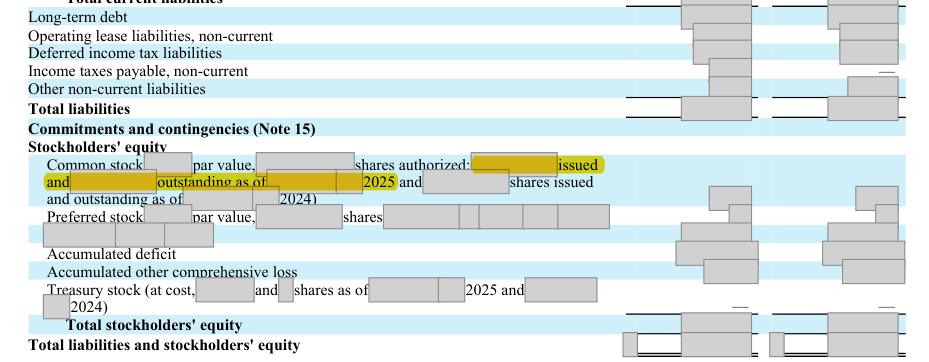
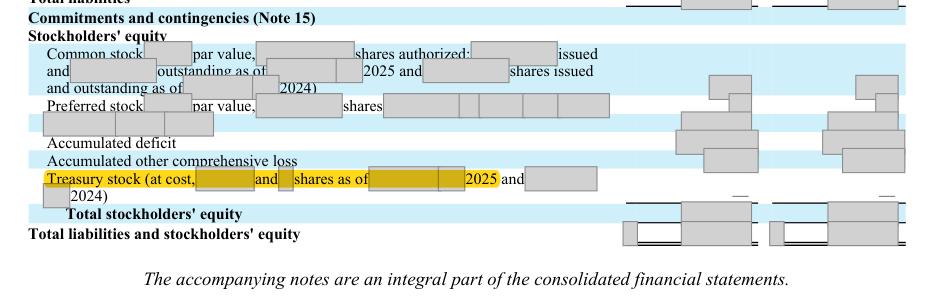
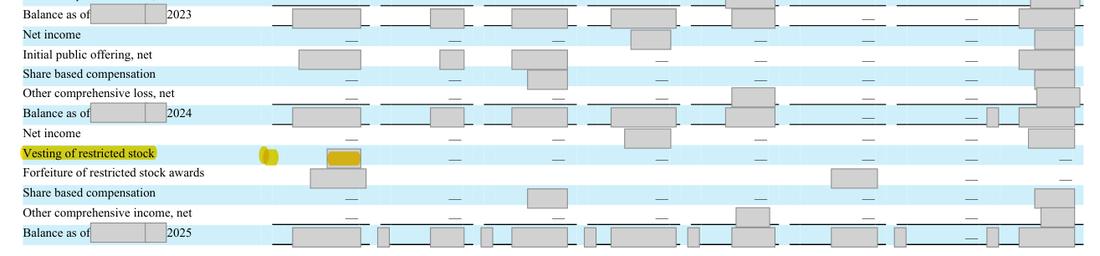
The balance sheet shows [n] shares issued, [n] outstanding and [n] in treasury at [date]. Issued less treasury gives [n], which is [n] short of the outstanding figure. The [n] are the restricted stock units that vested in 2025, which the equity statement adds to shares; the issued count was not raised for them.
The evidence, as filed
What the filing shows, and what the rule requires
| What the filing shows | What the rule requires |
|---|---|
[n] issued and [n] outstanding, with [n] treasury shares; [n] - [n] = [n], a gap of [n] to the outstanding count | [n] issued ([n] outstanding + [n] treasury), or an explanation if the [n] vested units had not yet been delivered as shares |
| What we checked. Balance sheet caption, statement of stockholders' equity, restricted stock unit and restricted stock award tables, and the first 2026 Form 10-Q | |
The rule
Regulation S-X Rule 5-02, caption [n] (Common stocks)
For each class of common shares state, on the face of the balance sheet, the number of shares issued or outstanding, as appropriate (see § [n]-07), and the dollar amount thereof.
Version: Text in force at the date of this review · Source: Regulation S-X, 17 CFR 210.5-02 (Balance sheets), as in the electronic Code of Federal Regulations
Why it applies here. [n] outstanding plus [n] in treasury implies [n] issued. The Form 10-Q for the quarter ended [date] shows exactly [n] issued at that date while repeating [n] for [date]. The par value involved is about [amount], so no dollar amount changes.
Why it matters
- The share counts on the face of the audited balance sheet do not agree with each other; a reader rebuilding the share base from issued less treasury lands [n] shares below the outstanding count used for per-share data.
- At most a staff comment; the correction is to a caption, and earnings per share does not change.
How often the SEC staff raises this. In 1,100 SEC staff comment letters on fiscal 2023 and 2024 Forms 10-K, released January 2025 to October 2026, financial statement presentation drew 254 of the 1,774 numbered comments (14.3%): the second most frequent topic.
Exposure
No dollar amount is affected; a correction of the comparative caption in the next filing would cure it.
Our workings
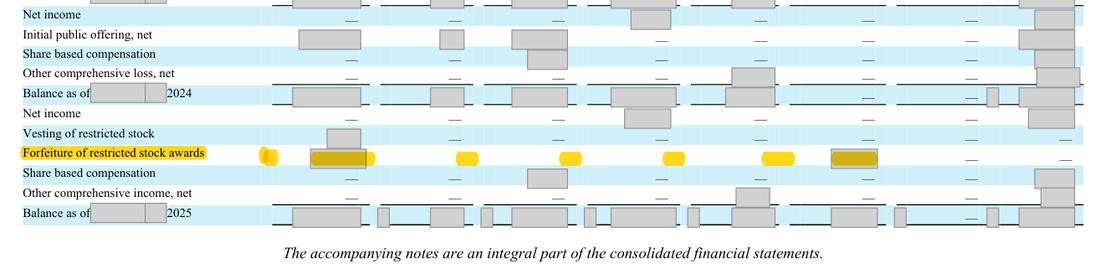
the common stock caption reads [n] issued and [n] outstanding at [date], and the treasury stock caption [n] shares. The equity statement moves the share column from [n] by 'Vesting of restricted stock' of [n] and by the forfeiture of [n] restricted stock awards into treasury, ending at [n]. The restricted stock unit table shows [n] units vested in 2025; the restricted stock award table shows [n] awards vested, which were already issued shares and so do not change the count.
issued less treasury, [n] - [n] = [n]; outstanding less that, [n] - [n] = [n]; issued implied by the equity statement, [n] + [n] = [n].
the vested units were added to shares outstanding but not to shares issued. The par value line is not affected in thousands ([n] shares at [amount] is about [amount]).
| Step | Shares |
|---|---|
| Issued less treasury: [n] - [n] | [n] |
| Outstanding less that: [n] - [n] | [n] |
| Issued implied by outstanding plus treasury: [n] + [n] | [n] |
Management’s best defense, and our reply
Management could say the [n] units vested near the year-end and the shares were delivered by the transfer agent only in early 2026, so [n] was the legal count of issued shares at [date]. It could add that the difference is about [amount] of par value and immaterial to every figure in the statements. The answer: if the shares were not yet issued, then the outstanding count of [n] - which the equity statement and the share-based payment note both use - includes shares that did not exist, so one caption is still inconsistent with the other; and the first 2026 Form 10-Q shows [n] issued at [date] after a quarter with no new issuance, which points to the year-end issued figure being the one that is short.
The fix
- Show the [date] caption as '[n] issued and [n] outstanding' in the next Form 10-Q and Form 10-K comparatives (or state why the [n] vested units were not yet issued shares at the year-end).
Evidence relied on
| # | What it shows | Type | Where |
|---|---|---|---|
| 1 | Balance sheet caption: shares issued and outstanding at [date] | Document | Form 10-K 2025, page 75 |
| 2 | Balance sheet caption: treasury shares at [date] | Document | Form 10-K 2025, page 75 |
| 3 | Equity statement adds [n] vested shares to the share column | Document | Form 10-K 2025, page 78 |
| 4 | Equity statement moves [n] forfeited awards into treasury | Document | Form 10-K 2025, page 78 |
| 5 | Restricted stock unit table: [n] units vested in 2025 (new shares on delivery) | Document | Form 10-K 2025, page 116 |
| 6 | The note confirms the outstanding count of [n] | Document | Form 10-K 2025, page 117 |
| 7 | Restricted stock award table: [n] awards vested (already issued shares, so no change to the count) | Document | Form 10-K 2025, page 117 |
| 8 | Par value of [amount] per share | Document | Form 10-K 2025, page 75 |
| 9 | First 2026 Form 10-Q: issued count at [date] equals the implied year-end figure, while the [date] comparative is repeated unchanged | Document | |
| 10 | The Note 25 parent-company balance sheet repeats the same issued and outstanding counts | Document | Form 10-K 2025, page 127 |
| 11 | The Note 25 parent-company balance sheet shows [n] treasury shares, so issued less treasury gives [n], not the outstanding count printed | Document | Form 10-K 2025, page 127 |
Prepared by Pramanex from the company’s public SEC filings, without the company’s involvement, to show how a 10-K Pre-filing Check reads. The company is not named, and nothing on this page is a statement about any identifiable company. Observations are not an audit, review or other attestation or assurance engagement, and not legal advice. An SEC-style question is a question, not a conclusion.
Want this on your own 10-K, before you file?
Start with three free findings on your latest 10-K, or book a fixed-price 10-K Pre-filing Check.
Your next 10-K will be in draft before the audit is done.
Have it read before you file.
Start with three free findings on your latest 10-K, or book a fixed-price 10-K check. Drafts only under NDA, inside your insider trading policy.