3.05 The long-term liability for uncertain tax positions, listed last year as a material cash requirement at [amount], is no longer mentioned
Company F · a US-listed networking equipment company · SEC-style question
In brief
Last year's management's discussion and analysis (MD&A) listed, among the material cash requirements, [amount] of long-term tax liabilities for uncertain tax positions whose settlement timing could not be estimated. This year's list covers only purchase obligations, leases and the [city] building. The tax liability is not mentioned, and its recorded amount is given nowhere in this 10-K, although gross unrecognized tax benefits rose to [amount]. We ask what the liability now is and why it was dropped.
The evidence, as filed
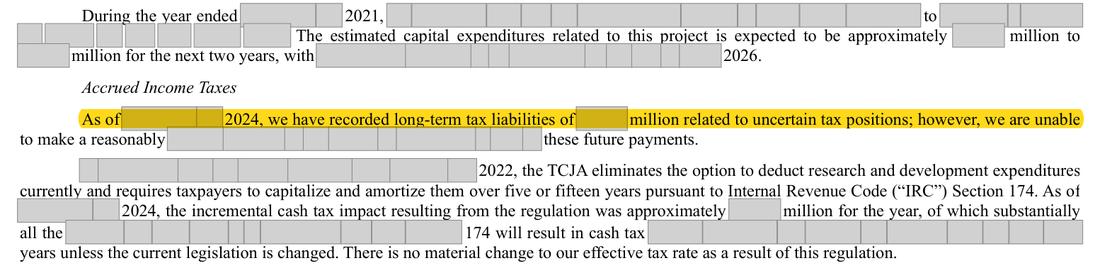
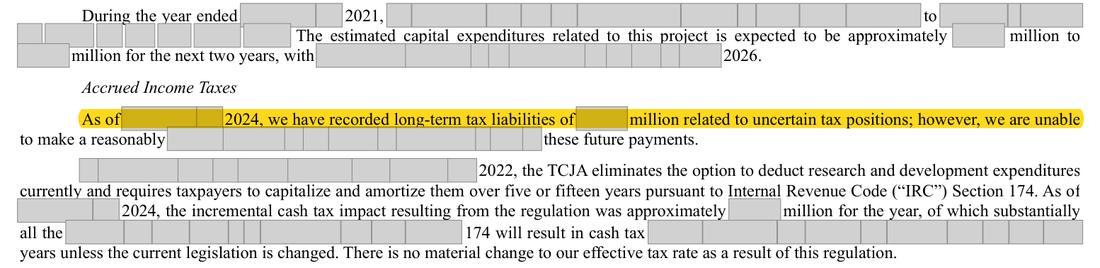
2 further page extracts: screenshot withheld to protect the company’s identity. The rows below say what each shows.
What the filing shows, and what the rule requires
| What the filing shows | What the rule requires |
|---|---|
MD&A material cash requirements at [date]: purchase obligations, leases and the property project, then off-balance sheet arrangements; no accrued income taxes item and no recorded long-term tax liability figure anywhere in the 10-K. | The recorded long-term liability for uncertain tax positions at [date] given in the material cash requirements, with the statement that its settlement timing cannot be estimated, or a sentence explaining why it is no longer a material cash requirement. |
The rule
Regulation S-K Item 303(b)(1) (liquidity and capital resources: material cash requirements)
The discussion should analyze material cash requirements from known contractual and other obligations. Such disclosures must specify the type of obligation and the relevant time period for the related cash requirements.
Version: Text in force at the date of this review · Source: Regulation S-K, 17 CFR 229.303
Why it applies here. either the liability is no longer material, or it was dropped without explanation; the filing does not let a reader tell which.
Why it matters
A reader of the liquidity discussion no longer sees a tax liability the company itself treated as a cash requirement last year, and cannot find its current amount anywhere in the filing.
Exposure
A question only; at most a staff comment asking the company to restore or explain the item in future filings.
Our workings
the prior-year MD&A (page 65) listed 'Accrued Income Taxes' among the material cash requirements: long-term tax liabilities of [amount] for uncertain tax positions, timing of settlement not reasonably estimable. This year's MD&A (page 60) lists purchase obligations, leases and the property project and then moves to off-balance sheet arrangements; the accrued income taxes item is gone. Note 8 (page 93) gives gross unrecognized tax benefits of [amount] at [date] against [amount] a year earlier, but not the amount recorded as a liability; the recorded figure ([amount] last year) differs from the gross amount and appeared only in the MD&A.
gross unrecognized tax benefits rose by [n] in 2025; last year the recorded liability was [n]% of the gross balance; the last disclosed liability is 2.59% of 2025 pre-tax income. Law: Regulation S-K Item 303(b)(1) asks the MD&A to analyze material cash requirements from known contractual and other obligations, specifying the type of obligation and the relevant time period.
| Item | Computation | Result |
|---|---|---|
| Change in gross unrecognized tax benefits in 2025 | [n] - [n] = [n] | [n] |
| Recorded long-term liability as a share of the gross balance at [date] | [n] / [n] = [n]% | [n]% |
| Last disclosed liability against 2025 pre-tax income | [n] / [n] = 2.59% | 2.59% |
Management’s best defense, and our reply
A liability with no estimable settlement date cannot be placed in a time period, as Item 303(b)(1) asks, so many registrants leave it out of the material cash requirements and rely on the income tax note. Note 8 gives the gross unrecognized tax benefits and their roll-forward, and the balance moved only modestly in 2025. However, the company itself treated the liability as a material cash requirement last year, and the recorded amount, which differs from the gross balance, now appears nowhere in the filing; no reason is given for the change. Because a reasonable preparer could hold that a liability of unknown timing falls outside Item 303(b)(1), the point is put as a question.
The fix
- Restore the item, for example: 'As of [date], we have recorded long-term tax liabilities of $X million related to uncertain tax positions; we are unable to make a reasonably reliable estimate of the timing of settlement.' If it is no longer material, say so.
Question for the company
What was the recorded long-term liability for uncertain tax positions at [date], and why was it removed from the material cash requirements, where last year's 10-K gave it as [amount]?
Evidence relied on
| # | What it shows | Type | Where |
|---|---|---|---|
| 1 | Prior-year MD&A listed [amount] of long-term tax liabilities for uncertain tax positions as a material cash requirement | Document | Form 10-K 2024 (prior year), page 65 |
| 2 | This year's list follows: purchase obligations, leases, property project only | Document | Form 10-K 2025, page 60 |
| 3 | Note 8 gives the gross unrecognized tax benefits ([amounts]) but not the recorded liability | Document | Form 10-K 2025, page 93 |
| 4 | Pre-tax income benchmark for 2025 ([amount]) | Document | Form 10-K 2025, page 69 |
Absence check
- Document
- Form 10-K 2025
- Where it would appear
- Material Cash Requirements
- What is missing
- the accrued income taxes item: recorded long-term liability for uncertain tax positions and the statement that its settlement timing cannot be estimated
- Pages looked at
- p.58-62 (MD&A liquidity, material cash requirements, critical accounting estimates), p.68 (balance sheet), p.90-93 (Note 8 income taxes)
- Result
- 'long-term tax liabilit', 'Accrued Income Taxes' and 'timing of settlement' have no hits. 'uncertain tax position' hits unnumbered page (forward-looking statements list), p.62 (critical accounting estimate on income taxes), p.73 (use of estimates), p.79 (income tax policy) and p.93 (Note 8 heading and gross unrecognized tax benefits roll-forward); none gives the recorded liability or treats it as a cash requirement.
Prepared by Pramanex from the company’s public SEC filings, without the company’s involvement, to show how a 10-K Pre-filing Check reads. The company is not named, and nothing on this page is a statement about any identifiable company. Observations are not an audit, review or other attestation or assurance engagement, and not legal advice. An SEC-style question is a question, not a conclusion.
Want this on your own 10-K, before you file?
Start with three free findings on your latest 10-K, or book a fixed-price 10-K Pre-filing Check.
Your next 10-K will be in draft before the audit is done.
Have it read before you file.
Start with three free findings on your latest 10-K, or book a fixed-price 10-K check. Drafts only under NDA, inside your insider trading policy.