1.11 The [litigant] patent case disclosed last year as a reasonably possible loss is no longer mentioned, with no statement of how it ended
Company F · a US-listed networking equipment company · SEC-style question
In brief
The prior-year Form 10-K described a patent suit by [litigant], LLC and said a loss was reasonably possible but could not be estimated. The company's quarterly report for the [date] quarter still described it as pending; the reports for the [date] quarter and this Form 10-K no longer mention it and do not say how or when it ended. If it ended before the fourth quarter, this Form 10-K needed nothing more; if it ended in the fourth quarter, Form 10-K Item 3(b) asks for the date and the disposition. The prior-year Form 10-K also named the case in two risk factors as litigation the company intended to defend (printed pages 34 and 37); the current litigation risk factor no longer mentions it. We ask what happened to the case and when.
The evidence, as filed
5 further page extracts: screenshot withheld to protect the company’s identity. The rows below say what each shows.
What the filing shows, and what the rule requires
| What the filing shows | What the rule requires |
|---|---|
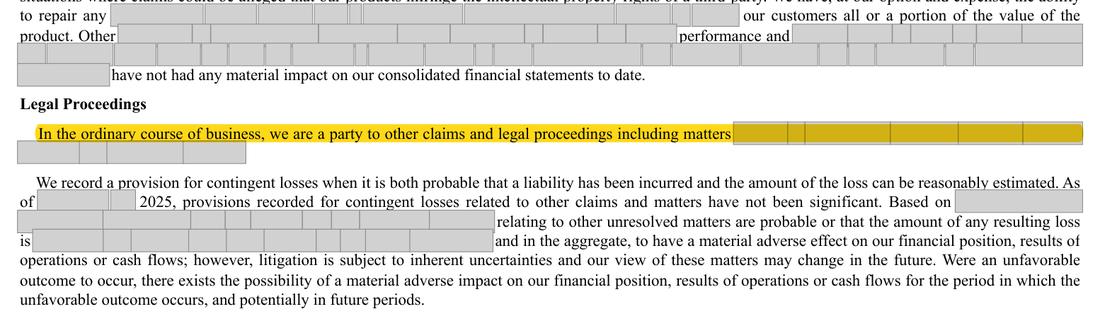
Legal Proceedings in Note 5 (page 86): 'In the ordinary course of business, we are a party to other claims and legal proceedings ...'; no named matter and no statement that the [litigant] case was dismissed, settled or otherwise ended. | If the case ended in the fourth quarter of 2025, its date of termination and disposition; if it ended earlier, nothing further is required in this Form 10-K, but a one-line statement of the outcome would close a contingency the company itself had judged reasonably possible. |
The rule
Form 10-K, Part I, Item 3(b) (proceedings terminated during the fourth quarter)
As to any proceeding that was terminated during the fourth quarter of the fiscal year covered by this report, furnish information similar to that required by Item 103 of Regulation S-K
Version: Text in force at the date of this review · Source: Form 10-K General Instructions and Items (SEC form as amended, current edition)
Why it applies here. neither filing lets a reader tell how the matter ended.
Why it matters
A reader cannot tell whether a disclosed patent claim ended in the company's favor, was settled (and at what cost), or is still pending but no longer disclosed.
Exposure
A question only; if the case ended in the fourth quarter, the missing Item 3(b) particulars would be the subject of a staff comment.
Our workings
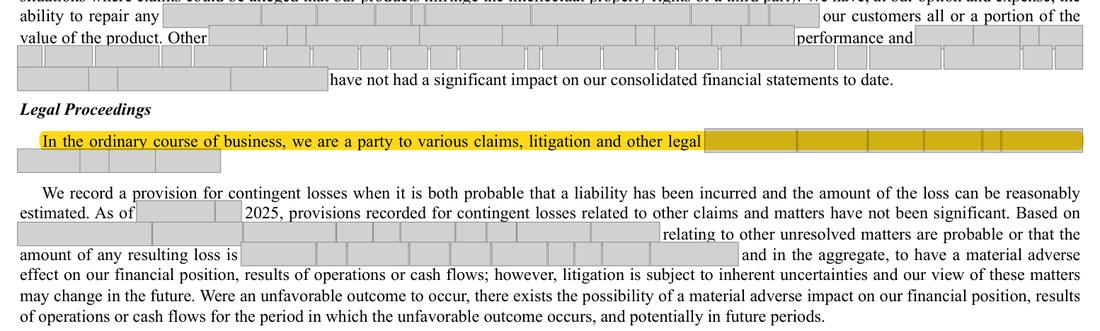
the prior-year note (fiscal 2024, page 95) described the [litigant] suit filed in 2020 and said a loss was not probable but reasonably possible and could not be estimated. The company's Form 10-Q for the [date] quarter (filed [date]) still described the case, stayed after the Federal Circuit affirmed the patent board's ruling against the challenged claims. The Form 10-Q for the [date] quarter (filed [date]) dropped the description and gives only the general paragraph on 'various claims'; this Form 10-K does the same, keeping the word 'other' from the old text, and '[litigant]', 'inter partes' and 'reasonably possible' appear nowhere in it. Item 3 on page 48 incorporates the note by reference. Law: Form 10-K Item 3(b) asks, for a proceeding terminated in the fourth quarter, for information similar to Regulation S-K Item 103, including the date of termination and the disposition. Under Accounting Standards Codification (ASC) paragraph 450-20-50-4 a reasonably possible loss needs its nature and an estimate or a statement that none can be made; a matter that is resolved, or whose loss becomes remote, needs no contingency disclosure. Grey area: the description vanished in the [date] quarterly report, which points to the case ending (or becoming remote) in the third quarter; if so, this [n] is compliant and any gap lay in that quarterly report.
Management’s best defense, and our reply
The description was dropped in the [date] quarterly report, so the case most likely ended or became remote in the third quarter, and Item 3(b) of Form 10-K covers only proceedings terminated in the fourth quarter. A resolved matter, or one whose loss is remote, needs no contingency disclosure under the Codification, and the general paragraph covers routine claims. That defense is likely right for this Form 10-K, which is why the point is put only as a question; but no filing states the outcome of a matter the company had judged reasonably possible, so the date and disposition remain to be confirmed.
The fix
- State in the next filing, for example: 'In [month] 2025 the [litigant] litigation was [dismissed / resolved] with no material impact on our consolidated financial statements.'
Question for the company
What happened to the [litigant] patent litigation described in the prior-year Form 10-K and the [date] Form 10-Q, and on what date? If it ended in the fourth quarter of 2025, why does the Form 10-K not give the date of termination and the disposition; if it ended in the third quarter, where was its disposition reported?
Evidence relied on
| # | What it shows | Type | Where |
|---|---|---|---|
| 1 | The note names no matter but still refers to 'other' claims | Document | Form 10-K 2025, page 86 |
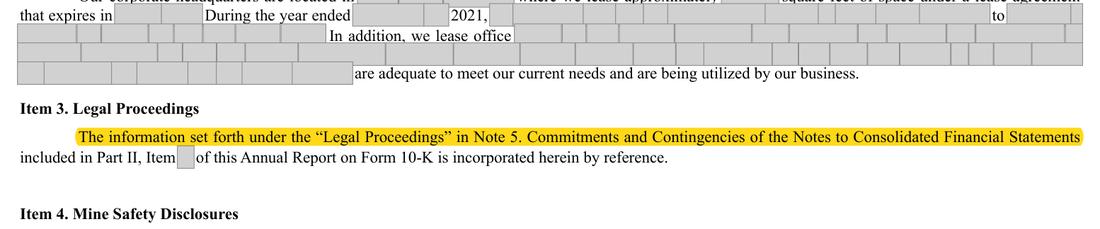
| 2 | Item 3 relies entirely on this note | Document | Form 10-K 2025, page 48 |
| 3 | The prior-year note described the [litigant] patent suit | Document | Form 10-K 2024 (prior year), page 95 |
| 4 | The prior year judged a loss reasonably possible | Document | Form 10-K 2024 (prior year), page 95 |
| 5 | The [date] Form 10-Q still described the [litigant] case as pending and stayed | Document | |
| 6 | At [date] the company still judged a loss reasonably possible | Document | |
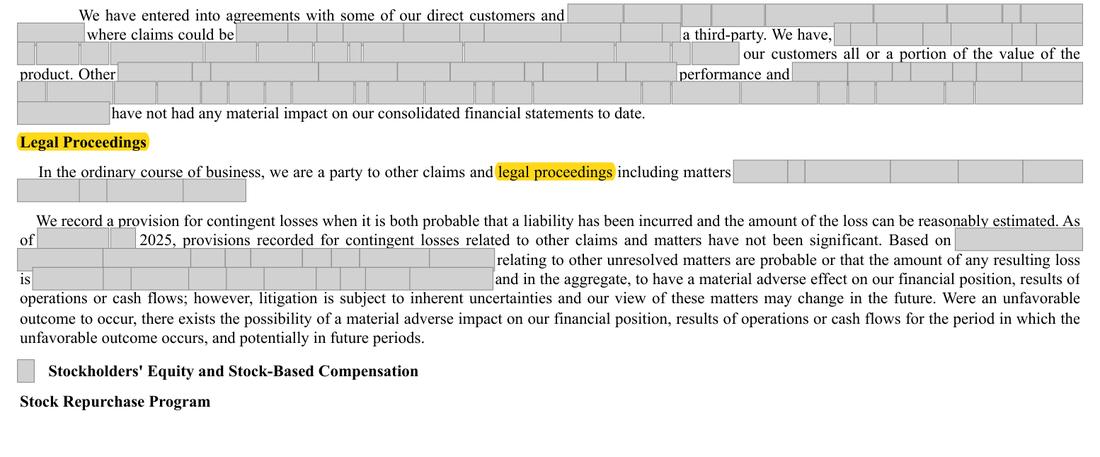
| 7 | The [date] Form 10-Q drops the [litigant] description with no statement that the case ended | Document | |
| 8 | Prior-year intellectual property risk factor names the [litigant] case as current litigation | Document | Form 10-K 2024 (prior year), page 34 |
| 9 | Prior-year litigation risk factor gives the case history and the company's stated intention to defend it | Document | Form 10-K 2024 (prior year), page 37 |
| 10 | Current litigation risk factor, now under General Risks, where the prior year described the [litigant] case | Document | Form 10-K 2025, page 45 |
Absence check
- Document
- Form 10-K 2025
- Where it would appear
- Legal Proceedings
- What is missing
- any statement of the status, termination date or disposition of the [litigant] patent case
- Pages looked at
- p.86 (Note 5), p.48 (Item 3), p.77 (loss-contingency policy), p.45 (litigation risk factor)
- Result
- None of the five terms appears anywhere in the report.
Absence check
- Document
- Form 10-K 2025
- Where it would appear
- We may become involved in litigation that may materially adversely affect us.
- What is missing
- any reference to the [litigant] patent case or to how it ended
- Pages looked at
- p.32, [n]
- Result
- None of the terms appears anywhere in the current 10-K.
Prepared by Pramanex from the company’s public SEC filings, without the company’s involvement, to show how a 10-K Pre-filing Check reads. The company is not named, and nothing on this page is a statement about any identifiable company. Observations are not an audit, review or other attestation or assurance engagement, and not legal advice. An SEC-style question is a question, not a conclusion.
Want this on your own 10-K, before you file?
Start with three free findings on your latest 10-K, or book a fixed-price 10-K Pre-filing Check.
Your next 10-K will be in draft before the audit is done.
Have it read before you file.
Start with three free findings on your latest 10-K, or book a fixed-price 10-K check. Drafts only under NDA, inside your insider trading policy.