1.10 The table of debt securities in an unrealized loss position is given for [date] only, not for [date]
Company F · a US-listed networking equipment company · SEC-style question
In brief
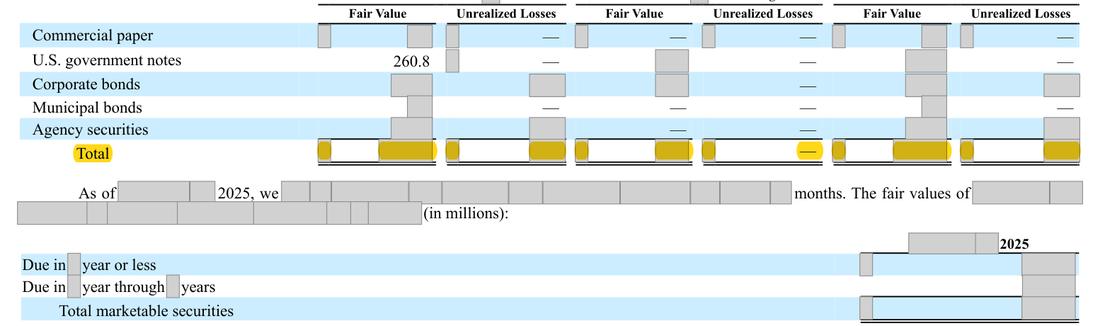
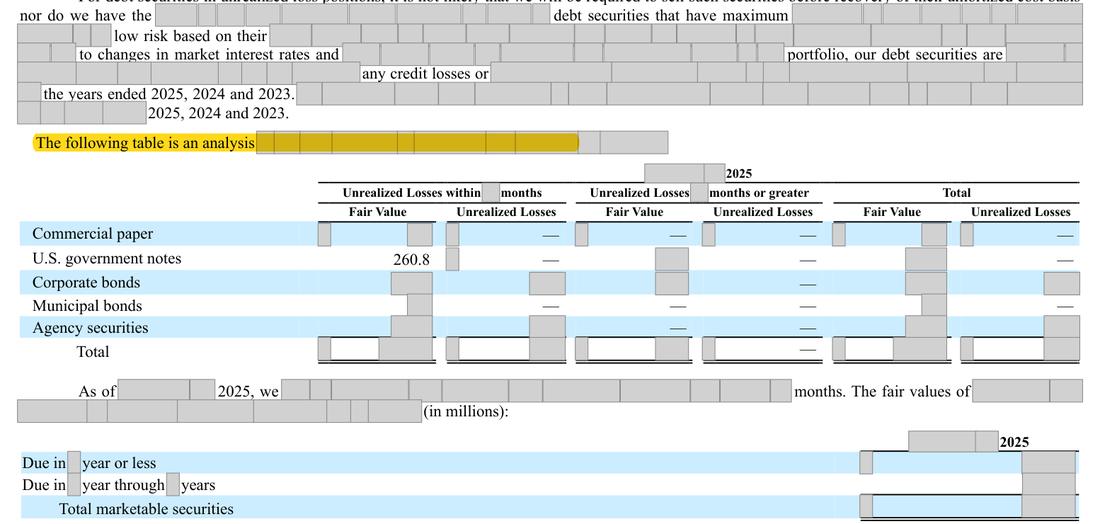
Note 2 analyses the debt securities in an unrealized loss position (fair value and loss, split into under and over 12 months) only at [date], when the losses were [amount]. At [date], the other balance-sheet date, the losses were [amount], but this Form 10-K gives no fair value or aging for them; the prior-year Form 10-K likewise gave the table only for its own year-end. We ask whether the comparative table was left out on materiality grounds.
The evidence, as filed

3 further page extracts: screenshot withheld to protect the company’s identity. The rows below say what each shows.
What the filing shows, and what the rule requires
| What the filing shows | What the rule requires |
|---|---|
Unrealized-loss table at [date] only (fair value [amount], losses [amount]); at [date] only the losses by category appear ([amount] in total), with no fair value of the securities in a loss position and no under / over 12-month split. | The same table at each balance-sheet date presented ([date] and [date]), or a statement that the comparative-date amounts are not material. |
The rule
Regulation S-X Rule 4-01(a)(1), read with FASB ASC paragraph 326-30-50-3 (securities in an unrealized loss position, each balance-sheet date presented)
Financial statements filed with the Commission which are not prepared in accordance with generally accepted accounting principles will be presumed to be misleading or inaccurate, despite footnote or other disclosures
Version: Text in force at the date of this review · Source: Regulation S-X, 17 CFR 210.4-01
Why it applies here. the tabular part is required at both dates; whether its omission at the earlier date is immaterial is a judgment only the company can explain.
Why it matters
A reader cannot see how much of the larger [date] loss position had been in loss for more than 12 months, or the fair value exposed, and so cannot compare the two dates the balance sheet presents.
How often the SEC staff raises this. In 1,100 SEC staff comment letters on fiscal 2023 and 2024 Forms 10-K, released January 2025 to October 2026, financial statement presentation drew 254 of the 1,774 numbered comments (14.3%): the second most frequent topic.
Exposure
A question only; at most a staff comment asking for the comparative table in future filings, with no effect on any reported amount.
Our workings
the table on page 82 is headed for [date] only. The amortized-cost table on page 81 shows that at [date] the portfolio held unrealized losses of [amount] (U.S. government), [amount] (corporate bonds) and [amount] (agency securities). The prior-year Form 10-K gave the aging table at [date] ([amount] of losses on securities with a fair value of [amount]) but not at [date].
[n] + [n] + [n] = [n]; [n] = [n]; the [date] losses are [n] times those at [date] and 0.32% of fiscal 2025 pre-tax income. Law: Financial Accounting Standards Board (FASB) Accounting Standards Codification (ASC) paragraph 326-30-50-3 asks, for available-for-sale debt securities in an unrealized loss position without an allowance for credit losses, for the aggregate fair value and the aggregate unrealized loss by major security type, split by time in a continuous loss position, as of each balance-sheet date presented; the narrative on why no allowance was needed is required only for the latest date. Regulation S-X Rule 4-01(a)(1) makes GAAP compliance a filing condition.
| Item | Computation | Result |
|---|---|---|
| [date] losses by category (this 10-K, page 81) | [n] + [n] + [n] = [n] | [n] |
| [date] aging in the prior-year 10-K (thousands) | [n] + [n] = [n] | [n] |
| Prior-year figure expressed in millions (that 10-K prints thousands) | [n] / [n] = [n] | [n] |
| [date] table (this 10-K, page 82) | [n] + [n] = [n] | losses [n] |
| [date] losses against [date] losses | [n] / [n] = [n] | [n] times |
| [date] losses against fiscal 2025 pre-tax income | [n] / [n] = 0.32% | 0.32% |
Management’s best defense, and our reply
The [date] table was published in the prior-year Form 10-K, and this 10-K still shows the [date] losses by security type in the amortized-cost table on the page before. The losses are 0.32% of pre-tax income on a short-duration, high-grade portfolio, and the Codification need not be applied to immaterial items. The answer: the paragraph asks for the table as of each balance-sheet date presented, the company chose to present it at the date when losses were only [amount], and the fair value in a loss position and the aging at [date] appear nowhere in this 10-K. Because a reasonable preparer could still treat the comparative as immaterial, the point is put as a question.
The fix
- Present the unrealized-loss table at both balance-sheet dates in the next Form 10-K, or add: 'Securities in an unrealized loss position at [date] were not material.'
Question for the company
Note 2 gives the table of debt securities in an unrealized loss position only at [date]. Was the [date] table (losses of [amount]) left out because the company judged it immaterial, and will the next Form 10-K present the table for both balance-sheet dates?
Evidence relied on
| # | What it shows | Type | Where |
|---|---|---|---|
| 1 | The aging table is introduced for one date, [date] | Document | Form 10-K 2025, page 82 |
| 2 | At [date] securities with a fair value of [amount] carried losses of [amount] | Document | Form 10-K 2025, page 82 |
| 3 | U.S. government securities carried a [amount] loss at [date] | Document | Form 10-K 2025, page 81 |
| 4 | Corporate bonds carried a [amount] loss at [date] | Document | Form 10-K 2025, page 81 |
| 5 | Agency securities carried a [amount] loss at [date] | Document | Form 10-K 2025, page 81 |
| 6 | Total unrealized losses of [amount] at [date], shown without fair value or aging | Document | Form 10-K 2025, page 81 |
| 7 | The prior-year 10-K's aging at [date] (thousands): the comparative data exist | Document | Form 10-K 2024 (prior year), page 88 |
Absence check
- Document
- Form 10-K 2025
- Where it would appear
- The following table is an analysis of our debt securities in unrealized loss positions
- What is missing
- the same table at [date] (fair value and unrealized loss by security type, under and over 12 months)
- Pages looked at
- p.74 (investment policy), p.81-82 (Note 2), p.63 (market risk)
- Result
- 'unrealized loss position' hits p.74 (the accounting policy for impairment, no figures) and p.82 (the [date] table); 'Unrealized Losses within' and '12 months or greater' hit only the [date] table on p.82; 'continuous' hits p.4, 7, [n] and [n] (business and risk narrative, not securities).
Prepared by Pramanex from the company’s public SEC filings, without the company’s involvement, to show how a 10-K Pre-filing Check reads. The company is not named, and nothing on this page is a statement about any identifiable company. Observations are not an audit, review or other attestation or assurance engagement, and not legal advice. An SEC-style question is a question, not a conclusion.
Want this on your own 10-K, before you file?
Start with three free findings on your latest 10-K, or book a fixed-price 10-K Pre-filing Check.
Your next 10-K will be in draft before the audit is done.
Have it read before you file.
Start with three free findings on your latest 10-K, or book a fixed-price 10-K check. Drafts only under NDA, inside your insider trading policy.