1.09 Receivables policy still describes an allowance for accounts 'determined to be uncollectible' rather than expected credit losses
Company F · a US-listed networking equipment company · SEC-style question
In brief
Note 1 says the Company has recorded an allowance for doubtful accounts for receivables 'that we have determined to be uncollectible', which describes an incurred-loss allowance. Under the current expected credit loss model in the Accounting Standards Codification (ASC), the allowance covers losses expected over the life of all receivables, including those not yet past due. The note never states the allowance against accounts receivable, net of [amount], of which the top two resellers account for [n]%. Management should confirm the measurement basis and update the wording.
The evidence, as filed
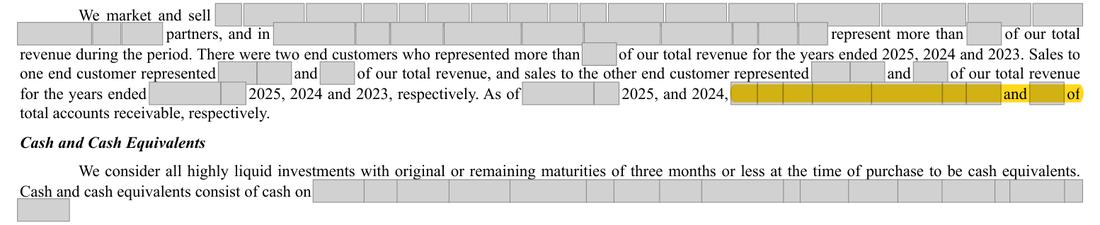
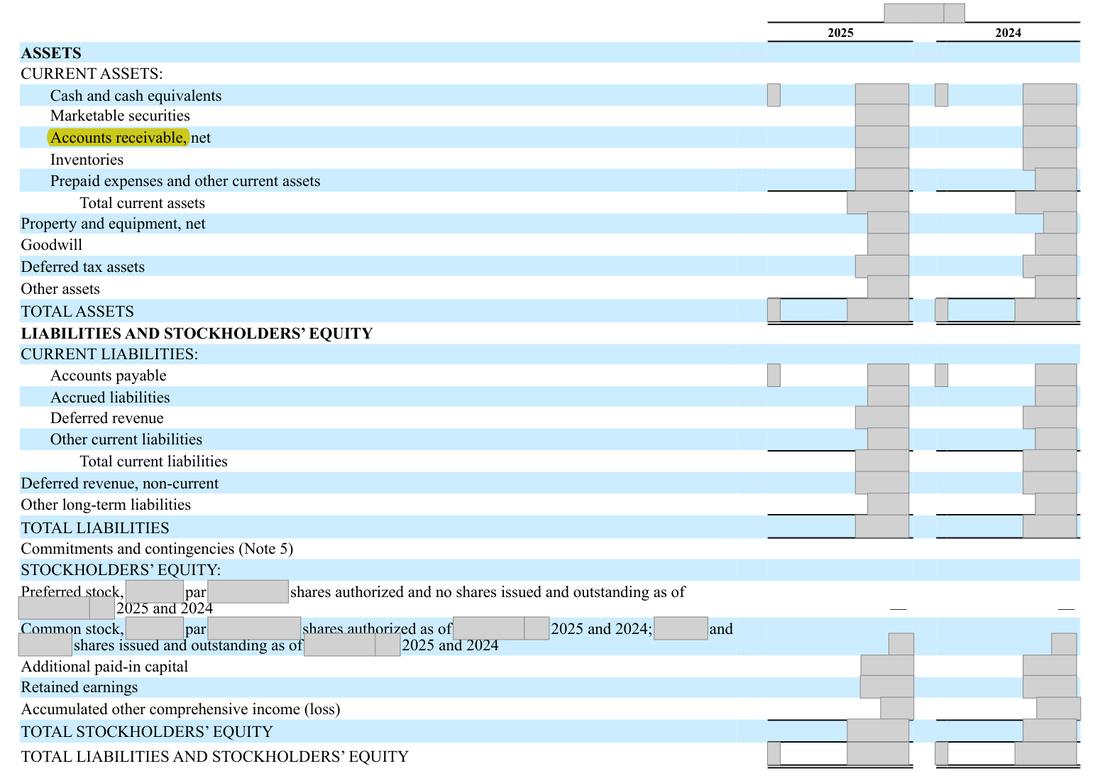
4 further page extracts: screenshot withheld to protect the company’s identity. The rows below say what each shows.
What the filing shows, and what the rule requires
| What the filing shows | What the rule requires |
|---|---|
Policy: an allowance 'for accounts receivables that we have determined to be uncollectible'; the next paragraph cites historical trends and 'reasonable and supportable information'; no allowance balance on the balance sheet or in the notes; Item 15 omits schedules, among other reasons, as 'not present in amounts sufficient to require submission'; same wording in the prior-year 10-K | A policy stating that the allowance reflects expected credit losses over the contractual life of the receivables, estimated on a pooled basis where risk characteristics are similar; and, where material, the allowance balance and its movement for each year (in the note or in Schedule II). |
The rule
ASC 326-20-50-11 to 50-13
Summary; FASB/IFRS text is copyrighted Describe how expected credit losses are estimated and why they changed, show allowance activity by portfolio segment, and (PBEs) credit quality and write-offs by vintage.
Version: Text in force at the date of this review · Source: FASB Accounting Standards Codification, ASC 326-20-50-11 to 50-13 (as amended by ASU 2016-13); paraphrase
Why it applies here. the first sentence describes specific identification of uncollectible accounts (the incurred-loss approach the expected credit loss standard replaced); the second describes inputs consistent with an expected-loss estimate. The note does not say which governs. The Item 15 statement suggests, but does not prove, that the allowance is small, so the measurement point is a question and the wording point is the likely outcome.
Why it matters
If the allowance were set only for specifically identified uncollectible accounts it would not meet ASC 326 and could be understated; if it is an expected-loss estimate, the policy sentence misdescribes the method. Either way the staff of the Securities and Exchange Commission (SEC) could ask for revised policy wording in future filings.
Exposure
No penalty attaches to policy wording; the realistic outcome, if any, is a request to revise the wording in future filings.
Our workings
Note 1 (page 74) says the allowance is recorded for receivables 'that we have determined to be uncollectible', and two paragraphs later that it is estimated from historical trends and reasonable and supportable information about customers' economic conditions. The balance sheet (page 68) shows accounts receivable, net of [amount] and the note says the top two resellers account for [n]% of it. No page of the 10-K gives the allowance balance or its movement, and Item 15 (page 99) omits the schedules, among other reasons, as not present in sufficient amounts. The prior-year 10-K used the same sentence.
receivables due from the top two resellers are [n] x [n]% = [n] (workings).
| Item | Figure (USD million) | Source |
|---|---|---|
| Accounts receivable, net, [date] | [n] | Balance sheet, page 68 |
| Top two resellers' share of receivables | [n]% | Note 1, page 74 |
| Receivables due from the top two resellers | [n] x [n]% = [n] | computed |
Management’s best defense, and our reply
The finance team would say the accounts receivable paragraph already describes an expected-loss estimate built on historical trends and reasonable and supportable information, so measurement complies with the expected credit loss standard and only one legacy sentence is loose. They would add that the allowance is immaterial, as the Item 15 statement on omitted schedules reflects. They would also point out that receivables are short-dated and owed largely by large, creditworthy resellers, so an incurred-loss and an expected-loss estimate barely differ. That case is credible on measurement, so the point is put as a question and not a finding.
The fix
- Replace the sentence with: 'We maintain an allowance for credit losses for expected credit losses on our accounts receivable, estimated on a pooled basis using historical loss experience adjusted for current conditions and reasonable and supportable forecasts'; state the allowance balance on the balance sheet face or in the note if it becomes material.
Question for the company
Is the allowance on accounts receivable measured as expected credit losses over the life of all receivables (pooled where risk is similar), what was its balance at [date] and 2024, and will the policy sentence describing an allowance for receivables 'determined to be uncollectible' be revised in the next Form 10-K?
Evidence relied on
| # | What it shows | Type | Where |
|---|---|---|---|
| 1 | The policy describes the allowance as covering receivables determined to be uncollectible | Document | Form 10-K 2025, page 74 |
| 2 | The accounts receivable paragraph cites expected-loss style inputs | Document | Form 10-K 2025, page 74 |
| 3 | Concentration of receivables in two resellers ([n]% at [date]) | Document | Form 10-K 2025, page 74 |
| 4 | Receivables shown net, with no allowance stated on the face | Document | Form 10-K 2025, page 68 |
| 5 | Item 15 omits the financial statement schedules, including on grounds of immateriality | Document | Form 10-K 2025, page 99 |
Absence check
- Document
- Form 10-K 2025
- Where it would appear
- Accounts Receivable
- What is missing
- the balance of the allowance for credit losses on accounts receivable and its movement for each year
- Pages looked at
- p.68 (balance sheet), p.72-80 (Note 1), p.99 (Item 15)
- Result
- 'allowance for doubtful' hits only page 74 (this policy); the risk factor on page 28 mentions reserves for 'doubtful accounts' without an amount; 'allowance for credit losses' hits page 74 only, in the available-for-sale debt securities policy; 'bad debt' and 'net of allowance' hit only the page 74 policy paragraph; 'Valuation and Qualifying' has no hit. No hit gives an allowance balance or movement.
Prepared by Pramanex from the company’s public SEC filings, without the company’s involvement, to show how a 10-K Pre-filing Check reads. The company is not named, and nothing on this page is a statement about any identifiable company. Observations are not an audit, review or other attestation or assurance engagement, and not legal advice. An SEC-style question is a question, not a conclusion.
Want this on your own 10-K, before you file?
Start with three free findings on your latest 10-K, or book a fixed-price 10-K Pre-filing Check.
Your next 10-K will be in draft before the audit is done.
Have it read before you file.
Start with three free findings on your latest 10-K, or book a fixed-price 10-K check. Drafts only under NDA, inside your insider trading policy.