1.01 The intangible-asset amortization schedule shows three single years, not the five succeeding years required
Company F · a US-listed networking equipment company · Compliance or disclosure gap
In brief
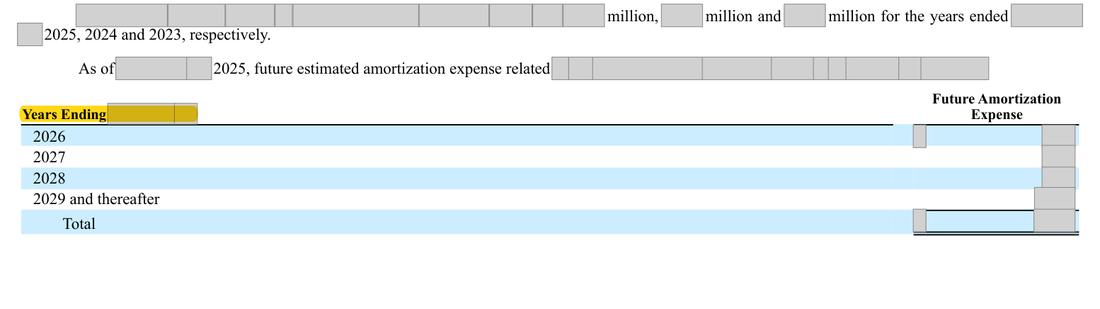
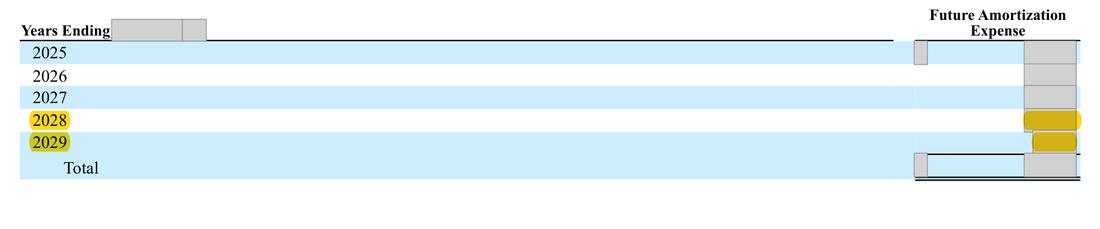
Note 4 gives estimated amortization expense for 2026, 2027 and 2028 and then one line of [amount] for '2029 and thereafter'. US generally accepted accounting principles (GAAP) require the estimate for each of the five succeeding fiscal years, so 2029 and 2030 should each be shown. The prior-year Form 10-K showed five single years, and the company's own Form 10-Q for the [date] quarter shows 2029 alone as [amount].
The evidence, as filed


What the filing shows, and what the rule requires
| What the filing shows | What the rule requires |
|---|---|
Future amortization table at [date]: 2026 [amount], 2027 [amount], 2028 [amount], '2029 and thereafter' [amount], total [amount]. | Each of 2026, 2027, 2028, 2029 and 2030 shown separately, with a 'thereafter' line only for the years after 2030. |
The rule
Regulation S-X Rule 4-01(a)(1), read with FASB ASC 350-30-50-2(a)(3) (estimated amortization expense for each of the five succeeding fiscal years)
Financial statements filed with the Commission which are not prepared in accordance with generally accepted accounting principles will be presumed to be misleading or inaccurate, despite footnote or other disclosures
Version: Text in force at the date of this review · Source: Regulation S-X, 17 CFR 210.4-01
FASB ASC 350-30-50
Summary; FASB/IFRS text is copyrighted ASC 350-30-50-2(a)(3) of the FASB Accounting Standards Codification (ASC) requires the estimated amortization expense for each of the five succeeding fiscal years; Regulation S-X Rule 4-01(a)(1) makes GAAP compliance a condition of the filing. A 'thereafter' line is allowed only beyond year five.
Paragraphs: FASB ASC 350-30-50, as codified for the fiscal year under review.
Why it applies here. Two of the five required years are merged into one line holding [n]% of the net balance. The total is right; the split by year is missing, a change from the company's own fiscal 2024 practice.
Why it matters
- Readers modeling future earnings cannot see the amortization charge for 2029 and 2030.
- A staff comment asking for the full five-year schedule in future filings is the realistic outcome; no amount is restated, because the total and the balance are right.
How often the SEC staff raises this. In 1,100 SEC staff comment letters on fiscal 2023 and 2024 Forms 10-K, released January 2025 to October 2026, financial statement presentation drew 254 of the 1,774 numbered comments (14.3%): the second most frequent topic.
Exposure
A staff comment asking for the full five-year schedule and a future-filings undertaking; no restatement, because the total and the balance are right.
Our workings
the table on page 85 lists 2026, 2027 and 2028 and then '2029 and thereafter' [amount]; the total of [amount] equals the net carrying amount in the intangible-asset table on the same page. The prior-year Form 10-K listed 2025, 2026, 2027, 2028 and 2029 as single years. The Form 10-Q for the quarter ended [date] splits the same line into 2029 ([amount]) and '2030 and thereafter' ([amount]).
[n] + [n] + [n] + [n] = [n]; [n] + [n] = [n]; the unsplit line is [n]% of the net balance. Law: Financial Accounting Standards Board (FASB) Accounting Standards Codification (ASC) paragraph 350-30-50-2(a)(3) asks, for intangible assets subject to amortization, for the estimated aggregate amortization expense for each of the five succeeding fiscal years, for each balance-sheet date presented; Regulation S-X Rule 4-01(a)(1) makes compliance with GAAP a condition of the filing. There is no scaled relief for a large accelerated filer, and the paragraph sets a minimum of five single years; a 'thereafter' line is allowed only beyond year five.
two of the five required years (2029 and 2030) are merged into one line holding [n]% of the balance, a change from the company's own prior-year practice.
| Item | Computation | Result |
|---|---|---|
| Schedule total | [n] + [n] + [n] + [n] = [n] | [n] = net carrying amount |
| Split shown in the [date] Form 10-Q | [n] + [n] = [n] | 2029 alone = [n] |
| Share of the balance not split by year | [n] / [n] = [n]% | [n]% |
| Unsplit line against pre-tax income | [n] / [n] = 2.73% | 2.73% |
| Prior-year schedule (thousands) | [n] + [n] + [n] + [n] + [n] = [n] | five single years |
Management’s best defense, and our reply
The total of [amount] is correct and agrees with the balance sheet, and the grouping is a presentation choice for a balance that is under 2% of total assets. The 2029 amount of [amount] is about half a percent of pre-tax income, and the company gave the split in its next quarterly report, so a reader was not misled about the total charge. However, the five single years are a stated minimum in the Codification, not a matter of judgment; the company met it the year before, and the unsplit line holds [n]% of the net balance, so the gap is not trivial to a reader estimating future amortization.
The fix
- In the next Form 10-K show 2026, 2027, 2028, 2029 and 2030 as single years and a separate 'Thereafter' line (for example: '2029 ... [n]; 2030 ...; Thereafter ...').
Evidence relied on
| # | What it shows | Type | Where |
|---|---|---|---|
| 1 | Every year from 2029 onward is grouped in one line of [amount] | Document | Form 10-K 2025, page 85 |
| 2 | Only 2026, 2027 and 2028 are shown as single years | Document | Form 10-K 2025, page 85 |
| 3 | The net carrying amount of [amount] that the schedule totals to | Document | Form 10-K 2025, page 85 |
| 4 | The company's [date] Form 10-Q shows 2029 alone as [amount] and '2030 and thereafter' as [amount] | Document |
Absence check
- Document
- Form 10-K 2025
- Where it would appear
- Years Ending [date],
- What is missing
- single-year amounts for 2029 and for 2030
- Pages looked at
- p.81-89 (notes 2-7) and p.72-80 (accounting policies)
- Result
- '2030' and 'five succeeding' do not appear anywhere in the report; 'fifth' appears only on p.84 (timing of remaining performance obligations, not amortization); '2029 and thereafter' appears only in this table on p.85.
Prepared by Pramanex from the company’s public SEC filings, without the company’s involvement, to show how a 10-K Pre-filing Check reads. The company is not named, and nothing on this page is a statement about any identifiable company. Observations are not an audit, review or other attestation or assurance engagement, and not legal advice. An SEC-style question is a question, not a conclusion.
Want this on your own 10-K, before you file?
Start with three free findings on your latest 10-K, or book a fixed-price 10-K Pre-filing Check.
Your next 10-K will be in draft before the audit is done.
Have it read before you file.
Start with three free findings on your latest 10-K, or book a fixed-price 10-K check. Drafts only under NDA, inside your insider trading policy.