2.03 Item 7A gives no prior-year market risk comparison, and its rate-decrease figure does not reflect the [n]% SOFR floor
Company C · a US-listed specialty healthcare products company · Compliance or disclosure gap
In brief
Item 7A now quantifies interest rate risk (a 1% rise or fall would change annual interest on the [amount] term loans by about [amount]), but gives no figure for the preceding year and does not explain how the exposure changed after the 2025 refinancing, which Item 305(a)(3) requires. Separately, the loans carry a [n]% SOFR floor and the cash rate at the year end was [n]%, only [n] points above the 8.50% floor rate, so a 1% fall would save about [n] dollars rather than [n]; the figure for a rise, which is the potential loss, is right.
The evidence, as filed
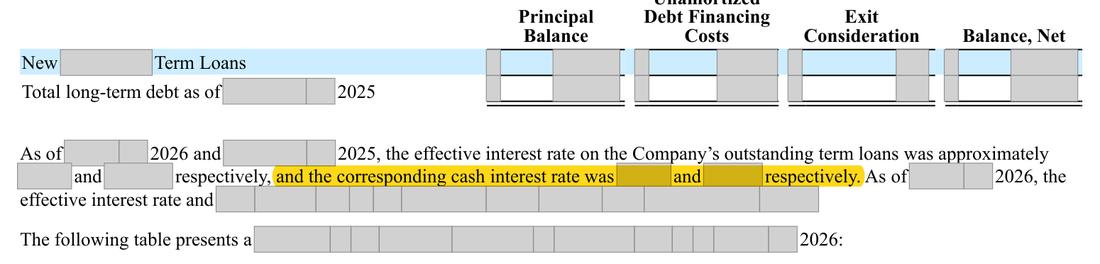
3 further page extracts: screenshot withheld to protect the company’s identity. The rows below say what each shows.
What the filing shows, and what the rule requires
| What the filing shows | What the rule requires |
|---|---|
No prior-year market risk figure and no explanation of the change in exposure; a symmetric sensitivity of [n] for a 1% increase or decrease, with the floor stated as a loan term but not applied to the decrease. | The preceding year's exposure summarized ([n] of principal, SOFR floor 1.0%, margin [n]%; about [n] for a 1% change) and the reasons for the change explained; the decrease figure given as about [n], limited by the [n]% SOFR floor. |
The rule
Regulation S-K Item 305(a)(3), 17 CFR [n](a)(3)
Registrants shall present summarized market risk information for the preceding fiscal year. In addition, registrants shall discuss the reasons for material quantitative changes in market risk exposures between the current and preceding fiscal years.
Version: Text in force at the date of this review · Source: Regulation S-K Item 305, 17 CFR [n], as adopted by Release No. 33-7386 and amended
Regulation S-K Item 305(a)(2), 17 CFR [n](a)(2)
This discussion shall include summarized descriptions of instruments, positions, and transactions omitted from the quantitative market risk disclosure information or the features of instruments, positions, and transactions that are included, but not reflected fully in the quantitative market risk disclosure information.
Version: Text in force at the date of this review · Source: Regulation S-K Item 305, 17 CFR [n], as adopted by Release No. 33-7386 and amended
Regulation S-K Item 305, Instructions to paragraph 305(a), instruction 3.F (sensitivity analysis)
a description as to how optionality is addressed by the model
Version: Text in force at the date of this review · Source: Regulation S-K Item 305, 17 CFR [n], as adopted by Release No. 33-7386 and amended
Why it applies here. Item 305(a)(3) requires summarized market risk information for the preceding fiscal year and a discussion of the reasons for material quantitative changes. It is excused only when no Item 305(a)(1) disclosure is required for the current year or in the first year a registrant must present Item 305 information; neither applies, because the current year is quantified and the prior-year report already carried Item 7A. The refinancing raised principal from [n] to [n] and changed both floor and margin, so the change in exposure is the kind (a)(3) asks to be explained. The floor point is narrower: the potential loss that Item 305(a)(1)(ii) asks for comes from a rise in rates, and that figure is right; the floor is printed in the same sentence. Whether Item 305(a)(2) and the instruction on optionality require the decrease figure to apply the floor is arguable, so it is raised as a presentation point, not as a separate breach.
Why it matters
Readers cannot see how the 2025 refinancing changed the company's interest rate exposure against the year before, and the decrease figure suggests a saving about twice what the loan terms allow.
Exposure
No fine; the realistic consequence is a staff comment asking for the prior-year comparison (and possibly for the floor to be reflected), with a future-filings undertaking.
Our workings
p.58 states that the New [former lender] Term Loans bear interest at 3-month SOFR, subject to a SOFR floor of [n]%, plus 5.0%, that [amount] was outstanding, and that a 1% increase or decrease would change annual interest expense by approximately [amount]. Nothing in Item 7A gives the preceding year's exposure or the reasons it changed. The prior loan carried a SOFR floor of 1.0% plus [n]% (p.52), and the 2024 report said a 1% move would not have a material impact. The company's Form 10-Q for the quarter ended [date] states that the cash interest rate on the term loans at [date] was [n]%.
a 1% change on the [n] of principal outstanding at the end of 2024 was about [n], against [n] this year. The floor rate is [n]% + 5.00% = 8.50%; at [n]% the rate can fall only [n] points, so a 1% fall changes interest by [n] x 0.49% = [n], against the [n] stated, a gap of [n] (1.50% of the pre-tax loss; 51.0% of the stated figure).
| Step | Computation | Result |
|---|---|---|
| Stated sensitivity | [amount] = [n] | [n] |
| Prior-year exposure to a 1% change ([n] principal) | [n] x 1.00% | [n] |
| Floor rate | [n]% + 5.00% | 8.50% |
| Room above the floor at [date] | [n]% - 8.50% | [n] points |
| Decrease leg, capped at the floor | [n] x 0.49% | [n] |
| Gap on the decrease leg | [n] - [n] | [n] |
| Share of pre-tax loss | [n] / [n] | 1.50% |
| Share of the stated sensitivity | [n] / [n] | 51.0% |
Management’s best defense, and our reply
Management would say the required measure is the potential loss, which arises from a rise in rates and is stated correctly at about [amount], and that the [n]% floor is printed in the same sentence, so a reader can see that a fall is limited. It would add that the 2024 report described the exposure as not material, so there was no prior-year figure to carry forward. The answer: the first argument meets the decrease figure, which is why the floor is raised only as a presentation point; it does not meet Item 305(a)(3), which asks for the preceding year's summarized information once the current year is quantified, and a 1% move on the [n] then outstanding was about [n], close to this year's [n], while the refinancing changed principal, floor and margin.
The fix
- Next Form 10-K: 'A 1% increase in 3-month SOFR would increase annual interest expense by approximately [amount]; because the loans carry a [n]% SOFR floor, a 1% decrease would reduce it by approximately [amount]. At [date], a 1% change on the [amount] then outstanding would have changed interest expense by approximately [amount]; the change reflects the 2025 refinancing (higher principal, floor raised from 1.0% to [n]%, margin reduced from [n]% to 5.0%).'
Evidence relied on
| # | What it shows | Type | Where |
|---|---|---|---|
| 1 | The loan terms, including the [n]% SOFR floor, and the principal | Document | Form 10-K 2025, page 58 |
| 2 | The symmetric sensitivity stated | Document | Form 10-K 2025, page 58 |
| 3 | Form 10-Q for Q1 2026: cash interest rate on the term loans of [n]% at [date] | Document | |
| 4 | Prior loan terms: the floor and margin both changed in 2025 | Document | Form 10-K 2025, page 52 |
| 5 | Prior-year report: no figure, exposure described as not material | Document | Form 10-K 2024 (prior year), page 60 |
Absence check
- Document
- Form 10-K 2025
- Where it would appear
- Interest Rate and Market Risk
- What is missing
- The preceding year's summarized interest rate sensitivity, the reasons for the change in exposure, and any statement of how the [n]% SOFR floor limits the effect of a rate decrease
- Pages looked at
- p.58 (Item 7A) and p.48-57 (Item 7) page images
- Result
- 'floor of [n]%' hits p.52 (MD&A loan terms), p.58 (the loan terms in Item 7A) and p.81 (Note 7 loan terms): each states the floor as a contract term; none applies it to the sensitivity. The other terms do not hit.
Prepared by Pramanex from the company’s public SEC filings, without the company’s involvement, to show how a 10-K Pre-filing Check reads. The company is not named, and nothing on this page is a statement about any identifiable company. Observations are not an audit, review or other attestation or assurance engagement, and not legal advice. An SEC-style question is a question, not a conclusion.
Want this on your own 10-K, before you file?
Start with three free findings on your latest 10-K, or book a fixed-price 10-K Pre-filing Check.
Your next 10-K will be in draft before the audit is done.
Have it read before you file.
Start with three free findings on your latest 10-K, or book a fixed-price 10-K check. Drafts only under NDA, inside your insider trading policy.