4.14 The insurance and claims discussion does not quantify the large claim settlement, and the 2024 large claim was likewise unquantified
Company B · a US-listed transportation and logistics company · SEC-style question
In brief
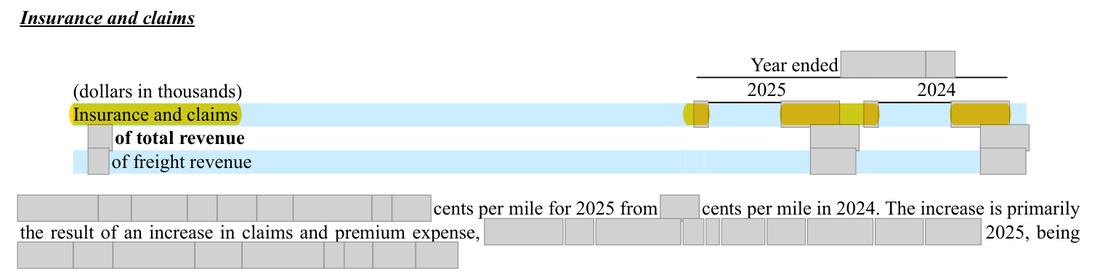
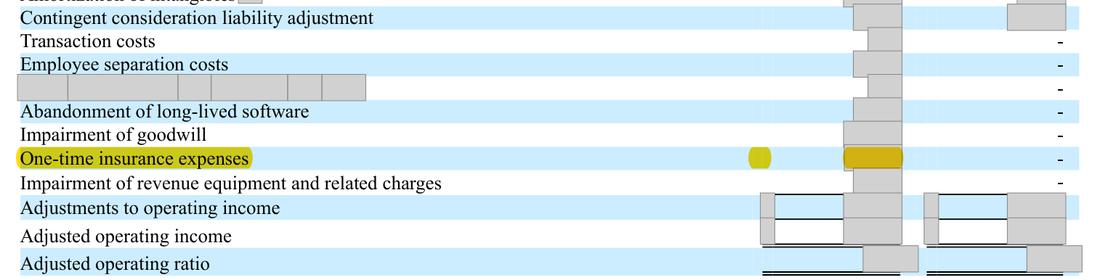
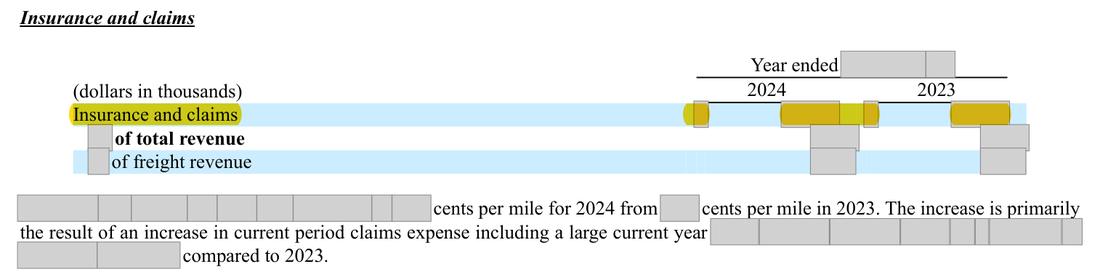
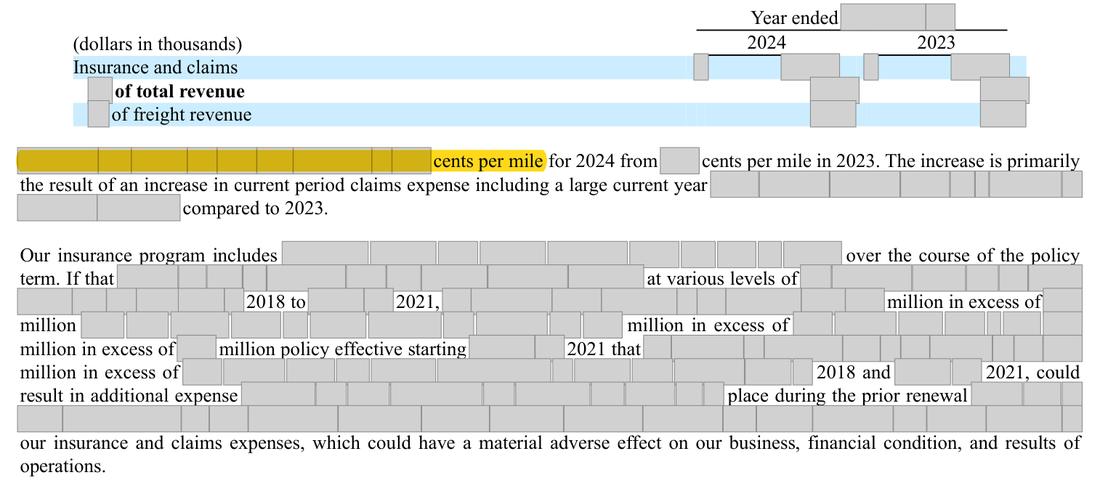
Insurance and claims expense rose by [amount], and MD&A attributes the rise to higher claims and premium [wording masked], without giving its amount. The MD&A non-GAAP table removes [amount] of 'one-time insurance expenses', and the earnings release names a large claims settlement of [amount]. If that is the same item, the rest of insurance and claims expense fell by about [amount], so the line contains offsetting movements the discussion does not describe. The prior-year 10-K did the same for 2024: it explained the rise in insurance and claims expense from [n] to [n] dollars by a large current-year claim, partly offset by lower premiums, without the amount of either.
The evidence, as filed
1 further page extract: screenshot withheld to protect the company’s identity. The rows below say what each shows.
What the filing shows, and what the rule requires
| What the filing shows | What the rule requires |
|---|---|
Insurance and claims [n] vs [n]; narrative 'increase in claims and premium [wording masked]'; no amount for the settlement in the line discussion; 'One-time insurance expenses [n]' in the non-GAAP table | The settlement quantified in the insurance and claims discussion, with the movement in the remaining expense (premiums and other claims) explained in quantitative terms, as the prior-year discussion of the 2024 large claim should also have been |
The rule
Regulation S-K Item 303(b) (underlying reasons, including offsetting changes)
Where the financial statements reflect material changes from period-to-period in one or more line items, including where material changes within a line item offset one another, describe the underlying reason
Version: Text in force at the date of this review · Source: 17 CFR 229.303, Regulation S-K Item 303, as amended by Release 33-10890
Why it applies here. if the one-time item is the settlement, the underlying expense fell slightly while the narrative attributes the rise to higher claims and premium expense; Item 303(b) asks for the underlying reasons for material changes, including offsetting changes within a line item, in quantitative and qualitative terms. Only management can confirm what the [n] comprises. Prior year: the fiscal 2024 discussion (Form 10-K 2024 (prior year) unnumbered page) explained an increase from [n] to [n] ([n]) by a large current-year claim partly offset by lower premiums, giving neither amount, so the large 2024 claim was likewise unquantified.
Why it matters
A reader cannot tell that the underlying insurance and claims cost was broadly flat and that the rise came from one settlement, which matters for judging the outlook statement that the expense will stay volatile.
Exposure
A question for management; if the staff took the same view, the realistic outcome is a comment asking for quantified drivers in future filings, with no fine.
Our workings
the insurance and claims table shows [n] against [n] and the narrative names the large claim settlement without an amount. The MD&A non-GAAP reconciliation adds back 'One-time insurance expenses' of [n] for 2025 and nothing for 2024; the earnings release lists a large claims settlement of [amount] among the 2025 charges.
the line increased by [n]; the one-time item exceeds it by [n], so insurance and claims excluding that item were [n] against [n].
| Item | Computation | Result |
|---|---|---|
| Increase in insurance and claims | [n] - [n] | [n] |
| One-time insurance expenses above the increase | [n] - [n] | [n] |
| Insurance and claims excluding the one-time item | [n] - [n] | [n] (2024: [n]) |
| Increase and excess in $ million | [n] / [n] = [n]; [n] / [n] = [n] | [n] and [n] |
| Prior-year increase in insurance and claims (2024 vs 2023) | [n] - [n] | [n] |
Management’s best defense, and our reply
Management can point out that the settlement amount is in the same MD&A, in the non-GAAP reconciliation two pages later, and in the earnings release, and that the per-mile cost explains the change in the way management runs the business. It may also say the [n] includes related premium or legal costs, so that 'an increase in claims and premium expense' is a fair description. That is a tenable reading, which is why this is a question. However, the line discussion itself gives no amount, and the reader has to match an unlabelled non-GAAP adjustment to a narrative phrase to see that the underlying expense did not rise.
The fix
- Add, for example: "The increase includes [amount] for [wording masked]; excluding it, insurance and claims expense decreased [amount], as lower claims ... offset higher premiums ...".
Question for the company
Is the [amount] of 'one-time insurance expenses' the 2025 [wording masked] settlement, and if so, what drove the remaining insurance and claims expense, which on these figures fell by about [amount] rather than rose?
Evidence relied on
| # | What it shows | Type | Where |
|---|---|---|---|
| 1 | insurance and claims expense, both years | Document | Form 10-K 2025, unnumbered page |
| 2 | settlement named without an amount | Document | Form 10-K 2025, unnumbered page |
| 3 | MD&A non-GAAP table removes [n] of insurance expense for 2025 | Document | Form 10-K 2025, page 39 |
| 4 | earnings release names the item as a large claims settlement | Document | |
| 5 | Insurance and claims expense in the prior-year 10-K rose from [n] to [n] (USD thousand) | Document | Form 10-K 2024 (prior year), unnumbered page |
| 6 | The prior-year MD&A names a large 2024 claim and lower premiums as the drivers but gives an amount for neither | Document | Form 10-K 2024 (prior year), unnumbered page |
Absence check
- Document
- Form 10-K 2024 (prior year)
- Where it would appear
- Insurance and claims per mile cost increased to [n] cents per mile
- What is missing
- the amount of the large 2024 claim and of the premium decrease that together explain the increase in the line
- Pages looked at
- Form 10-K 2024 (prior year) p.30-17 (self-insurance risk factor), [n] (insurance and claims), [n] (non-GAAP table), 69-70 (critical accounting estimates), 132-133 (Note 16)
- Result
- 'large current year claim' hits only the sentence on p.32 that names the claim without an amount; 'auto liability claim' hits the self-insurance risk factor (unnumbered page) and the critical audit matter, which describe the estimation process, not the 2024 claim; 'large claim' and 'claim settlement' do not hit
Prepared by Pramanex from the company’s public SEC filings, without the company’s involvement, to show how a 10-K Pre-filing Check reads. The company is not named, and nothing on this page is a statement about any identifiable company. Observations are not an audit, review or other attestation or assurance engagement, and not legal advice. An SEC-style question is a question, not a conclusion.
Want this on your own 10-K, before you file?
Start with three free findings on your latest 10-K, or book a fixed-price 10-K Pre-filing Check.
Your next 10-K will be in draft before the audit is done.
Have it read before you file.
Start with three free findings on your latest 10-K, or book a fixed-price 10-K check. Drafts only under NDA, inside your insider trading policy.