4.06 Item 7A interest-rate sensitivity (fiscal 2025) is worked on all variable-rate debt, including the hedged note, not on the unhedged debt it describes
Company B · a US-listed transportation and logistics company · Presentation point
In brief
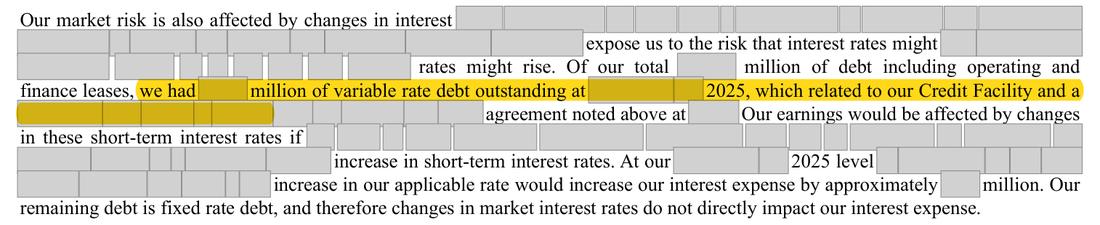
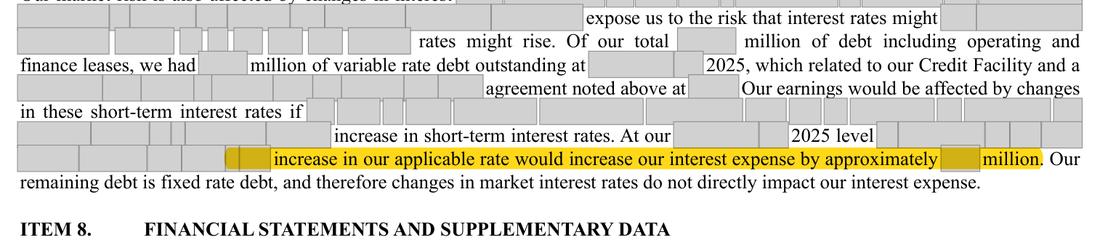
Item 7A says that, at year-end borrowing on non-hedged variable-rate debt, a 1% rate increase would raise interest expense by about [amount]. The only non-hedged variable-rate debt is the [amount] drawn on the Credit Facility; the real-estate note ([n] in the debt note) is fixed by the swap. A 1% rise on [amount] is [amount]; the [amount] matches 1% of the whole [amount], hedged note included.
The evidence, as filed

What the filing shows, and what the rule requires
| What the filing shows | What the rule requires |
|---|---|
'At our [date] [wording masked] 1% increase in our applicable rate would increase our interest expense by approximately [amount]' | Approximately [amount] (1% of the [amount] unhedged Credit Facility borrowing), or the basis restated if the figure is meant to cover all variable-rate debt |
The rule
Regulation S-K Item 305(a)(1)(ii)(A)
Sensitivity analysis disclosures that express the potential loss in future earnings, fair values, or cash flows of market risk sensitive instruments resulting from one or more selected hypothetical changes in interest rates
Version: Text in force at the date of this review · Source: Regulation S-K, 17 CFR 229.305(a), as adopted by Release 33-7386 (1997); text in force throughout fiscal 2025
Regulation S-K Item 305(a)(1)(ii)(B)
Registrants shall provide a description of the model, assumptions, and parameters, which are necessary to understand the disclosures required under paragraph (a)(1)(ii)(A) of this Item 305
Version: Text in force at the date of this review · Source: Regulation S-K, 17 CFR 229.305(a), as adopted by Release 33-7386 (1997); text in force throughout fiscal 2025
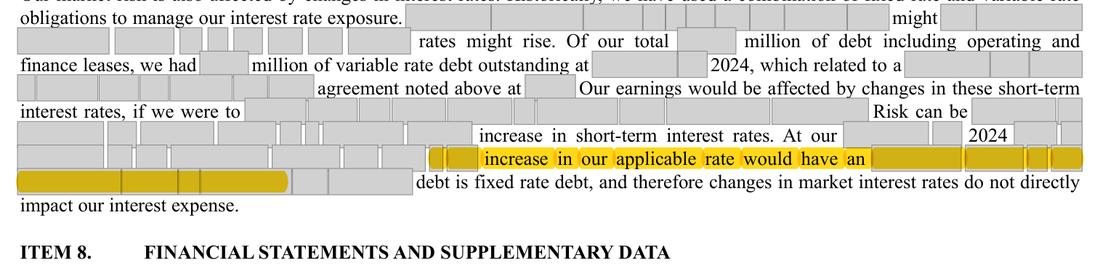
Why it applies here. The figure and the stated base do not agree: [amount] unhedged gives [amount]; [amount] in total gives [amount]. In 2024, with no unhedged borrowing, the effect was called immaterial.
Why it matters
- Small in money, but it is the only quantified interest-rate risk in the 10-K.
- Correctable in the next periodic report; no penalty exposure.
Exposure
Presentation inconsistency; corrected in the next periodic report. No fixed penalty.
Our workings
Item 7A states [amount] of variable-rate debt 'which related to our Credit Facility and a [wording masked]', and gives a [amount] effect of a 1% rise '[wording masked]'. The liquidity section lists [amount] drawn on the Credit Facility, and the debt note (p.71) gives the real estate note as [n] current and [n] non-current, [n] in all; [n] plus [n] is the [n].
1% of the unhedged [n] is [n], while 1% of the full [n] is [n], which rounds to [amount].
the sensitivity appears to have been computed on all variable-rate debt; the description and the figure cannot both hold. In 2024, when the hedged note was the only variable-rate debt, the 10-K called the effect immaterial, so the base used then excluded the hedged note.
| Item | USD thousand | Working |
|---|---|---|
| Variable-rate debt | [n] | real estate note (hedged) [n] + [n] = [n]; plus Credit Facility [n] + [n] = [n] |
| Effect of a 1% rise | [n] / [n] | unhedged only [n] x 1% = [n] ([n] / [n] = [n]); all debt [n] x 1% = [n], printed as [amount] |
| Difference | [n] | [n] - [n] = [n]; [n] / [n] = [n]% of pre-tax income |
Management’s best defense, and our reply
Management could argue that a rounded, conservative figure is what a sensitivity disclosure is for. It could say the figure is a rounded, deliberately conservative estimate, that average Credit Facility borrowings during the coming year may exceed the year-end balance, and that the difference is immaterial to the financial statements. It could add that the hedge only offsets cash flows if it remains effective. However, the sentence expressly measures the effect 'at our [date] [wording masked]', the swap is stated to fix the note's rate through 2035, and the figure reproduces exactly from the total including the hedged note, so the base used contradicts the base described.
The fix
- Restate as: 'At our [date] [wording masked] ([amount]), a 1% increase in our applicable rate would increase our annual interest expense by approximately [amount].'
Evidence relied on
| # | What it shows | Type | Where |
|---|---|---|---|
| 1 | Variable-rate debt and the hedged note | Document | Form 10-K 2025, unnumbered page |
| 2 | Reported sensitivity on 'non-hedged' debt | Document | Form 10-K 2025, unnumbered page |
| 3 | Unhedged Credit Facility borrowing at year-end | Document | Form 10-K 2025, unnumbered page |
| 4 | The real-estate note fixed by the swap | Document | Form 10-K 2025, unnumbered page |
| 5 | Prior year: no unhedged borrowing | Document | Form 10-K 2024 (prior year), unnumbered page |
| 6 | Sensitivity stated for non-hedged variable-rate debt | Document | Form 10-K 2025, unnumbered page |
| 7 | The only non-hedged variable-rate debt: [amount] drawn, so 1% is [amount] | Document | Form 10-K 2025, unnumbered page |
| 8 | Debt note: the hedged real estate note ([n] + [n] = [n]), which with the [amount] makes the [amount] | Document | Form 10-K 2025, page 71 |
Prepared by Pramanex from the company’s public SEC filings, without the company’s involvement, to show how a 10-K Pre-filing Check reads. The company is not named, and nothing on this page is a statement about any identifiable company. Observations are not an audit, review or other attestation or assurance engagement, and not legal advice. An SEC-style question is a question, not a conclusion.
Want this on your own 10-K, before you file?
Start with three free findings on your latest 10-K, or book a fixed-price 10-K Pre-filing Check.
Your next 10-K will be in draft before the audit is done.
Have it read before you file.
Start with three free findings on your latest 10-K, or book a fixed-price 10-K check. Drafts only under NDA, inside your insider trading policy.