1.26 Operating and finance lease right-of-use assets are both carried inside 'Net property and equipment'
Company B · a US-listed transportation and logistics company · SEC-style question
In brief
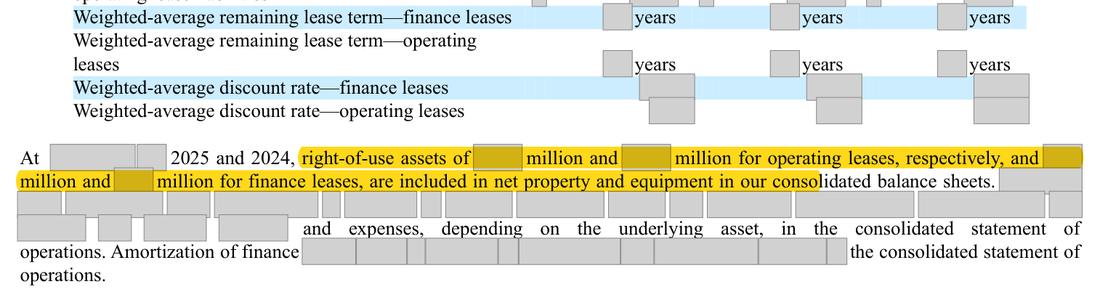
Note 11 says operating lease right-of-use (ROU) assets of [amount] and finance lease ROU assets of [amount] are both included in 'Net property and equipment' ([n], USD thousand). The lease liabilities are shown on separate balance-sheet lines for each kind of lease, but the two kinds of ROU asset share one line, and the lease standard's presentation guidance restricts that combination.
The evidence, as filed
What the filing shows, and what the rule requires
| What the filing shows | What the rule requires |
|---|---|
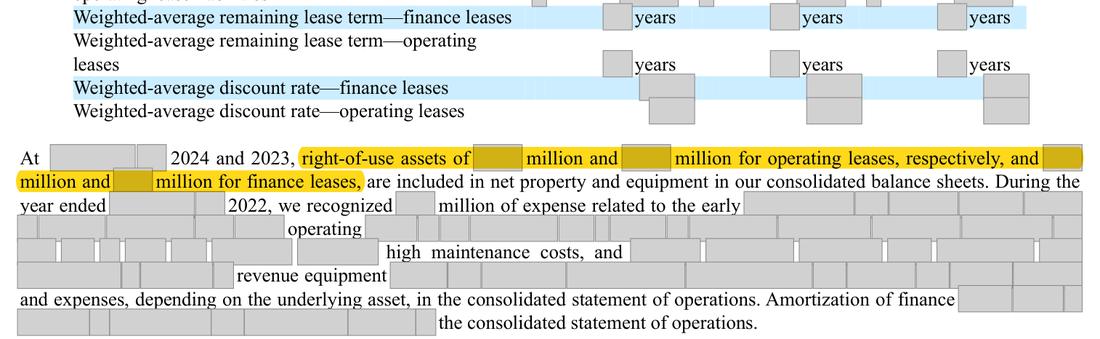
Operating ROU assets [amount] and finance ROU assets [amount] (together [n]% of the line) are included in the single line 'Net property and equipment' [n]; the note names the line. The same presentation was used in 2024. | Operating lease ROU assets presented on a line of their own (or at least not in the same line as finance lease ROU assets), with the line items that hold each kind of ROU asset stated in the note. |
The rule
Regulation S-X Rule 4-01(a) (form, order and terminology of financial statements)
Financial statements should be filed in such form and order, and should use such generally accepted terminology, as will best indicate their significance and character in the light of the provisions applicable thereto.
Version: Text in force at the date of this review · Source: Regulation S-X, 17 CFR 210.4-01(a), eCFR text as amended to 2025
Why it applies here. this is a presentation question, not a measurement error; only management can say whether the combination was a considered materiality judgment.
Why it matters
A presentation that combines the two kinds of ROU asset can draw a staff comment and a commitment to present them separately in future filings; it does not change any reported total.
Exposure
A question for management; no penalty attaches and no reported total changes.
Our workings
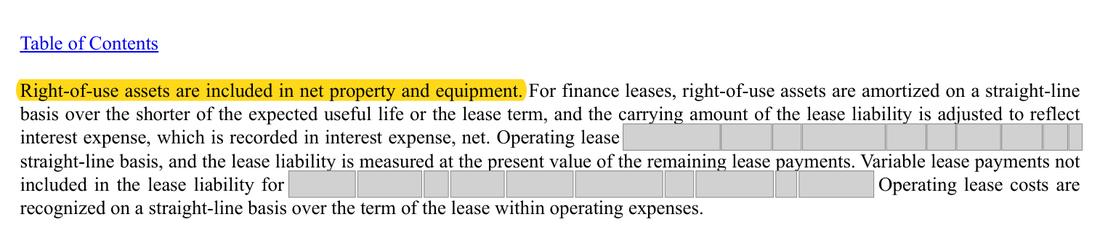
Note 11 states that ROU assets of [amount] (operating) and [amount] (finance) at the end of 2025, and [amounts] at the end of 2024, are included in net property and equipment; the policy note repeats that ROU assets are included in net property and equipment. The balance sheet shows finance and operating lease obligations on separate lines.
[n] + [n] = [n], or [n], which is [n]% of net property and equipment. Architecture: ASC paragraphs 842-20-45-1 and 45-2 let a lessee either present finance and operating ROU assets separately on the balance sheet or disclose them and name the lines that contain them, which the note does; as we read ASC paragraph 842-20-45-3, however, finance lease and operating lease ROU assets may not be presented in the same line item, whichever route is taken. The liabilities side follows that rule here; the asset side does not. Grey area: the finance lease ROU assets are small, the note gives every amount, and a preparer may treat the combined line as immaterial.
| Item | Computation |
|---|---|
| ROU assets combined in one line (million) | [n] + [n] = [n] |
| In thousands | [n] = [n] |
| Share of net property and equipment | [n] / [n] = [n]% |
Management’s best defense, and our reply
Management would say the note discloses both amounts and names the line that holds them, which is what the presentation paragraphs ask when ROU assets are not shown separately, and that finance lease ROU assets of [amount] are immaterial within net property and equipment of [n]. The practice is long-standing and was unchanged from 2024. However, the bar on combining the two kinds of ROU asset in one line applies whether or not the amounts are disclosed, and the fix, moving the operating ROU assets to their own line, costs nothing and changes no total.
The fix
- Present 'Operating lease right-of-use assets' as a separate balance-sheet line (finance lease ROU assets may stay in property and equipment), and keep the note's statement of which line holds each kind.
Question for the company
Does management consider that carrying finance lease and operating lease ROU assets together in 'Net property and equipment' is consistent with the lease standard's presentation guidance, and if so on what basis (for example the materiality of the finance lease assets)?
Evidence relied on
| # | What it shows | Type | Where |
|---|---|---|---|
| 1 | both kinds of ROU asset are inside one balance-sheet line | Document | Form 10-K 2025, unnumbered page |
| 2 | the accounting policy states the same presentation | Document | Form 10-K 2025, unnumbered page |
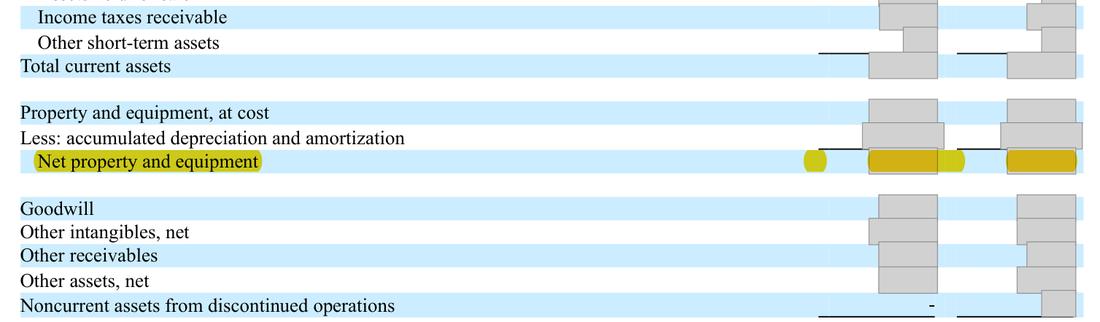
| 3 | the single balance-sheet line that holds both kinds of ROU asset | Document | Form 10-K 2025, unnumbered page |
| 4 | the liabilities, by contrast, are on separate lines for finance and operating leases | Document | Form 10-K 2025, unnumbered page |
| 5 | operating lease liabilities on their own line | Document | Form 10-K 2025, unnumbered page |
Prepared by Pramanex from the company’s public SEC filings, without the company’s involvement, to show how a 10-K Pre-filing Check reads. The company is not named, and nothing on this page is a statement about any identifiable company. Observations are not an audit, review or other attestation or assurance engagement, and not legal advice. An SEC-style question is a question, not a conclusion.
Want this on your own 10-K, before you file?
Start with three free findings on your latest 10-K, or book a fixed-price 10-K Pre-filing Check.
Your next 10-K will be in draft before the audit is done.
Have it read before you file.
Start with three free findings on your latest 10-K, or book a fixed-price 10-K check. Drafts only under NDA, inside your insider trading policy.