1.14 Segment reconciliation: the 'segment' total includes [n] of non-segment revenue and one 'Other' line hides a [n] goodwill impairment
Company B · a US-listed transportation and logistics company · SEC-style question
In brief
The segment table prints a total 'Segment operating income' of [n] (USD thousand), but the four reportable segments add to [n]; the [n] difference is 'Other revenues' that belong to no segment yet sit inside the segment total. The single reconciling line 'Other' of ([n]) combines unallocated costs with a goodwill impairment of [n] and a held-for-sale write-down of [n] (together [n], or 29.3% of 'Other'), none of which is given an amount in the reconciliation.
The evidence, as filed
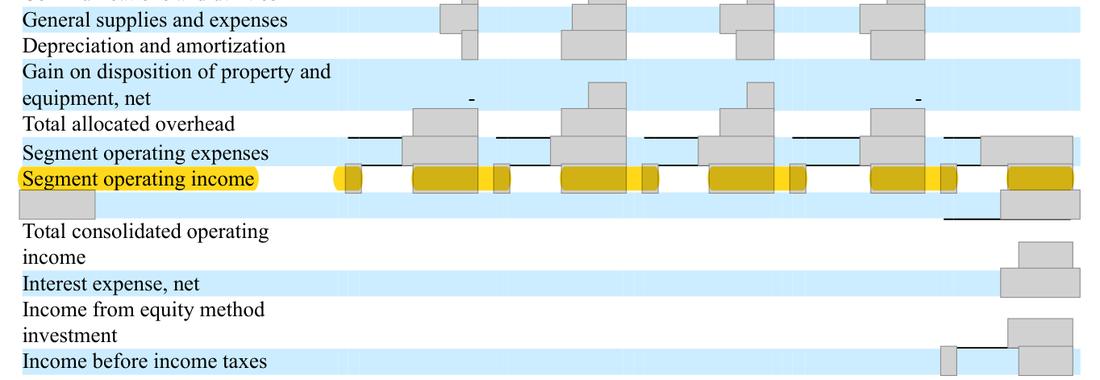
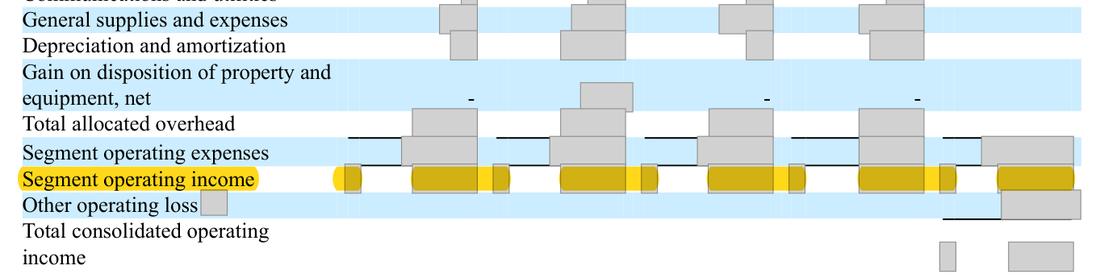
2 further page extracts: screenshot withheld to protect the company’s identity. The rows below say what each shows.
What the filing shows, and what the rule requires
| What the filing shows | What the rule requires |
|---|---|
Total segment operating income [n] = four segments [n] + other revenues [n]; one reconciling line 'Other' ([n]), described by type in a footnote but not by amount. | The reconciliation starts from the total of the reportable segments ([n]); the non-segment revenue ([n]) is a separate reconciling item or 'all other' amount; and each significant reconciling item (goodwill impairment, held-for-sale write-down, amortization of intangibles, unallocated costs, contingent consideration adjustments) is separately identified with its amount. |
The rule
FASB ASC paragraphs 280-10-50-28A to 50-30, as amended by ASU 2023-07 (segment profit measure and reconciliation of totals to consolidated amounts)
Summary; FASB/IFRS text is copyrighted Report the CODM's segment profit measure; if several are reported, include the one closest to GAAP; explain measurements and reconcile totals to consolidated amounts.
Version: Text in force at the date of this review · Source: FASB Accounting Standards Codification, ASC 280-10-50 (as amended by ASU 2023-07) (paraphrase)
Regulation S-X Rule 4-01(a) (further material information)
The information required with respect to any statement shall be furnished as a minimum requirement to which shall be added such further material information as is necessary to make the required statements, in the light of the circumstances under which they are made, not misleading.
Version: Text in force at the date of this review · Source: Regulation S-X, 17 CFR 210.4-01(a), eCFR text as amended to 2025
Why it applies here. the label 'Segment operating income' on a total that includes non-segment revenue overstates the segments' combined result by [n], and a single line that mixes recurring unallocated costs with an impairment larger than pre-tax income does not let a reader see the recurring cost of the corporate layer.
Why it matters
Segment reporting under ASU 2023-07 is a current staff comment theme; the staff has asked registrants to quantify significant reconciling items and to keep non-segment amounts out of segment totals.
How often the SEC staff raises this. In 1,100 SEC staff comment letters on fiscal 2023 and 2024 Forms 10-K, released January 2025 to October 2026, segment reporting drew 191 of the 1,774 numbered comments (10.8%): topic 4 of 25 by frequency.
Exposure
A question for management; no penalty attaches. The realistic outcome of a staff review would be a comment and a revised reconciliation in later filings.
Our workings
for 2025 the four reportable segments report operating income of [n]; the total column prints [n]. Other revenues of [n] appear only in the total column. The reconciliation then deducts one line, 'Other' ([n]), to reach operating income of [n], and footnote (2) lists its components by type: indirect costs, amortization of intangibles, goodwill impairment, held-for-sale write-down and contingent consideration adjustments. The income statement shows the goodwill impairment of [n] and the held-for-sale write-down of [n].
[n] + [n] + [n] + [n] = [n], so [n] - [n] = [n], exactly the other revenues; the two named one-off items total [n], 29.3% of 'Other'; the goodwill impairment alone is 191.3% of pre-tax income. Architecture: ASC paragraph 280-10-50-30 requires a reconciliation of the total of the reportable segments' measures of profit or loss to consolidated income before income taxes; ASC paragraph 280-10-50-31 requires all significant reconciling items to be separately identified and described; ASC paragraph 280-10-50-15 puts other business activities in an 'all other' category separate from the reconciling items. ASU 2023-07, effective from 2024, kept these requirements and added the significant-expense disclosures that the table gives. Grey area: a footnote that names the components, with the two largest one-off amounts visible on the face of the income statement, may be argued to identify them.
| Item | Computation |
|---|---|
| Sum of the four segments' operating income | [n] + [n] + [n] + [n] = [n] |
| Total printed as segment operating income | [n] |
| Total less 'Other' = consolidated operating income | [n] - [n] = [n] |
| Difference | [n] - [n] = [n] (equal to other revenues, in no segment) |
| Difference against pre-tax income | [n] / [n] = [n]% |
| Two items named in footnote (2), from the income statement | [n] + [n] = [n] |
| Share of 'Other' they represent | [n] / [n] = 29.3% |
| Goodwill impairment against pre-tax income | [n] / [n] = 191.3% |
Management’s best defense, and our reply
Management would say the [n] is incidental revenue too small for an 'all other' column, and that adding it to the total simply carries total revenue down to operating income; they would also say footnote (2) identifies and describes every component of 'Other', and the two largest one-off items are shown on the face of the income statement, so nothing is hidden. The reconciliation arrives at the correct operating income and pre-tax income. However, a line labelled 'Segment operating income' should be the sum of the reportable segments, and the standard asks for significant reconciling items to be separately identified, which a list of types without amounts does not do when one item, the goodwill impairment, is 191.3% of pre-tax income.
The fix
- Total the four reportable segments ([n]); show 'Other revenues' ([n]) as a separate reconciling item; split 'Other' into unallocated corporate costs, amortization of intangibles, goodwill impairment ([n]), held-for-sale write-down ([n]) and contingent consideration adjustments, each with its amount.
Question for the company
Why does the 'Segment operating income' total include the [n] of other revenues that belongs to no reportable segment, and what is that revenue? Will the reconciliation show the goodwill impairment, held-for-sale write-down, amortization of intangibles and unallocated corporate costs as separate amounts rather than one 'Other' line?
Evidence relied on
| # | What it shows | Type | Where |
|---|---|---|---|
| 1 | segment revenues; the four columns add to the subtotal | Document | Form 10-K 2025, unnumbered page |
| 2 | revenue shown only in the total column, in no segment | Document | Form 10-K 2025, unnumbered page |
| 3 | the four segments and the total that includes the [n] | Document | Form 10-K 2025, unnumbered page |
| 4 | the single reconciling line | Document | Form 10-K 2025, unnumbered page |
| 5 | the reconciliation ends at pre-tax income | Document | Form 10-K 2025, unnumbered page |
| 6 | footnote (2): the components of 'Other' by type, with no amounts | Document | Form 10-K 2025, page 77 |
| 7 | held-for-sale write-down on the face of the income statement | Document | Form 10-K 2025, page 55 |
| 8 | goodwill impairment on the face of the income statement | Document | Form 10-K 2025, page 55 |
| 9 | Fiscal 2024 segment table, first year of the new segment standard: total segment operating income [n]. | Document | Form 10-K 2024 (prior year), unnumbered page |
| 10 | One reconciling line of ([n]) takes segment operating income of [n] down to consolidated operating income of [n]. | Document | Form 10-K 2024 (prior year), unnumbered page |
| 11 | The fiscal 2024 note described the whole line only as unallocated corporate expenses. | Document | Form 10-K 2024 (prior year), page 77 |
| 12 | Intangible amortization of [amount] was charged in 2024. | Document | Form 10-K 2024 (prior year), page 69 |
| 13 | A fair value increase of [n] in the earn-out liability was charged in 2024. | Document | Form 10-K 2024 (prior year), page 66 |
| 14 | The fiscal 2025 note says the same line includes intangible amortization and contingent consideration adjustments; its 2024 column carries the same ([n]). | Document | Form 10-K 2025, page 77 |
Prepared by Pramanex from the company’s public SEC filings, without the company’s involvement, to show how a 10-K Pre-filing Check reads. The company is not named, and nothing on this page is a statement about any identifiable company. Observations are not an audit, review or other attestation or assurance engagement, and not legal advice. An SEC-style question is a question, not a conclusion.
Want this on your own 10-K, before you file?
Start with three free findings on your latest 10-K, or book a fixed-price 10-K Pre-filing Check.
Your next 10-K will be in draft before the audit is done.
Have it read before you file.
Start with three free findings on your latest 10-K, or book a fixed-price 10-K check. Drafts only under NDA, inside your insider trading policy.