1.13 [equity investee] investment: carrying amount and equity income differ from [n]% of the investee's own reported figures, and Note 13 does not reconcile them
Company B · a US-listed transportation and logistics company · SEC-style question
In brief
The Company carries its [n]% interest in [equity investee], LLC ([equity investee]) at [n] (USD thousand), but [n]% of the investee's own reported equity is [n], a difference of [n]. Its 2025 equity income from [equity investee] of [n] is [n] more than [n]% of the investee's reported net income ([n]). Note 13 does not say what either difference is or how it is accounted for, although equity income from [equity investee] is 263.1% of the year's pre-tax income.
The evidence, as filed
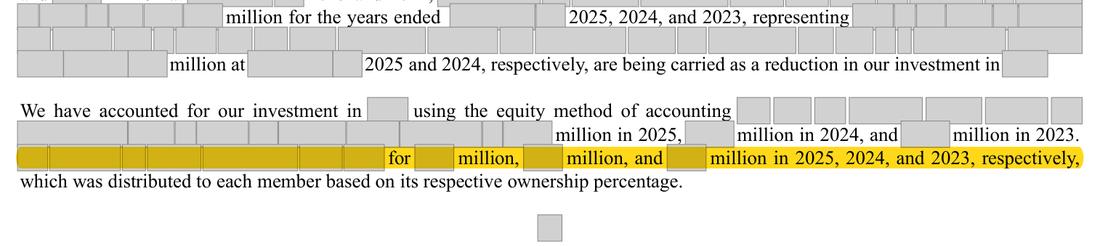
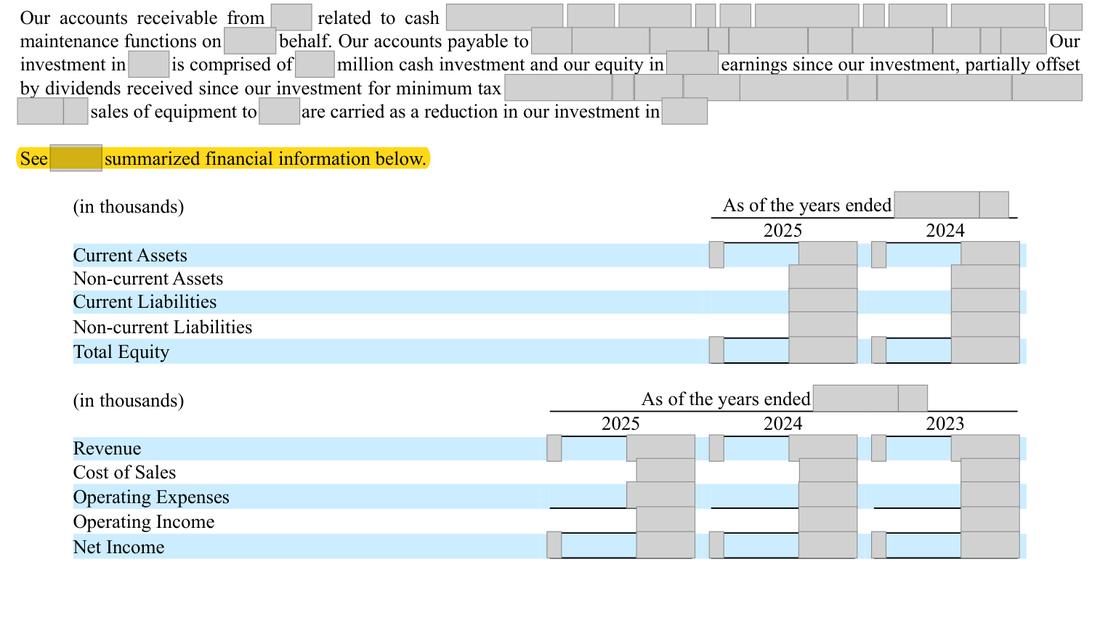
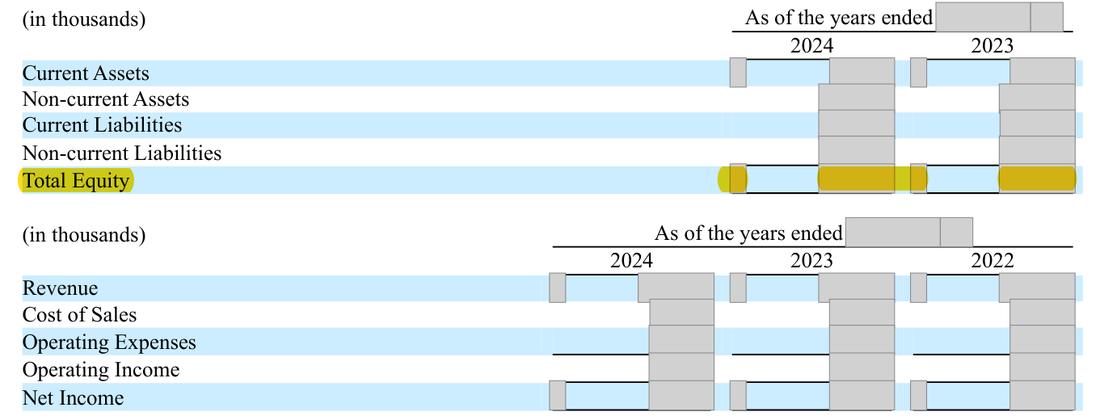
1 further page extract: screenshot withheld to protect the company’s identity. The rows below say what each shows.
What the filing shows, and what the rule requires
| What the filing shows | What the rule requires |
|---|---|
Note 13 gives the investee's summarized balance sheet and income statement but no link to the Company's figures: carrying amount [n] against [n]% of [equity investee] equity [n] (difference [n]); equity income [n] against [n]% of [equity investee] net income [n] (difference [n]). In 2024 the gaps were [n] and -[n]. | Note 13 states the difference between the carrying amount and the Company's share of the investee's net assets, what it consists of and how each part is accounted for, and why equity income differs from [n]% of the investee's reported net income. |
The rule
FASB ASC 323-10-50-3 (equity method investments: disclosures, including the difference between carrying amount and underlying equity in net assets)
Summary; FASB/IFRS text is copyrighted Disclose equity-method investees, ownership percentages, policies, basis differences and their accounting, quoted market values, and summarized investee financial information when material.
Version: Text in force at the date of this review · Source: FASB Accounting Standards Codification, ASC 323-10-50-3 (paraphrase; long-standing Codification guidance)
Regulation S-X Rule 4-01(a) (further material information)
The information required with respect to any statement shall be furnished as a minimum requirement to which shall be added such further material information as is necessary to make the required statements, in the light of the circumstances under which they are made, not misleading.
Version: Text in force at the date of this review · Source: Regulation S-X, 17 CFR 210.4-01(a), eCFR text as amended to 2025
Why it applies here. the deferred gains reduce the carrying amount, so they widen rather than explain the gap; a fixed equity-method goodwill cannot move by +[n] in one year and -[n] in the next. The movement points to something else (allocation terms in the operating agreement, intra-entity eliminations, or a timing difference between the investee's audited results and the amounts used for the pickup), which only management can confirm. Because [equity investee] income is 263.1% of pre-tax income, a reader needs this link to test the main earnings driver.
Why it matters
A reader cannot reconcile the largest single component of 2025 earnings to the investee's own reported results. The staff commonly asks registrants to explain such a difference and to undertake to disclose it in future filings.
Exposure
A question for management; no penalty attaches. If the answer shows a required disclosure is missing, the realistic outcome is a staff comment and a future-filings undertaking.
Our workings
Note 13 states a [n]% interest in [equity investee], a carrying amount of [n] (2024: [n]), equity income of [n] (2024: [n]), and the investee's summarized total equity of [n] (2024: [n]) and net income of [n] (2024: [n]). It also states deferred gains of [amount] carried as a reduction of the investment, and that the investment comprises the [amount] cash investment plus the Company's equity in the investee's earnings since then, less dividends received; that sentence explains how the carrying amount is built up, not why it differs from [n]% of the investee's equity.
[n]% of the investee's equity is [n], so the carrying amount is [n] higher; [n]% of the investee's net income is [n], so 2025 equity income is [n] higher; in 2024 the pickup was [n] lower than [n]% of the investee's net income. The investment rolls forward exactly ([n] + [n] - [n] = [n], rounding), so the pickup, not the distributions, drives the gap. Architecture: ASC paragraph 323-10-50-3 requires an investor to disclose, among other things, the difference between the carrying amount and the underlying equity in net assets and the accounting treatment of that difference; ASC paragraph 323-10-35-13 accounts for such a basis difference as if the investee were a consolidated subsidiary (amortized where it relates to depreciable assets, not amortized where it is equity-method goodwill), and ASC paragraph 323-10-35-7 eliminates intra-entity profits. Regulation S-X Rule 4-08(g) separately requires the summarized investee information, which is given.
| Item | 2025 | 2024 |
|---|---|---|
| [n]% of [equity investee] total equity | [n] x [n]% = [n] | [n] x [n]% = [n] |
| Carrying amount less [n]% share | [n] - [n] = [n] | [n] - [n] = [n] |
| [n]% of [equity investee] net income | [n] x [n]% = [n] | [n] x [n]% = [n] |
| Equity income less [n]% share | [n] - [n] = [n] | [n] - [n] = -[n] |
| Distribution received (thousand) | [n] = [n] | - |
| Investment roll-forward | [n] + [n] - [n] = [n] (printed [n]) | - |
| Size of the differences | [n] / [n] = 16.2%; [n] / [n] = [n]% | - |
| Equity income against pre-tax income | [n] / [n] = 263.1% | - |
Management’s best defense, and our reply
Management would say the excess is mainly the premium originally paid for the [equity investee] interest (equity-method goodwill, which is not amortized), adjusted for deferred gains on equipment sold to [equity investee] and for timing between the investee's audited statements and the amounts used for the pickup. They would add that [n] is [n]% of the investment and a small fraction of total assets, so the auditor could treat the disclosure as immaterial, and that the summarized [equity investee] information Regulation S-X requires is given in full. However, a fixed goodwill amount cannot move by [n] in 2025 and by -[n] in 2024, and an annual difference equal to 16.2% of pre-tax income, in a year when [equity investee] income is 263.1% of pre-tax income, is not small to a reader of these statements.
The fix
- Add to Note 13 a short reconciliation: [n]% of the investee's equity, plus or minus each basis difference (for example equity-method goodwill or allocation adjustments), less deferred gains, equals the carrying amount; state how each part is accounted for and why equity income differs from [n]% of the investee's net income.
Question for the company
What makes up the [n] by which the [equity investee] carrying amount exceeds [n]% of the investee's reported equity, and the [n] by which 2025 equity income exceeds [n]% of the investee's reported net income (for example equity-method goodwill, allocation terms of the operating agreement, intra-entity profit eliminations or a timing lag)? How is each part accounted for, and will Note 13 disclose it?
Evidence relied on
| # | What it shows | Type | Where |
|---|---|---|---|
| 1 | the ownership percentage used in every computation | Document | Form 10-K 2025, page 75 |
| 2 | 2025 distribution used in the investment roll-forward | Document | Form 10-K 2025, page 75 |
| 3 | the only reconciling item the note names; it reduces the carrying amount | Document | Form 10-K 2025, page 75 |
| 4 | carrying amount of the investment, 2025 and 2024 | Document | Form 10-K 2025, unnumbered page |
| 5 | the investee's reported equity in the summarized balance sheet | Document | Form 10-K 2025, unnumbered page |
| 6 | the investee's reported net income in the summarized income statement | Document | Form 10-K 2025, unnumbered page |
| 7 | equity income recorded by the Company (shown as a deduction in other expenses), 2025 and 2024 | Document | Form 10-K 2025, page 55 |
| 8 | 2025 pre-tax income, the benchmark | Document | Form 10-K 2025, unnumbered page |
Absence check
- Document
- Form 10-K 2025
- Where it would appear
- See the investee's summarized financial information below.
- What is missing
- any statement of the difference between the carrying amount of the [equity investee] investment and the Company's share of the investee's net assets, its components and its accounting treatment
- Pages looked at
- p.75-133 and 136-137 (page images); p.59-60 (accounting policy for [equity investee])
- Result
- None of the terms appears anywhere in the report. The nearest wording is on unnumbered page itself, which says the investment comprises the [amount] cash investment plus the equity in the investee's earnings, less dividends received and less deferred gains; it describes how the carrying amount is built up but not how it compares with [n]% of the investee's net assets. p.60 describes how an impairment of the investment would be measured, not the basis difference.
Prepared by Pramanex from the company’s public SEC filings, without the company’s involvement, to show how a 10-K Pre-filing Check reads. The company is not named, and nothing on this page is a statement about any identifiable company. Observations are not an audit, review or other attestation or assurance engagement, and not legal advice. An SEC-style question is a question, not a conclusion.
Want this on your own 10-K, before you file?
Start with three free findings on your latest 10-K, or book a fixed-price 10-K Pre-filing Check.
Your next 10-K will be in draft before the audit is done.
Have it read before you file.
Start with three free findings on your latest 10-K, or book a fixed-price 10-K check. Drafts only under NDA, inside your insider trading policy.