1.01 The Level 3 earn-out liability is shown with no unobservable inputs and no sensitivity narrative
Company B · a US-listed transportation and logistics company · Compliance or disclosure gap
In brief
Note 3 carries the earn-out (contingent consideration) liability of [amount] as a Level 3 recurring fair value measurement, and the 2025 rollforward charges a further [amount] of fair value change to earnings. The annual notes name only the technique (a probability-weighted model); they give no quantitative information about the significant unobservable inputs and no narrative of how the value would move if those inputs changed. The company's own quarterly reports list the inputs, but the Form 10-K leaves out even that list, and the prior-year Form 10-K had the same gap.
The evidence, as filed
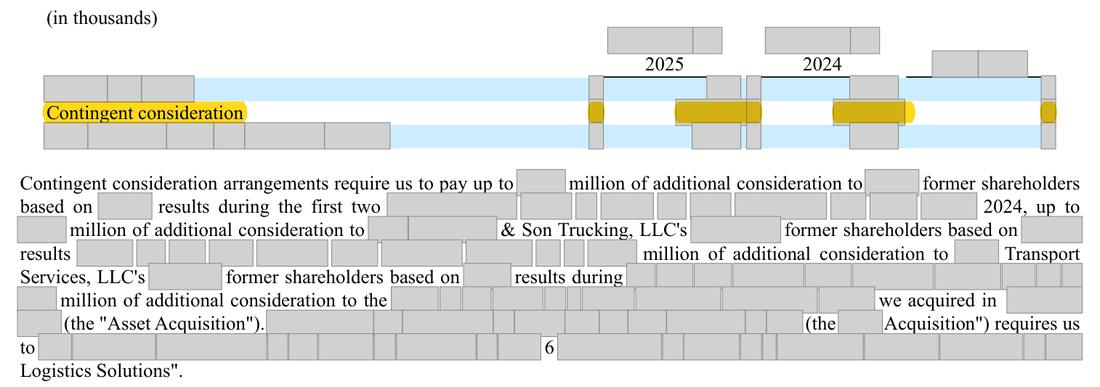
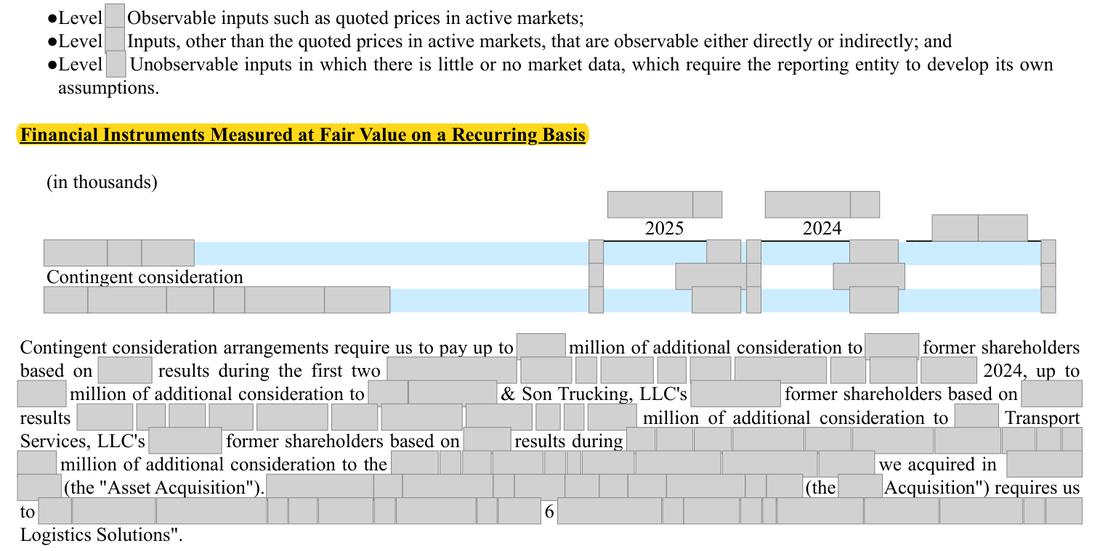
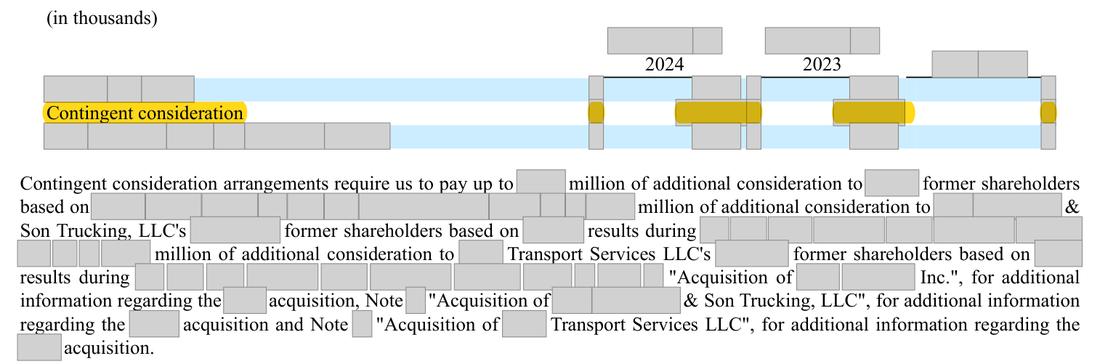
1 further page extract: screenshot withheld to protect the company’s identity. The rows below say what each shows.
What the filing shows, and what the rule requires
| What the filing shows | What the rule requires |
|---|---|
Note 3 table: contingent consideration ([n]) at input level 3; Notes 6-8: valued with a probability-weighted model on significant inputs not observable in the market. No input, range, weighted average or sensitivity narrative anywhere in the 10-K. | For the recurring Level 3 liability: each significant unobservable input (for example projected earnings before interest, taxes, depreciation and amortization (EBITDA) of the acquired business, probability of reaching the earn-out targets, discount rate) with its range and weighted average, and a narrative of how a reasonably possible change in those inputs would change the fair value. |
The rule
FASB ASC 820-10-50-2(bbb) and 820-10-50-2(g)
Summary; FASB/IFRS text is copyrighted Disclose fair values by hierarchy level, Level 3 techniques and significant unobservable inputs with ranges and weighted averages, Level 3 changes and measurement uncertainty.
Version: Text in force at the date of this review · Source: FASB Accounting Standards Codification, ASC 820-10-50-2 (as amended by ASU 2018-13); paraphrased summary
Regulation S-X Rule 4-01(a)(1)
Financial statements filed with the Commission which are not prepared in accordance with generally accepted accounting principles will be presumed to be misleading or inaccurate, despite footnote or other disclosures
Version: Text in force at the date of this review · Source: Regulation S-X, 17 CFR 210.4-01(a)(1), eCFR
Why it applies here. The hierarchy level, technique and rollforward are given; the inputs (such as projected earnings before interest, taxes, depreciation and amortization (EBITDA), probability of reaching targets and discount rate) and the sensitivity narrative are not. The fiscal 2024 Form 10-K had the same gap.
Why it matters
- Readers cannot judge how far the liability, and the general supplies and expenses line that absorbs its changes, could move.
- The SEC staff would be likely to ask for the inputs and an undertaking to add them in future filings.
Exposure
No fixed penalty; the realistic consequence is a staff comment letter and an undertaking to add the inputs in future filings.
Our workings
Note 3 presents contingent consideration of ([n]) at [date] and ([n]) at [date] at input level 3 (unnumbered page) and a rollforward in which the 2025 row charges ([n]) of fair value change. The acquisition notes say the earn-outs were valued 'using a probability-weighted model' on 'significant inputs not observable in the market' (unnumbered page). The Form 10-Q for the quarter ended [date] states that the significant unobservable inputs are the financial projections over the earn-out period, the volatility of the underlying financial metrics and estimated discount rates; that sentence is not in the 10-K.
the 2025 rollforward foots (see workings), so the omission is of the input disclosure, not of the movement analysis.
under the FASB Accounting Standards Codification (ASC), the fair value disclosure paragraph 820-10-50-2 is built in layers - (b) the hierarchy level, (bb) the technique and inputs for Level 2 and 3, (bbb) quantitative information about the significant unobservable inputs for every Level 3 measurement, (c) the Level 3 rollforward, and (g) for recurring Level 3 measurements of a public business entity a narrative of the uncertainty arising from those inputs. The company gives (b), the technique and (c), but not (bbb) or (g). The only carve-out in (bbb) - inputs not developed by the entity, such as unadjusted third-party prices - does not apply, because the earn-out inputs are the company's own projections of the acquired businesses. Amended by Accounting Standards Update (ASU) 2018-13, the paragraph lets an entity give another reasonable quantitative measure in place of a weighted average, but not omit the inputs.
| Item | Arithmetic (USD thousand) |
|---|---|
| 2025 rollforward of the Level 3 liability | -[n] - [n] - [n] + [n] = -[n] |
| Closing Level 3 liability in Note 3 table | [n] (agrees to rollforward) |
Management’s best defense, and our reply
The note already gives the technique, the maximum payable under each arrangement and a full Level 3 rollforward, which together tell readers the bounds of the exposure; the underlying EBITDA projections of acquired businesses are commercially sensitive. The staff reviewed the prior-year Form 10-K, which had the same presentation, and closed its review on [date] without raising the point, and the auditor accepted it. The answer: ASC 820-10-50-2(bbb) has no exception for commercial sensitivity and can be met with ranges of probabilities and discount rates that reveal no forecast; the maximum payable is a contractual cap, not an input. The company already prints the qualitative list of inputs in its Forms 10-Q, so it evidently treats the information as disclosable, and the staff's closing letter states that the company remains responsible for the adequacy of its disclosures notwithstanding any absence of comment.
The fix
- After the recurring fair value table add: 'Contingent consideration (Level 3) is valued with a probability-weighted model. Significant unobservable inputs at [date]: projected EBITDA of the acquired businesses; probability of achieving the earn-out targets (range x%-y%, weighted average z%); discount rate (range a%-b%). Higher projected EBITDA or probability, or a lower discount rate, would increase the liability.'
Note 3, after the recurring fair value table, page 66
Also: followed by the inputs at [date], with ranges and weighted averages
Evidence relied on
| # | What it shows | Type | Where |
|---|---|---|---|
| 1 | The earn-out liability is a Level 3 recurring fair value measurement at both year ends | Document | Form 10-K 2025, unnumbered page |
| 2 | 2025 rollforward: fair value change of [n] charged in the year | Document | Form 10-K 2025, page 66 |
| 3 | The acquisition notes describe only the technique and the Level 3 label, not the inputs | Document | Form 10-K 2025, unnumbered page |
| 4 | Form 10-Q for the quarter ended [date] (filed [date]) names the inputs; the annual note does not | Document | |
| 5 | At [date] the earn-out liability of [n] (thousand) was a recurring Level 3 measurement in the prior-year Note 3 table. | Document | Form 10-K 2024 (prior year), unnumbered page |
| 6 | The 2024 roll-forward charged [n] of fair value change to earnings, so the unobservable inputs drove a material amount of 2024 operating expense. | Document | Form 10-K 2024 (prior year), page 66 |
Absence check
- Document
- Form 10-K 2025
- Where it would appear
- Financial Instruments Measured at Fair Value on a Recurring Basis
- What is missing
- Quantitative information about the significant unobservable inputs of the Level 3 earn-out liability (ranges and weighted averages) and a narrative of how changes in those inputs would change its fair value
- Pages looked at
- p.103-66 (accounting policies, Note 3), p.118-68 (Notes 6-8), unnumbered page (critical accounting estimates)
- Result
- 'unobservable' hits p.107 and [n] only for the interest rate swap credit-spread input and the hierarchy definitions; 'discount rate' hits unnumbered page only for lease discount rates; 'probability-weighted' hits p.118-120, naming the technique without any input; 'sensitiv' hits p.3, [n] on unrelated subjects (customers, drug testing, systems, interest-rate and fuel sensitivity); 'earn-out period' and 'financial projections' have no hits.
Absence check
- Document
- Form 10-K 2024 (prior year)
- Where it would appear
- Financial Instruments Measured at Fair Value on a Recurring Basis
- What is missing
- the significant unobservable inputs of the Level 3 earn-out liability with their range and weighted average, and a narrative of the sensitivity of the fair value to changes in them
- Pages looked at
- Form 10-K 2024 (prior year) unnumbered page (fair value policy), 111-112 (Note 3), 116-118 (acquisition notes), 66-70 (MD&A and critical accounting estimates)
- Result
- 'unobservable' hits p.105 and [n] only for the swap counterparty credit-spread inputs and the generic Level 3 definition; 'discount rate' hits only the lease note; 'probability' hits p.63 (share-award policy) and p.67-118, which name a probability-weighted model with no inputs; 'sensitiv' hits only business descriptions, risk factors and the fuel sensitivity (p.3, [n]); 'financial projections' has no hit.
Prepared by Pramanex from the company’s public SEC filings, without the company’s involvement, to show how a 10-K Pre-filing Check reads. The company is not named, and nothing on this page is a statement about any identifiable company. Observations are not an audit, review or other attestation or assurance engagement, and not legal advice. An SEC-style question is a question, not a conclusion.
Want this on your own 10-K, before you file?
Start with three free findings on your latest 10-K, or book a fixed-price 10-K Pre-filing Check.
Your next 10-K will be in draft before the audit is done.
Have it read before you file.
Start with three free findings on your latest 10-K, or book a fixed-price 10-K check. Drafts only under NDA, inside your insider trading policy.