7.10 Fiscal 2024 dividend-per-share labels are transposed between Common Stock and Class B Common Stock
Company A · a US-listed consumer leisure company · Drafting slip
In brief
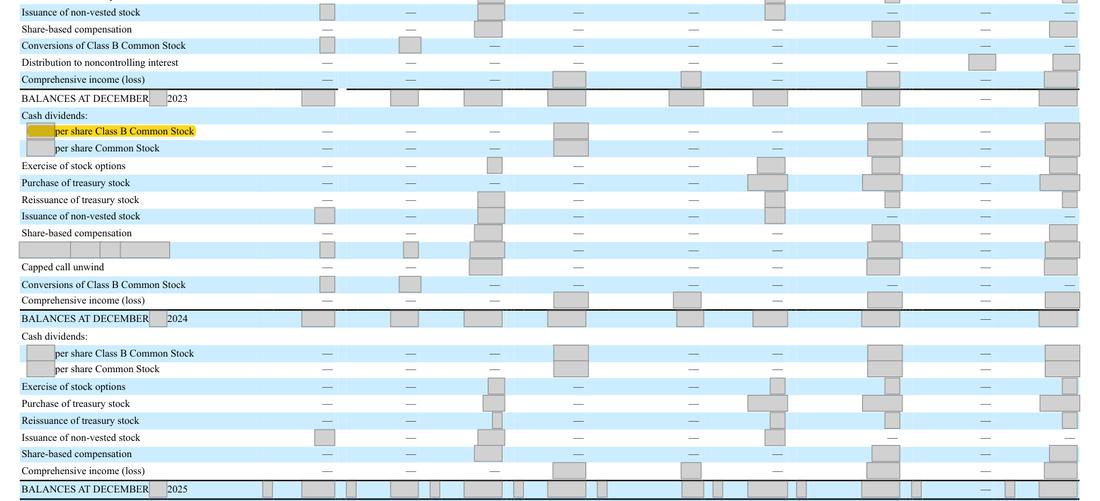
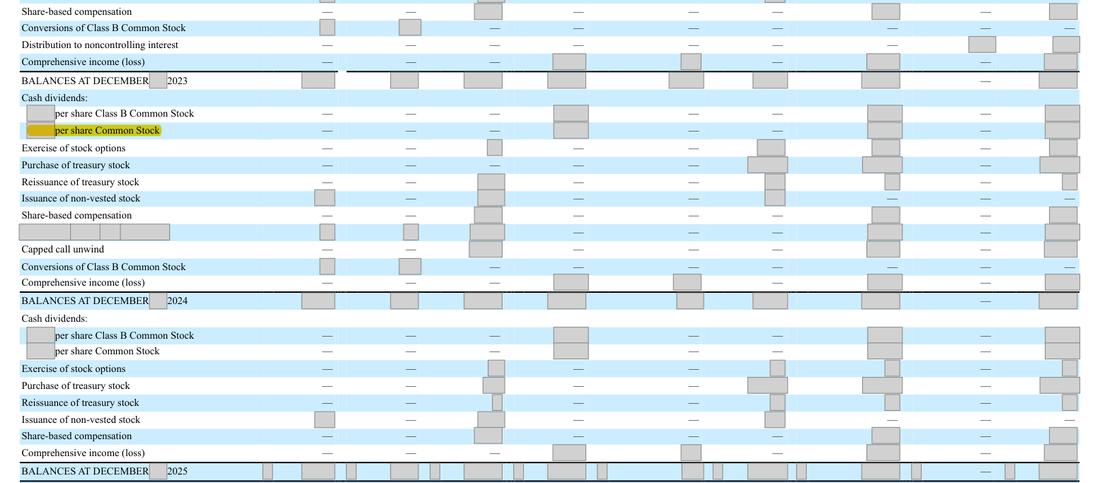
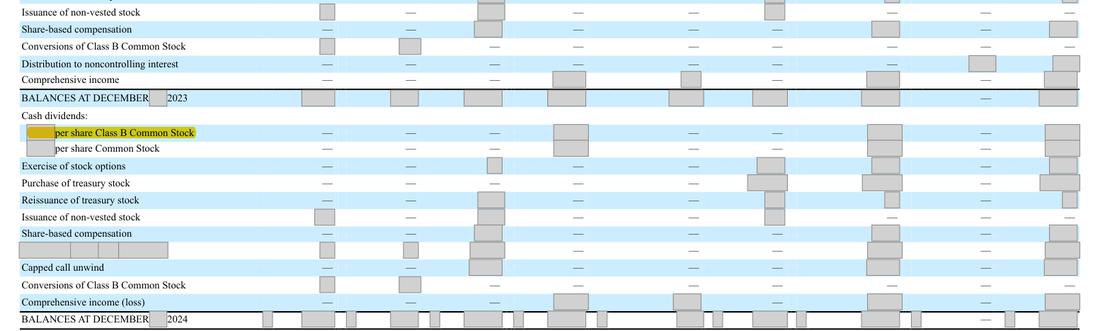
The fiscal 2024 dividend rows of the statement of shareholders' equity print '[amount] per share Class B Common Stock' and '[amount] per share Common Stock'. Common Stock is entitled to [n]% of the dividend paid on each Class B share, and the regular quarterly Common dividend in fiscal 2024 was [amount], so the higher figure belongs to Common Stock: the two labels are swapped. The dollar amounts are unaffected, and the same rows were printed in the prior-year Form 10-K.
The evidence, as filed
What the filing shows, and what the rule requires
| What the filing shows | What the rule requires |
|---|---|
Fiscal 2024 rows: '[amount] per share Class B Common Stock' and '[amount] per share Common Stock' (the fiscal 2025 rows correctly show Common [amount] above Class B [amount]) | Fiscal 2024 rows labelled with the higher per-share figure ([amount]) against Common Stock and the lower figure against Class B Common Stock |
The rule
Regulation S-X Rule 3-04 (changes in stockholders' equity)
With respect to any dividends, state the amount per share and in the aggregate for each class of shares.
Version: In force from [date] · Source: 17 CFR 210.3-04, as amended by Release 33-10532
Why it applies here. a Class B per-share dividend above the Common per-share dividend is impossible under the charter ratio, so the labels are transposed; the fiscal 2023 and fiscal 2025 rows are in the right order.
Why it matters
A reader computing the per-share dividend of each class from the statement gets the classes reversed for fiscal 2024; no amount, total or per-share earnings figure is affected.
Exposure
Presentation slip; no amount affected.
Our workings
the equity statement gives dividends per share by class for each year, and the fiscal 2024 rows attach [amount] to Class B and [amount] to Common Stock.
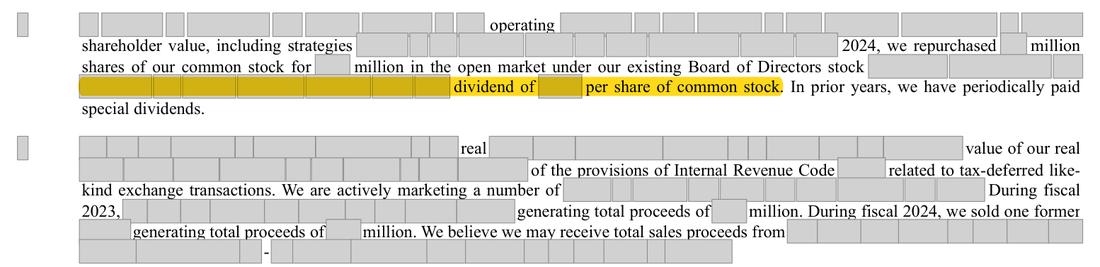
Note 7 states that Common Stock receives [n]% of each Class B dividend, and the prior-year Form 10-K describes the regular quarterly Common dividend as [amount] per share.
Management’s best defense, and our reply
Management would say the aggregate dividends by class are correct and agree to the cash flow statement, and that the per-share labels are a clerical point carried over from the prior-year statement that no investor relies on. The answer: that is why the point is only a drafting slip, but Rule 3-04 asks for the per-share amount for each class, and as printed the Class B figure exceeds the Common figure, which the charter ratio does not allow.
The fix
- In the next Form 10-K relabel the fiscal 2024 rows as '[amount] per share Common Stock' and the Class B figure as declared (the lower amount), after agreeing both to the dividend declarations.
Evidence relied on
| # | What it shows | Type | Where |
|---|---|---|---|
| 1 | Fiscal 2024 row attaches [amount] per share to Class B Common Stock | Document | Form 10-K 2025, page 57 |
| 2 | Fiscal 2024 row attaches [amount] per share to Common Stock | Document | Form 10-K 2025, page 57 |
| 3 | Fiscal 2025 row: Class B Common Stock at [amount] per share | Document | Form 10-K 2025, page 57 |
| 4 | Fiscal 2025 row: Common Stock at [amount], above Class B, the order the charter ratio requires | Document | Form 10-K 2025, page 57 |
| 5 | Charter ratio: Common Stock receives [n]% of the Class B dividend | Document | Form 10-K 2025, page 72 |
| 6 | Fiscal 2024 regular quarterly Common dividend of [amount] (prior-year Form 10-K) | Document | Form 10-K 2024 (prior year), page 30 |
Prepared by Pramanex from the company’s public SEC filings, without the company’s involvement, to show how a 10-K Pre-filing Check reads. The company is not named, and nothing on this page is a statement about any identifiable company. Observations are not an audit, review or other attestation or assurance engagement, and not legal advice. An SEC-style question is a question, not a conclusion.
Want this on your own 10-K, before you file?
Start with three free findings on your latest 10-K, or book a fixed-price 10-K Pre-filing Check.
Your next 10-K will be in draft before the audit is done.
Have it read before you file.
Start with three free findings on your latest 10-K, or book a fixed-price 10-K check. Drafts only under NDA, inside your insider trading policy.