7.05 MD&A wording slips: [unit revenue metric] defined as total revenue per room, and fiscal 2024 impairment counted as three operating venues in one place and four elsewhere
Company A · a US-listed consumer leisure company · Drafting slip
In brief
The lodging property statistics define [unit revenue metric] as 'total revenue per available unit', but the figures shown are unit revenue (occupancy times average daily rate). Footnote (3) to the Adjusted EBITDA reconciliation says the fiscal 2024 impairment related to three operating venues, while the results discussion and the critical accounting estimate say four. Both slips also appear in the prior-year 10-K.
The evidence, as filed
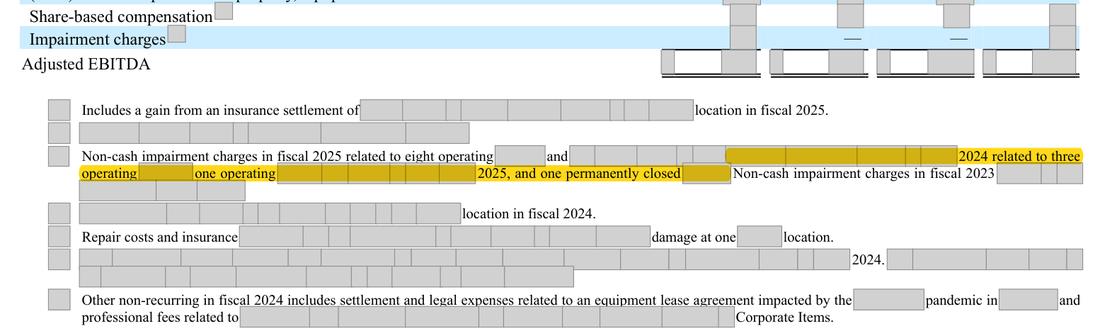
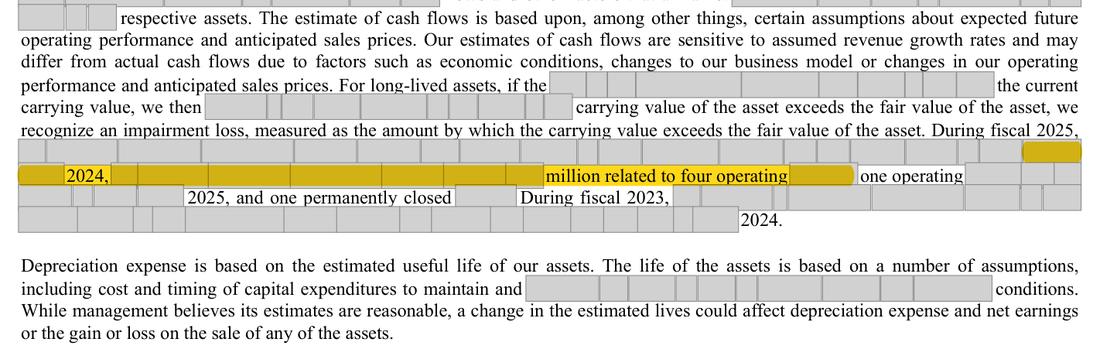
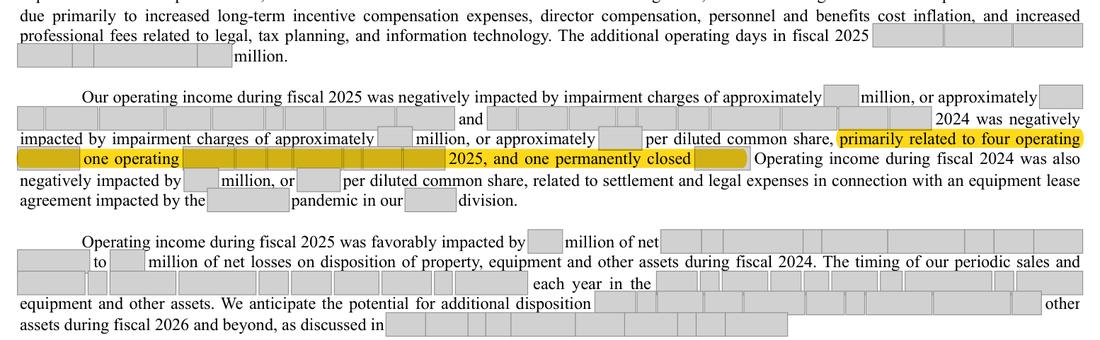
3 further page extracts: screenshot withheld to protect the company’s identity. The rows below say what each shows.
What the filing shows, and what the rule requires
| What the filing shows | What the rule requires |
|---|---|
'our total revenue per available unit (“[unit revenue metric]”)'; footnote (3): 'three operating venues' against 'four operating venues' on printed pages 32, 35 and 48. | 'room revenue per available unit ([unit revenue metric])', and one consistent count of the operating venues impaired in fiscal 2024. |
Why it matters
Cosmetic; a reader comparing [unit revenue metric] with peers' total revenue per available unit could be misled.
Exposure
Drafting only.
Our workings
The [unit revenue metric] shown for each year equals the occupancy percentage multiplied by the average daily rate on the same table, which is unit revenue; total revenue per available unit would also include food and beverage and other revenue. The fiscal 2024 impairment count differs between footnote (3) on p.41 and three other places in the same MD&A.
Management’s best defense, and our reply
[unit revenue metric] is a standard industry term that lodging property readers understand as unit revenue, and the impairment amount is the same in every place. The slips change no figure; they are corrected simply by aligning the words.
The fix
- Change the definition to 'room revenue per available unit ([unit revenue metric])' and align footnote (3) with the count used elsewhere (or correct the other three places if three is right).
Evidence relied on
| # | What it shows | Type | Where |
|---|---|---|---|
| 1 | Slip 1: [unit revenue metric] is defined as total revenue per available unit | Document | Form 10-K 2025, page 38 |
| 2 | The [unit revenue metric] figures equal occupancy times [rate metric] on the same table, i.e. Unit revenue | Document | Form 10-K 2025, page 38 |
| 3 | Slip 2: footnote (3) counts three operating venues for fiscal 2024 | Document | Form 10-K 2025, page 41 |
| 4 | The critical accounting estimate counts four operating venues for the same charge | Document | Form 10-K 2025, page 48 |
| 5 | The results discussion also counts four | Document | Form 10-K 2025, page 32 |
Prepared by Pramanex from the company’s public SEC filings, without the company’s involvement, to show how a 10-K Pre-filing Check reads. The company is not named, and nothing on this page is a statement about any identifiable company. Observations are not an audit, review or other attestation or assurance engagement, and not legal advice. An SEC-style question is a question, not a conclusion.
Want this on your own 10-K, before you file?
Start with three free findings on your latest 10-K, or book a fixed-price 10-K Pre-filing Check.
Your next 10-K will be in draft before the audit is done.
Have it read before you file.
Start with three free findings on your latest 10-K, or book a fixed-price 10-K check. Drafts only under NDA, inside your insider trading policy.