7.02 Five wording slips in Notes 1, 2, 5 and 7
Company A · a US-listed consumer leisure company · Drafting slip
In brief
Five small slips in the notes: 'shared outstanding' for shares outstanding in the earnings per share note; 'performance of obligations' for performance obligations in the revenue note; a covenant ratio printed as [n]:1:[n] (printed the same way in the MD&A); the capped call increase printed as 'a [n] increase' without the dollar sign the prior-year note carried; and a sentence on performance stock units that ends in a comma.
The evidence, as filed

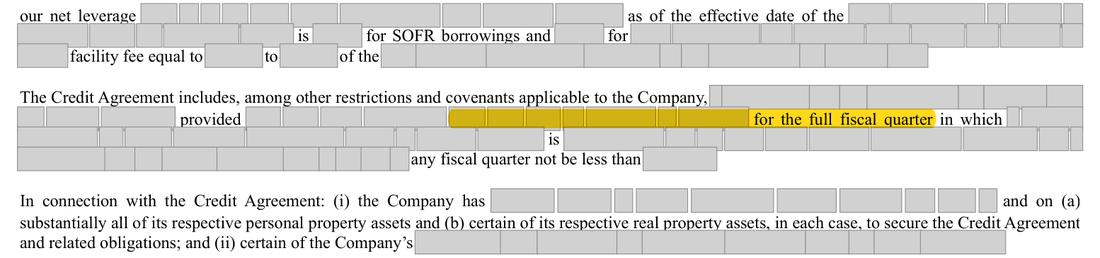
2 further page extracts: screenshot withheld to protect the company’s identity. The rows below say what each shows.
What the filing shows, and what the rule requires
| What the filing shows | What the rule requires |
|---|---|
'diluted weighted-average shared outstanding'; 'satisfies its performance of obligations'; '[n]:1:[n]'; 'a [n] increase'; 'based on current information,' ending the paragraph. | 'diluted weighted-average shares outstanding'; 'satisfies its performance obligations'; '[n]:[n]'; 'a [amount] increase'; 'based on current information.' |
Why it matters
Cosmetic only; a reader-facing filing should be free of such slips.
Exposure
None.
Our workings
Each slip is in reader-facing note text and changes no figure. They are grouped as one drafting point for correction before filing.
Management’s best defense, and our reply
The company would say none of these slips changes a figure, a policy or a conclusion, and that readers will read the intended meaning. That is right, which is why they are listed only as drafting slips to correct before filing.
The fix
- Correct the five phrases as shown in the should-be column.
Evidence relied on
| # | What it shows | Type | Where |
|---|---|---|---|
| 1 | 'shared outstanding' should read 'shares outstanding' | Document | Form 10-K 2025, page 63 |
| 2 | 'performance of obligations' should read 'performance obligations' | Document | Form 10-K 2025, page 64 |
| 3 | The ratio should read [n]:[n] | Document | Form 10-K 2025, page 69 |
| 4 | The dollar sign is missing before [n] | Document | Form 10-K 2025, page 70 |
| 5 | The prior-year note printed the dollar sign | Document | Form 10-K 2024 (prior year), page 70 |
| 6 | The sentence ends with a comma before the table | Document | Form 10-K 2025, page 75 |
Prepared by Pramanex from the company’s public SEC filings, without the company’s involvement, to show how a 10-K Pre-filing Check reads. The company is not named, and nothing on this page is a statement about any identifiable company. Observations are not an audit, review or other attestation or assurance engagement, and not legal advice. An SEC-style question is a question, not a conclusion.
Want this on your own 10-K, before you file?
Start with three free findings on your latest 10-K, or book a fixed-price 10-K Pre-filing Check.
Your next 10-K will be in draft before the audit is done.
Have it read before you file.
Start with three free findings on your latest 10-K, or book a fixed-price 10-K check. Drafts only under NDA, inside your insider trading policy.