1.08 In the first year of the new rate reconciliation, 'Other adjustments' exceeds the 5% itemisation threshold in fiscal 2025 and in the recast fiscal 2024 column
Company A · a US-listed consumer leisure company · SEC-style question
In brief
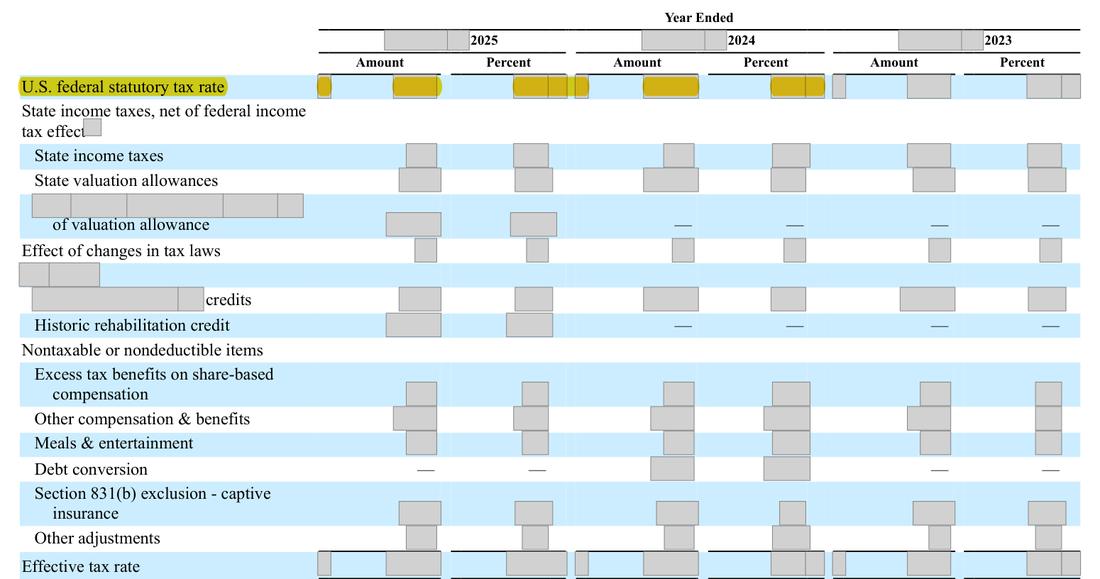
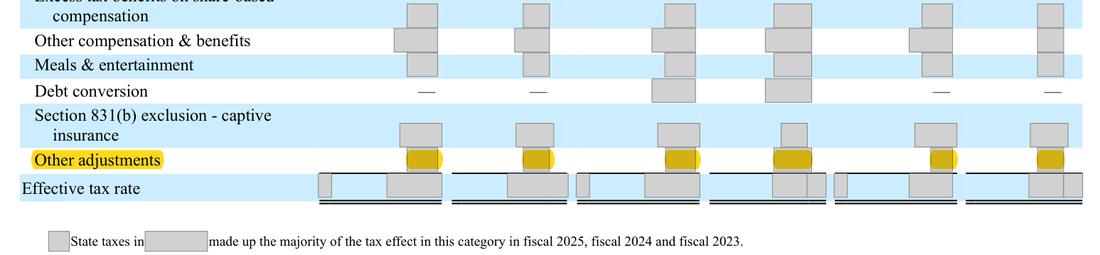
The company adopted the new income-tax disclosure standard this year and recast the prior years. Its rate reconciliation ends with 'Other adjustments' of [amount] in fiscal 2025 and [amount] in fiscal 2024, while 5% of the tax at the statutory rate is about [amounts]. If the line holds any single item of that size, the standard requires it to be shown separately by nature; the note does not say what the line contains.
The evidence, as filed
What the filing shows, and what the rule requires
| What the filing shows | What the rule requires |
|---|---|
'Other adjustments' [n] ([n]%) in fiscal 2025 and [n] (([n])%) in fiscal 2024, with no description, against 5% thresholds of [n] and [n]. | Any reconciling item equal to or above 5% of the statutory-rate tax shown separately by nature, or a statement that the remaining line is made up of items each below the threshold. |
| What we checked. Note 9 rate reconciliation (three years, image), the adoption paragraph in Note 1, and the tax narrative on p.81 and [n]. | |
The rule
FASB ASC 740-10-50-12A to 50-12B (rate reconciliation categories and the 5% threshold, as amended by ASU 2023-09)
Summary; FASB/IFRS text is copyrighted PBEs disclose annually a tabular rate reconciliation in percentages and amounts with specified categories, separately itemising qualifying reconciling items, and explaining state and local effects.
Version: Text in force at the date of this review · Source: FASB Accounting Standards Codification, ASC 740-10-50-12A to 50-12C (as amended by ASU 2023-09), paraphrased
Why it applies here. under Accounting Standards Codification (ASC) paragraphs 740-10-50-12A to 50-12B, as amended in 2023, a public business entity must show separately, by nature, any reconciling item at or above 5% of the statutory-rate amount, whether inside a specified category or outside them. Items individually below 5% may be combined, so an 'other' line above the threshold is not by itself a breach; but in fiscal 2024 the line is almost four times the threshold and the note gives no description of its make-up. The point is a question because only management knows the composition.
Why it matters
If the line contains an item at or above the threshold, the first-year adoption of the new disclosure is incomplete; the effect on tax expense is nil.
Exposure
None until the composition is known; if an item reaches the threshold, a staff comment answered by future-filing disaggregation.
Our workings
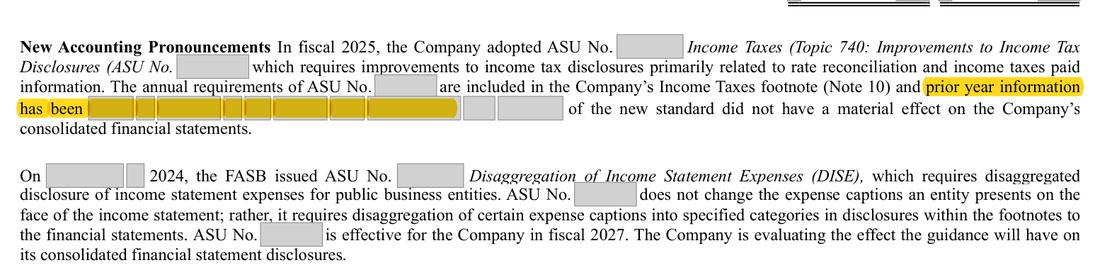
Note 1 says the company adopted the new income-tax disclosure update in fiscal 2025 and recast prior-year information. The rate reconciliation on the income-tax note shows statutory tax of [amount] for fiscal 2025 and [amount] for fiscal 2024, and a closing line 'Other adjustments' of [amounts] with no explanation.
5% of the statutory-rate tax is [n] ([n] x 5%) and [n] ([n] x 5%); the line is [n] and [n] times those thresholds.
| Measure | Fiscal 2025 | Fiscal 2024 |
|---|---|---|
| 5% threshold | [n] x 5% = [n] | [n] x 5% = [n] |
| Other adjustments against threshold | [n] / [n] = [n] | [n] / [n] = [n] |
Management’s best defense, and our reply
Management can argue that the line is a residual of several unrelated items, each below 5% of the statutory-rate tax, and that the standard expressly allows such items to be combined. It can add that the fiscal 2024 threshold is small because the pre-tax figure was a modest loss, so the line looks large against it. That reading is tenable, which is why this is a question: the note does not say what the line holds, and only management can confirm that no single item reaches the threshold.
The fix
- Either itemise any component at or above 5% by nature, or add: 'Other adjustments comprise items that are each below 5% of the tax computed at the statutory rate.'
Question for the company
What items make up 'Other adjustments' of [amount] (fiscal 2025) and [amount] (fiscal 2024), and does any single item equal or exceed 5% of the tax at the statutory rate?
Evidence relied on
| # | What it shows | Type | Where |
|---|---|---|---|
| 1 | Adoption of the new income-tax disclosures with recast prior years | Document | Form 10-K 2025, page 64 |
| 2 | Tax at the statutory rate, the base of the 5% threshold | Document | Form 10-K 2025, unnumbered page |
| 3 | The unexplained closing line, above the threshold in fiscal 2025 and 2024 | Document | Form 10-K 2025, unnumbered page |
Prepared by Pramanex from the company’s public SEC filings, without the company’s involvement, to show how a 10-K Pre-filing Check reads. The company is not named, and nothing on this page is a statement about any identifiable company. Observations are not an audit, review or other attestation or assurance engagement, and not legal advice. An SEC-style question is a question, not a conclusion.
Want this on your own 10-K, before you file?
Start with three free findings on your latest 10-K, or book a fixed-price 10-K Pre-filing Check.
Your next 10-K will be in draft before the audit is done.
Have it read before you file.
Start with three free findings on your latest 10-K, or book a fixed-price 10-K check. Drafts only under NDA, inside your insider trading policy.