4.05 Head office costs rose by [amount] (75%) and account for almost all of the fall in the adjusted operating margin, but the finance review attributes flat profit to the businesses' costs and does not mention them
UK Company C · an AIM-quoted scientific instruments group · Regulator-style question
In brief
The finance review says [wording masked] [amount] mainly because the Group's businesses invested for growth, which cut the adjusted operating margin from [n]% to [n]%. The segment note shows the two trading segments' adjusted operating profit up from [amount] to [amount], with a margin of [n]% against [n]%, while head office costs rose from [amount] to [amount]. The rise in head office costs, with head office staff unchanged at [n], is about 30% of statutory profit before tax and is not discussed anywhere in the strategic report.
The evidence, as filed
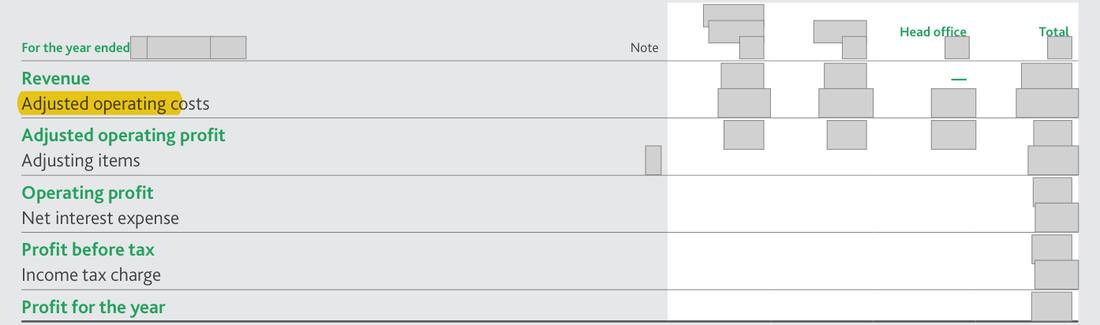
Annual Report 2024, page 75 · Prior year: In 2024 head office costs were [amount] and the 2024 report gave no separate commentary on them; the issue arises in 2025 because of the increase.
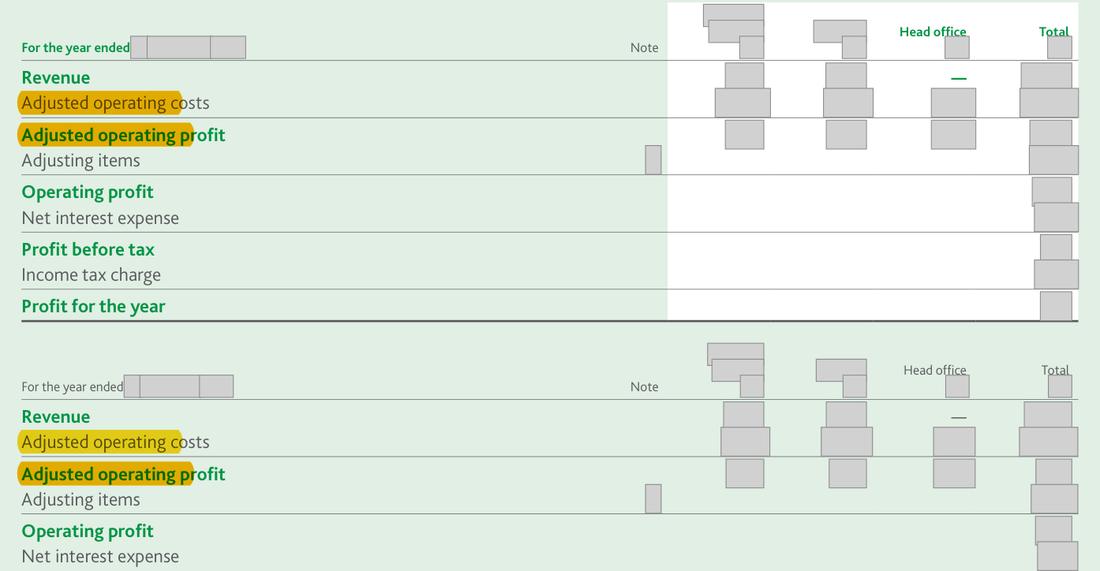
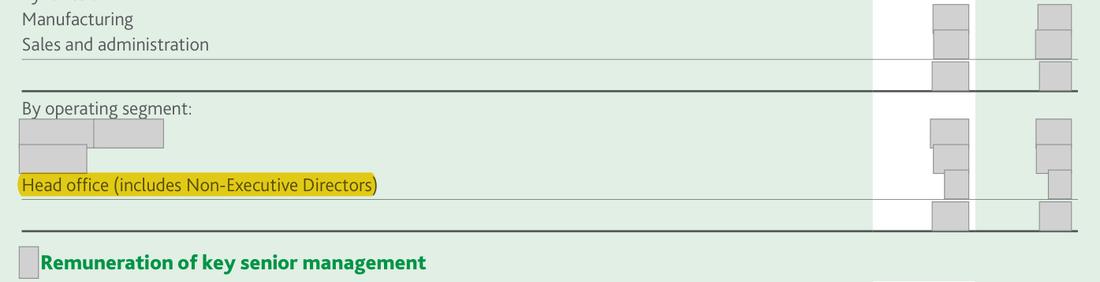
Further pages withheld to protect the company’s identity (one): Annual Report 2025, page 19. Their wording or layout could lead back to the company even with names and figures masked; the evidence list below records what each page shows.
Names, figures, dates, logos and any wording that could be searched back to the company are boxed out in grey; the point is highlighted in yellow.
What the report shows, and what the rule requires
| What the annual report shows | What the rule requires |
|---|---|
| What the annual report shows Finance review: flat profit and lower margin attributed to the businesses' costs; segment note: trading segments +[n], head office costs ([n]) to ([n]), £ million; no explanation of head office costs | What the rule requires A balanced review that names the increase in head office costs, explains what drove it (and whether it recurs), and attributes the margin fall accordingly |
The rule
Companies Act 2006 s.414C(3)
Version relied on: Companies Act 2006, revised text on legislation.gov.uk as in force for the financial year reviewed
The review required is a balanced and comprehensive analysis of
Companies Act 2006 s.414C(12)
Version relied on: Companies Act 2006, revised text on legislation.gov.uk as in force for the financial year reviewed
The report must, where appropriate, include references to, and additional explanations of, amounts included in the company’s annual accounts.
Why it applies here: the review's explanation leaves out the main driver of the flat profit and the margin fall.
Why it matters
A reader is told the businesses' cost growth explains the flat result and margin fall, when on the segment figures the trading businesses' profit rose and the increase in head office costs explains the margin fall; whether those costs recur matters for the 2026 guidance.
Exposure
A question for the Board on the balance of the review; no sanction attaches.
Our workings
the finance review says [wording masked] [amount] (2024: [amount]), primarily as [wording masked] acted [wording masked], deflating the adjusted operating margin to [n]% (2024: [n]%). Note 3 gives adjusted operating profit of [n] for [segment] and [n] for [segment] (2024: [n] and [n]) and head office adjusted operating costs of [n] (2024: [n]), in £ million; note 6 shows [n] head office employees, including Non-Executive Directors, in both years.
the trading segments' profit rose by [n] while head office costs rose by [n], or 75%; the segments' margin was [n]% against [n]%, and head office costs took [n]% of revenue against 3%, so almost all of the fall in the adjusted operating margin comes from head office.
The rise may reflect chief executive succession, new Group executives or one-off costs, but the report does not say, and a reader cannot tell whether it will recur.
| Measure (£ million unless stated) | 2025 | 2024 | Working |
|---|---|---|---|
| Trading segments' adjusted operating profit | [n] | [n] | [n] + [n] = [n]; [n] + [n] = [n]; change [n] - [n] = [n] |
| Head office adjusted operating costs | [n] | [n] | [n] - [n] = [n]; [n] / [n] = 75% |
| Trading segments' margin | [n]% | [n]% | [n] / [n] = [n]%; [n] / [n] = [n]% |
| Head office costs as % of revenue | [n]% | 3% | [n] / [n] = [n]%; [n] / [n] = 3% |
| Head office increase against profit before tax | 30% | [n] / [n] = 30% |
Management’s best defence, and our reply
The company could say the finance review is right that the businesses' costs grew almost as fast as revenue, absorbing most of the revenue increase, and that the Chief Executive's report gives the margin before central costs. It could add that head office costs in 2025 included the strengthened executive team announced in the report, which readers can infer. However, the segment note shows the trading businesses' profit rose by [amount] and their margin held, so the flat result is explained by head office, and neither the amount nor the drivers of that increase appear anywhere in the review. Because the cause may be disclosed in other investor material and the split of one-off costs is not public, the point is put as a question.
The fix
- Add a line on central costs to the finance review: the amount, the drivers of the increase (for example executive changes, succession or acquisition-team costs), the part that is one-off, and the margin before and after central costs.
Question for the company
What drove the increase in head office adjusted operating costs from [amount] to [amount] with unchanged head office headcount, how much of it is expected to recur, and why does the finance review attribute the flat profit and the margin fall to the businesses' costs without mentioning it?
Evidence relied on
| # | What it shows | Type | Where |
|---|---|---|---|
| 1 | The finance review's explanation of flat profit | Document | Annual Report 2025, page 19 |
| 2 | Margin fall | Document | Annual Report 2025, page 19 |
| 3 | 2025 head office adjusted operating costs [n] | Document | Annual Report 2025, page 75 |
| 4 | 2025 segment adjusted operating profit | Document | Annual Report 2025, page 75 |
| 5 | 2024 head office adjusted operating costs [n] | Document | Annual Report 2025, page 75 |
| 6 | 2024 segment adjusted operating profit | Document | Annual Report 2025, page 75 |
| 7 | 2025 revenue | Document | Annual Report 2025, page 75 |
| 8 | 2024 revenue | Document | Annual Report 2025, page 75 |
| 9 | Statutory profit before tax | Document | Annual Report 2025, page 75 |
| 10 | Head office headcount unchanged | Document | Annual Report 2025, page 78 |
Absence check
- Document
- Annual Report 2025
- Where it would appear
- Profits
- What is missing
- any explanation of the increase in head office costs from [amount] to [amount]
- Pages looked at
- p.12-21 (Chair, Chief Executive and finance reviews, images)
- Result
- 'head office' hits p.47 (Board meetings held at head office), [n] (auditor's site visits), 77-78 (segment note tables, the source of the figures), [n] (employee numbers) and [n] (registered addresses), none an explanation; 'central cost' hits p.15 and [n], where the margin and return measures are stated before central costs, and p.99 (glossary definition), none explaining the increase; 'group costs' and 'plc costs' do not hit.
Prepared by Pramanex from the company’s published annual reports, without the company’s involvement, to show how an annual report review reads. The company is not named, and nothing on this page is a statement about any identifiable company. Observations are not an audit, review or other assurance engagement, and not legal advice. A regulator-style question is a question, not a conclusion.
Want this on your own annual report, before it is published?
Start with three free findings on your latest published annual report, or talk to us about a fixed-fee pre-publication review.
Your annual report will be in draft before the year-end audit.
Have it read before it is published.
Under NDA, with our reviewer on your insider list under UK MAR.