1.15 A [n] '[wording masked]' is charged in operating costs as an adjusting item, outside the tax charge
UK Company C · an AIM-quoted scientific instruments group · Regulator-style question
In brief
Note 4 includes a '[wording masked]' of [n] in the adjusting items charged against operating profit, and note 5 includes it in operating costs. The tax note, which has its own line for foreign tax suffered ([n]) and for prior-year adjustments, does not include it, and the adjusting-items policy does not mention tax payments. If the payment is a tax on profits it belongs in the tax charge; if it is another kind of tax or a penalty, the report does not say so.
The evidence, as filed
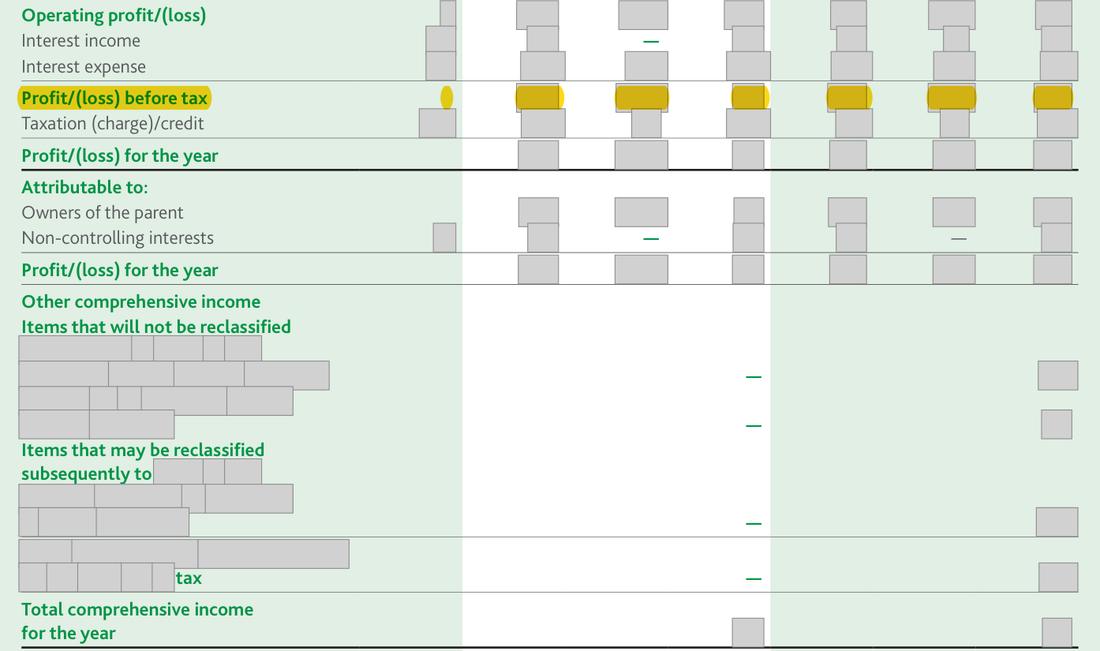
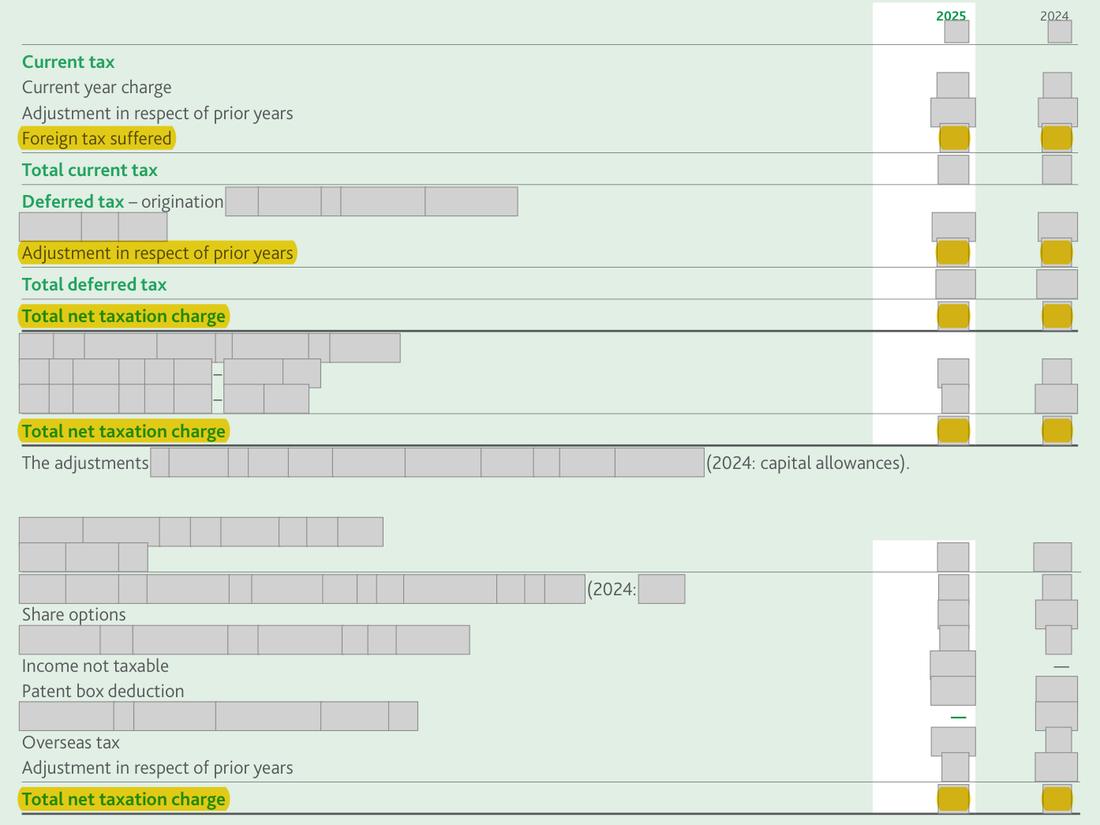
Further pages withheld to protect the company’s identity (two): Annual Report 2025, page 77; Annual Report 2025, page 74. Their wording or layout could lead back to the company even with names and figures masked; the evidence list below records what each page shows.
Names, figures, dates, logos and any wording that could be searched back to the company are boxed out in grey; the point is highlighted in yellow.
What the report shows, and what the rule requires
| What the annual report shows | What the rule requires |
|---|---|
| What the annual report shows [wording masked] [n] within adjusting items in operating profit and in total operating costs; tax note: foreign tax suffered [n], prior-year adjustments ([n]) current and [n] deferred. | What the rule requires Either the payment shown in the tax charge (if it is an income tax), or a description of the tax (for example a sales, payroll or customs tax, or interest and penalties) that explains why it is an operating cost and why it is excluded from adjusted results. |
The rule
IAS 12 Income Taxes, paragraph 2
Version relied on: UK-adopted international accounting standards (UK Endorsement Board), as in force for financial years beginning in or after January 2025
Income taxes cover all domestic and foreign taxes based on taxable profits.
IAS 12, paragraph 77
Version relied on: UK-adopted international accounting standards (UK Endorsement Board), as in force for financial years beginning in or after January 2025
Tax on profit or loss from ordinary activities is presented within profit or loss.
Why it applies here: the report does not say whether the payment is a tax on profits; if it is, both operating profit and the tax charge are misclassified by [n], and treating it as an adjusting item removes it from adjusted earnings per share.
Why it matters
If the payment is an income tax, operating profit is understated and the tax charge and effective tax rate understated by [n]; either way adjusted earnings exclude a tax cost without an explanation that fits the stated policy.
Exposure
A question for management; no regulatory consequence unless the payment proves to be an income tax presented outside the tax charge.
Our workings
note 4 lists '[wording masked]' of [n] (2024: nil) among adjusting items in operating profit; note 5 repeats it within total operating costs. Note 10 analyses the tax charge of [n], including foreign tax suffered of [n] and prior-year adjustments, with no reference to this payment. The adjusting-items policy names amortisation of acquired intangibles, acquisition costs, hedge fair-value movements and share-based payments. IAS 12 treats all domestic and foreign taxes based on taxable profits as income taxes, presented as tax expense.
[n] / [n] = 3% of profit before tax and [n] / [n] = 10% of the tax charge (workings).
| Measure | Figures | Result |
|---|---|---|
| Share of profit before tax | [n] / [n] = 3% | |
| Share of the tax charge | [n] / [n] = 10% | |
| Tax charge if the payment were an income tax | [n] + [n] = [n] | operating profit [n] + [n] = [n] |
Management’s best defence, and our reply
The company may say that the payment is not an income tax but, for example, an overseas indirect or employment tax or a settlement including interest and penalties, which properly sits in operating costs, and that a one-off prior-year charge is reasonably excluded from underlying results. That reading is tenable and may well be right. However, the caption calls it 'foreign taxes', the tax note has a line for foreign tax, and the policy does not mention such items, so only management can say which it is; the point is therefore put as a question.
The fix
- State the nature and jurisdiction of the [n] payment; if it is a tax on profits, present it in the tax charge (and the tax reconciliation); if not, describe it and extend the adjusting-items policy to cover it.
Question for the company
What tax does the [n] '[wording masked]' relate to, in which jurisdiction and for which years; is it a tax based on taxable profits (and so an income tax under IAS 12), or a different tax, interest or penalty; and why is it treated as an adjusting item?
Evidence relied on
| # | What it shows | Type | Where |
|---|---|---|---|
| 1 | Note 4 (and note 5 below it) charge [n] of prior-year foreign taxes in operating costs as an adjusting item | Document | Annual Report 2025, page 77 |
| 2 | The tax note has its own line for foreign tax, which does not include the [n] | Document | Annual Report 2025, page 80 |
| 3 | Deferred tax prior-year adjustment of [n]; current-tax prior-year adjustment is ([n]) | Document | Annual Report 2025, page 80 |
| 4 | Tax charge of [n] used in the comparison | Document | Annual Report 2025, page 80 |
| 5 | The adjusting-items policy describes amortisation, acquisition costs, hedging and share-based payments; it does not mention tax payments | Document | Annual Report 2025, page 74 |
| 6 | Profit before tax of [n] used as the benchmark | Document | Annual Report 2025, page 65 |
Prepared by Pramanex from the company’s published annual reports, without the company’s involvement, to show how an annual report review reads. The company is not named, and nothing on this page is a statement about any identifiable company. Observations are not an audit, review or other assurance engagement, and not legal advice. A regulator-style question is a question, not a conclusion.
Want this on your own annual report, before it is published?
Start with three free findings on your latest published annual report, or talk to us about a fixed-fee pre-publication review.
Your annual report will be in draft before the year-end audit.
Have it read before it is published.
Under NDA, with our reviewer on your insider list under UK MAR.