4.04 The going concern statement describes '[wording masked]' and tests a [n]% fall in orders, while the same report says 2026 orders are already running [n]% below 2025
UK Company C · an AIM-quoted scientific instruments group · Regulator-style question
In brief
The going concern paragraph, carried over almost word for word from the 2024 report, says the Group has [wording masked], and that the Directors planned for a downside of a [n]% fall in orders, the fall seen after Covid-19. Elsewhere the same report says 2026 began with a lower-than-desired order book, that order intake in the first 11 weeks of 2026 was [n]% below 2025, and that 2026 Adjusted earnings per share (EPS) is expected to be [amount] to [amount] against [amount]. The report does not say how the tested downside relates to the trading already seen.
The evidence, as filed
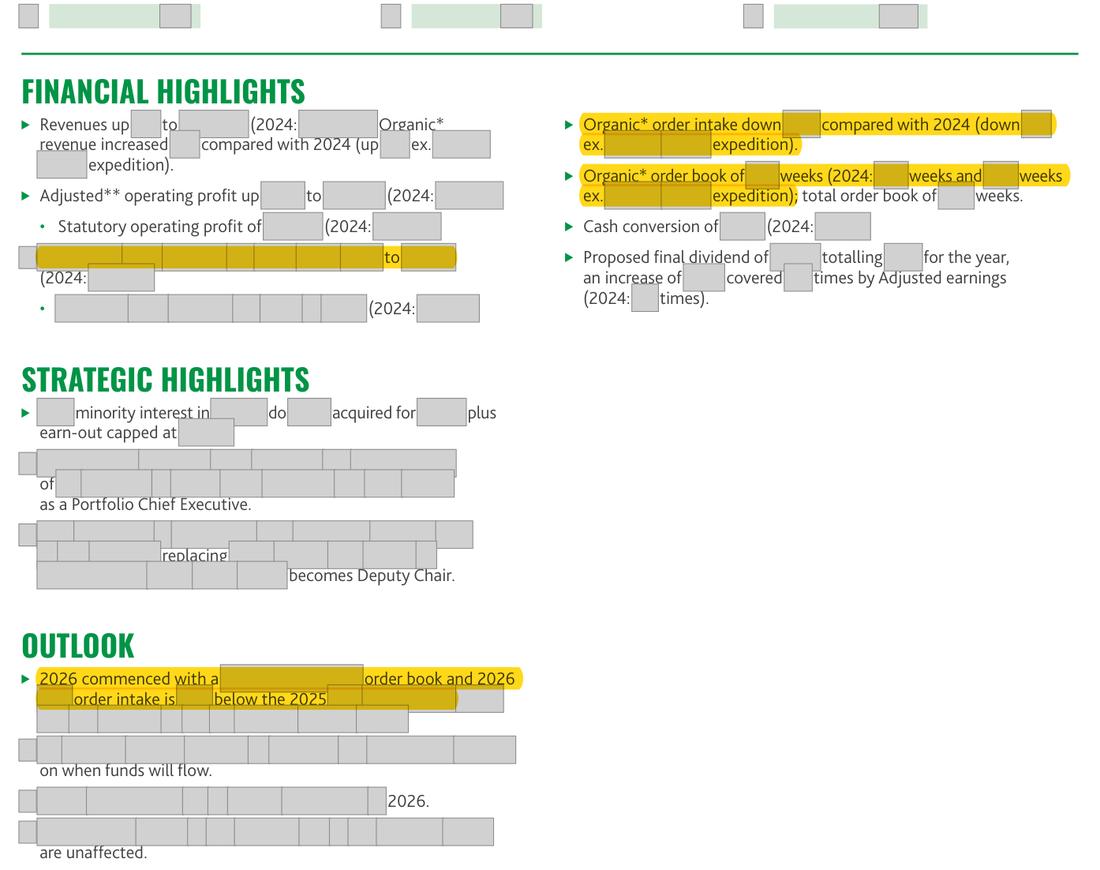
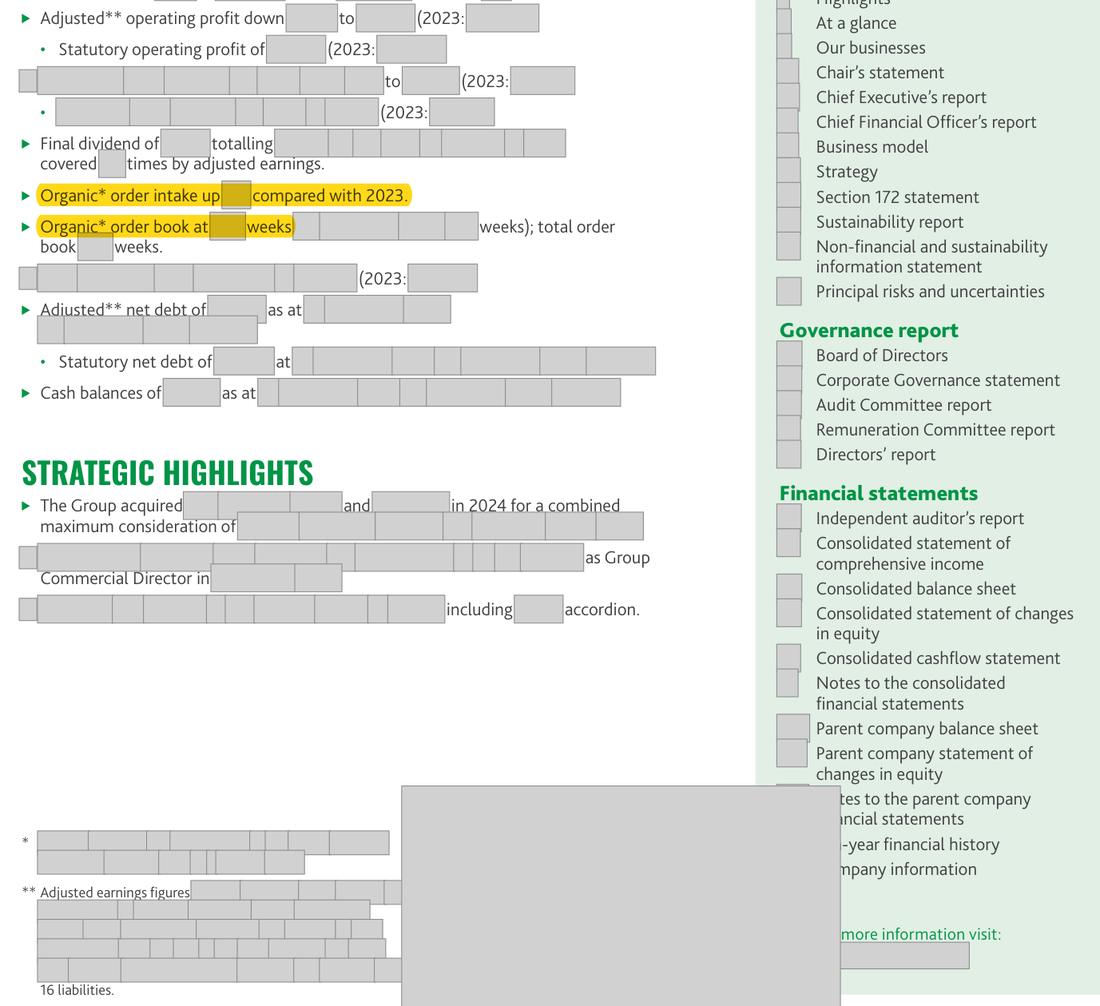
Further pages withheld to protect the company’s identity (five): Annual Report 2025, page 56; Annual Report 2024, page 56; Annual Report 2025, page 16; Annual Report 2025, page 21; Annual Report 2025, page 70. Their wording or layout could lead back to the company even with names and figures masked; the evidence list below records what each page shows.
Names, figures, dates, logos and any wording that could be searched back to the company are boxed out in grey; the point is highlighted in yellow.
What the report shows, and what the rule requires
| What the annual report shows | What the rule requires |
|---|---|
| What the annual report shows Going concern: '[wording masked]'; downside tested: [n]% reduction in orders in 2026; same report: 2026 year-to-date intake [n]% below 2025, lower-than-desired order book of [n] weeks (2024: [n]) | What the rule requires A going concern description consistent with the trading the report describes, saying how the downside scenario compares with year-to-date order intake and what covenant headroom remains in it |
The rule
IAS 1 Presentation of Financial Statements, paragraph 26
Version relied on: UK-adopted international accounting standards (UK Endorsement Board), as in force for financial years beginning in or after January 2025
In assessing going concern, management considers all available information about the future, covering at least twelve months from the year end.
Companies Act 2006 s.414C(3)
Version relied on: Companies Act 2006, revised text on legislation.gov.uk as in force for the financial year reviewed
The review required is a balanced and comprehensive analysis of
Why it applies here: the narrative description of order intake and order book is the one written for 2024, and the downside scenario of a [n]% fall in orders is milder than the [n]% fall the company had already seen when it approved the report.
Why it matters
Readers rely on the going concern description to judge how severe a downturn the Directors have tested; a scenario milder than current trading, described in words carried over from a stronger year, can give false comfort even where the conclusion is right.
Exposure
A question for the Board; no sanction attaches. Going concern disclosures are a recurring Financial Reporting Council (FRC) Corporate Reporting Review focus.
Our workings
the directors' report and note 2 say [wording masked], and that the Directors planned for a repetition of the [n]% reduction in orders seen [wording masked], which would not cause significant challenges; neither the base case nor the downside breaches the covenants (leverage not more than three times, interest cover not less than three times). The 2024 report used the same sentences, when Organic order intake had risen [n]%. The 2025 report says Organic order intake fell 10% in 2025 ([n]% excluding [product]), the year-end Organic order book was [n] weeks against [n], 2026 started with a lower-than-desired order book, intake in the first 11 weeks of 2026 was [n]% below the comparable 2025 period (trailing twelve-month intake excluding [product] was down [n]%), and the Board expects 2026 Adjusted EPS of [amount] to [amount], a fall of [n]% to [n]% from [amount].
The conclusion may well stand: year-end leverage was slightly below [n] times against a covenant of three times. But the description gives a reader no way to see that the stress test covers the trading actually under way.
| Measure | Figure | Working |
|---|---|---|
| 2026 Adjusted EPS guidance against 2025, low end | -[n]% | [n] / [n] - 1 = -[n]% |
| 2026 Adjusted EPS guidance against 2025, high end | -[n]% | [n] / [n] - 1 = -[n]% |
| Downside tested against year-to-date order intake | 4 points milder | [n] - [n] = 4 percentage points |
Management’s best defence, and our reply
The Directors could say the going concern conclusion is plainly right. Year-end leverage was about half the covenant limit of three times, the revolving facility runs to [date] with undrawn headroom, and the business is highly cash generative. They could add that the [n]% scenario is applied to a full year of orders and that other downsides were also modelled, since the paragraph mentions severe but plausible downside scenarios. However, the paragraph describes order intake as reasonable and the order book as solid in words copied from the stronger 2024 year, while the same report describes the opposite, and it names only a downside that is milder than trading already seen. Because the conclusion itself is likely sound and the detail of the modelling is not public, the point is put as a question.
The fix
- Rewrite the going concern paragraph each year: describe the 2026 order position as the outlook does, state the base case and the downside (for example a fall in orders of at least the [n]% seen year to date, combined with the lower end of EPS guidance), and give the covenant headroom in that downside.
Question for the company
What base case and downside did the Directors model for the going concern period to [date], how does the [n]% reduction in orders compare with the [n]% year-to-date fall and the [amount] to [amount] EPS guidance, and what leverage and interest cover headroom remains in the downside?
Evidence relied on
| # | What it shows | Type | Where |
|---|---|---|---|
| 1 | Going concern description of order intake and order book | Document | Annual Report 2025, page 56 |
| 2 | Downside scenario: a [n]% fall in orders | Document | Annual Report 2025, page 56 |
| 3 | Leverage covenant | Document | Annual Report 2025, page 56 |
| 4 | Order book and 2026 intake as the report itself describes them | Document | Annual Report 2025, page 1 |
| 5 | Year-end order book fell | Document | Annual Report 2025, page 1 |
| 6 | Year-to-date 2026 order intake | Document | Annual Report 2025, page 16 |
| 7 | 2026 earnings guidance | Document | Annual Report 2025, page 16 |
| 8 | 2025 Adjusted EPS | Document | Annual Report 2025, page 1 |
| 9 | Year-end leverage, the headroom against the covenant | Document | Annual Report 2025, page 21 |
| 10 | The same wording in note 2 to the financial statements | Document | Annual Report 2025, page 70 |
| 11 | The 2024 report used the same words, when 2024 order intake had risen | Document | Annual Report 2024, page 56 |
| 12 | 2025 order intake fell | Document | Annual Report 2025, page 1 |
| 13 | 2024 order intake rose when the same going concern words were first used | Document | Annual Report 2024, page 1 |
| 14 | 2024 order book | Document | Annual Report 2024, page 1 |
Prepared by Pramanex from the company’s published annual reports, without the company’s involvement, to show how an annual report review reads. The company is not named, and nothing on this page is a statement about any identifiable company. Observations are not an audit, review or other assurance engagement, and not legal advice. A regulator-style question is a question, not a conclusion.
Want this on your own annual report, before it is published?
Start with three free findings on your latest published annual report, or talk to us about a fixed-fee pre-publication review.
Your annual report will be in draft before the year-end audit.
Have it read before it is published.
Under NDA, with our reviewer on your insider list under UK MAR.