1.08 Financial instruments note counts warranty provisions as financial liabilities at amortised cost
UK Company C · an AIM-quoted scientific instruments group · Compliance or disclosure gap
In brief
Note 24's summary by category includes provisions of [amount] among financial liabilities at amortised cost, and the narrative calls provisions one of the Group's principal financial liabilities. [amount] of those provisions are product warranties, which IAS 32 says are not financial liabilities because they are settled by delivering goods and services. Financial liabilities at amortised cost and the [amount] total are therefore overstated by at least [amount]. The 2025 report keeps provisions ([amount]) in the same category.
The evidence, as filed
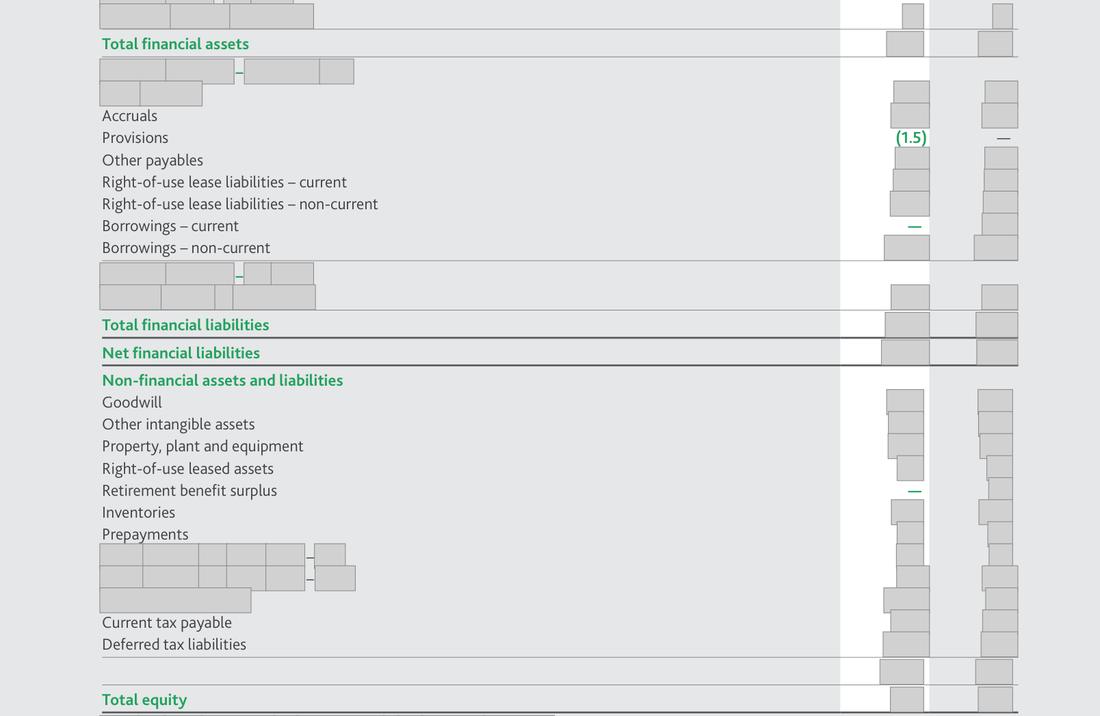
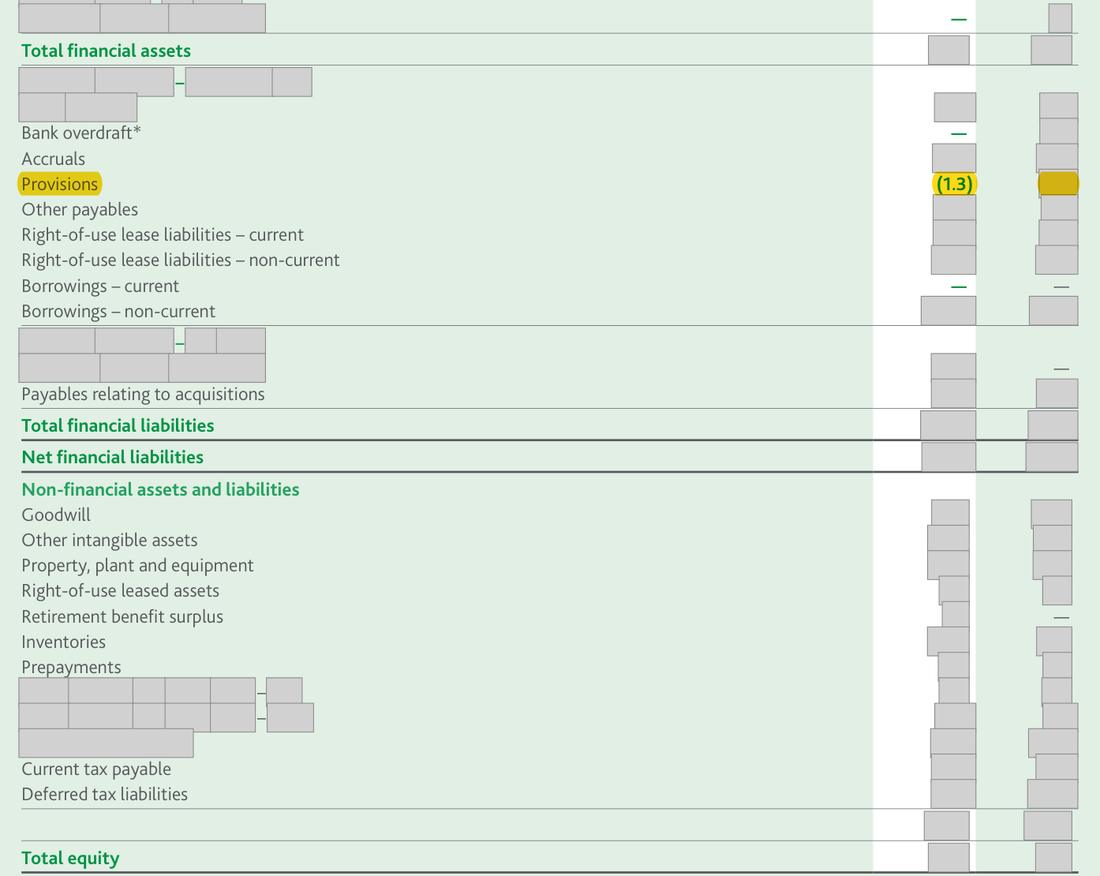
Further pages withheld to protect the company’s identity (three): Annual Report 2024, page 90; Annual Report 2025, page 92; Annual Report 2024, page 85. Their wording or layout could lead back to the company even with names and figures masked; the evidence list below records what each page shows.
Names, figures, dates, logos and any wording that could be searched back to the company are boxed out in grey; the point is highlighted in yellow.
What the report shows, and what the rule requires
| What the annual report shows | What the rule requires |
|---|---|
| What the annual report shows Provisions [amount] (warranties [amount], dilapidations [amount]) inside financial liabilities at amortised cost; total financial liabilities [amount] | What the rule requires Warranty provisions shown with the non-financial assets and liabilities; financial liabilities at amortised cost and total financial liabilities reduced to [amount] (to [amount] if dilapidations are also non-financial) |
What we checked: Note 24 category table and narrative on the page images in both reports; note [n] provisions; IAS 32 paragraph AG11; IFRS 7 paragraph 8
The rule
IAS 32 Financial Instruments: Presentation, Application Guidance paragraph AG11
Version relied on: UK-adopted international accounting standards (UK Endorsement Board), as in force for financial years beginning in or after January 2025
Deferred revenue and most warranty obligations are not financial liabilities, because they are settled by delivering goods or services rather than by paying cash.
IFRS 7 Financial Instruments: Disclosures, paragraph 8(g)
Version relied on: UK-adopted international accounting standards (UK Endorsement Board), as in force for financial years beginning in or after January 2025
The carrying amount of each category of financial asset and financial liability must be disclosed, on the face of the balance sheet or in the notes.
Why it applies here: IAS 32 paragraph AG11 states that most warranty obligations are not financial liabilities because the outflow is the delivery of goods and services;
Why it matters
- The IFRS 7 category totals, and the liquidity and fair-value analysis that rests on them, are drawn on the wrong population.
The IFRS 7 category totals overstate financial liabilities at amortised cost and net financial liabilities, and the liquidity and fair-value analysis that rests on the category is drawn on a wrong population.
Exposure
A classification point the Financial Reporting Council's Corporate Reporting Review could raise in a letter, closed by correction in the next report; no fine applies.
Our workings
the note [n] table lists 'Provisions ([n])' under 'Financial liabilities - amortised cost', within total financial liabilities of [amount], and the narrative says the [wording masked]. Note 21 shows provisions of [amount] at [date], of which warranties [amount] and dilapidations [amount], and describes warranty provisions as [wording masked]. The same table correctly places payments-on-account (a contract liability) among non-financial items.
[n] - [n] = [n] excluding warranties; [n] - [n] = [n] excluding all provisions.
IFRS 7 paragraph 8 asks for the carrying amount of financial liabilities measured at amortised cost, a category defined by IFRS 9, which a provision under IAS 37 does not enter. Dilapidations are arguable (a contractual obligation under a lease that may be settled in cash), so the conservative overstatement is the [amount] of warranties. The 2025 report repeats the classification (provisions [amount], of which warranties [amount]).
| Item ([date], £m) | Figure |
|---|---|
| Total financial liabilities as printed | [n] |
| Warranty provisions included (note [n]) | [n] |
| Total excluding warranties | [n] - [n] = [n] |
| Total excluding all provisions | [n] - [n] = [n] |
| Size against 2024 PBT | [n] / [n] = [n]% |
| Size against the line | [n] / [n] = [n]% |
Management’s best defence, and our reply
The finance team would say the table is a convenience reconciliation of net financial liabilities to equity, the amounts are small, and some warranty claims and dilapidations are settled in cash, so grouping provisions with payables is a reasonable shorthand. They might add that the auditor accepted the presentation in both years. The answer: IAS 32 paragraph AG11 deals with warranties directly and says they are not financial liabilities, the note's own wording describes warranties as commitments on goods sold, and the table already separates payments-on-account as non-financial, so the same test applied to provisions moves them out of the category. Dilapidations are left aside as arguable, which is why the overstatement is put at [amount], not [amount].
The fix
- Move provisions (at least warranties) from 'Financial liabilities - amortised cost' to 'Non-financial assets and liabilities' and delete 'provisions' from the list of principal financial liabilities; restate the comparative in the same way.
Evidence relied on
| # | What it shows | Type | Where |
|---|---|---|---|
| 1 | Provisions of [amount] listed under financial liabilities at amortised cost | Document | Annual Report 2024, page 89 |
| 2 | Total financial liabilities of [amount] include the provisions | Document | Annual Report 2024, page 89 |
| 3 | Contract liabilities are correctly placed with non-financial items, showing the distinction is applied elsewhere | Document | Annual Report 2024, page 89 |
| 4 | The narrative calls provisions a financial liability at amortised cost | Document | Annual Report 2024, page 90 |
| 5 | Provisions of [amount] comprise warranties [amount] and dilapidations [amount] | Document | Annual Report 2024, page 85 |
| 6 | Warranties are obligations to customers on goods sold, settled by repair or replacement | Document | Annual Report 2024, page 85 |
| 7 | The 2025 report keeps provisions ([amount]) among financial liabilities at amortised cost | Document | Annual Report 2025, page 91 |
| 8 | The 2025 narrative repeats that provisions are financial liabilities | Document | Annual Report 2025, page 92 |
Prepared by Pramanex from the company’s published annual reports, without the company’s involvement, to show how an annual report review reads. The company is not named, and nothing on this page is a statement about any identifiable company. Observations are not an audit, review or other assurance engagement, and not legal advice. A regulator-style question is a question, not a conclusion.
Want this on your own annual report, before it is published?
Start with three free findings on your latest published annual report, or talk to us about a fixed-fee pre-publication review.
Your annual report will be in draft before the year-end audit.
Have it read before it is published.
Under NDA, with our reviewer on your insider list under UK MAR.