1.07 Adjusted earnings per share is shown on the face of the income statement, where the standard allows it only in the notes
UK Company C · an AIM-quoted scientific instruments group · Compliance or disclosure gap
In brief
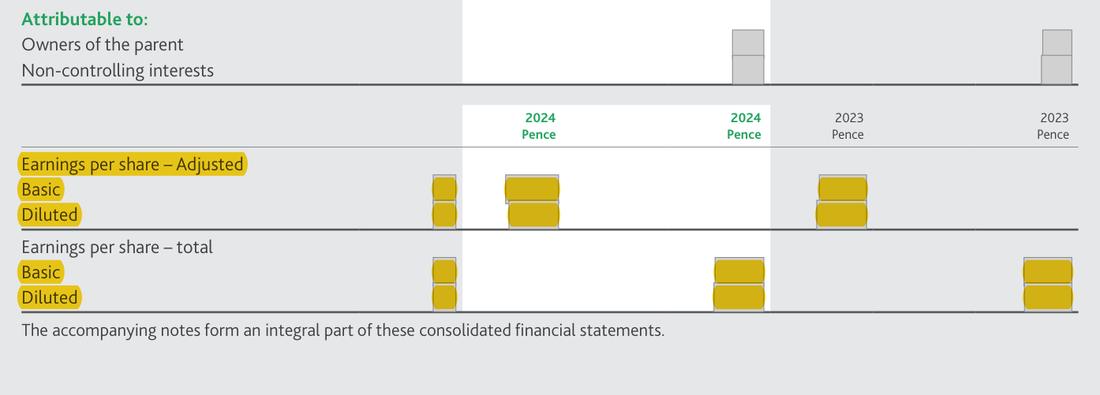
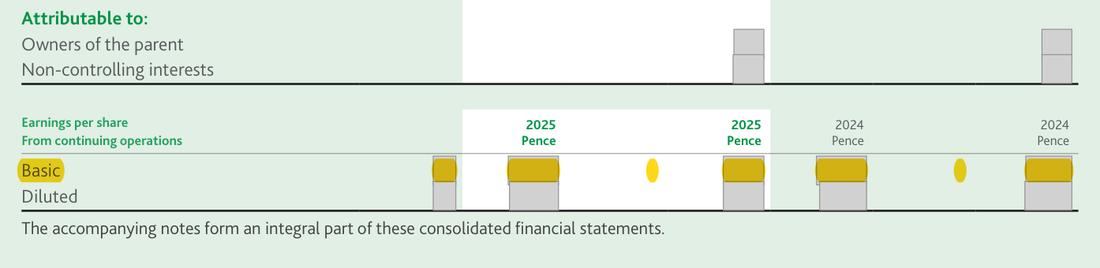
The consolidated statement of comprehensive income prints adjusted basic and diluted earnings per share (EPS) of [n] pence and [n] pence for 2024 alongside the statutory [n] pence and [n] pence. The standard on earnings per share allows per-share amounts based on any other component of profit only in the notes. The 2025 report repeats this, with the adjusted [n] pence printed first and labelled only by its column.
The evidence, as filed
Further pages withheld to protect the company’s identity (one): Annual Report 2024, page 80. Their wording or layout could lead back to the company even with names and figures masked; the evidence list below records what each page shows.
Names, figures, dates, logos and any wording that could be searched back to the company are boxed out in grey; the point is highlighted in yellow.
What the report shows, and what the rule requires
| What the annual report shows | What the rule requires |
|---|---|
| What the annual report shows Face of the 2024 income statement: 'Earnings per share – Adjusted' basic [n] pence and diluted [n] pence (2023: [n] pence and [n] pence) above 'Earnings per share – total' basic [n] pence; 2025 face: basic [n] pence (adjusted column) beside [n] pence (total). | What the rule requires Only basic and diluted earnings per share under the standard on the face of the statement; the adjusted per-share figures, with equal prominence and the basis of the numerator, in note [n]. |
The rule
IAS 33 Earnings per Share, paragraph 73
Version relied on: UK-adopted international accounting standards (UK Endorsement Board), as in force for financial years beginning in or after January 2025
Basic and diluted per-share amounts for any additional component must be shown with equal prominence and presented in the notes.
Why it applies here: presenting adjusted EPS on the face of the primary statement, and first in line, departs from paragraph 73 in both years.
Why it matters
- The non-statutory figure gains the authority and prominence of the audited primary statement, which the standard reserves for the statutory figures.
The non-statutory per-share figure gains the authority and prominence of the audited primary statement, which the standard reserves for the statutory figures; in 2025 adjusted EPS is more than three times the statutory figure and is the first number a reader sees.
Exposure
No fine; the realistic consequence is a Financial Reporting Council (FRC) Corporate Reporting Review question and an undertaking to move the adjusted figures to the notes.
Our workings
the 2024 consolidated statement of comprehensive income has a block headed 'Earnings per share – Adjusted' (basic [n] pence, diluted [n] pence) printed above 'Earnings per share – total' (basic [n] pence, diluted [n] pence); note [n] also explains and reconciles the adjusted figures. The 2025 statement prints basic [n] pence in the adjusted column and [n] pence in the total column, under a single heading 'Earnings per share'. Law: an entity that discloses per-share amounts based on a component of profit other than the one the standard requires must calculate them on the standard's share numbers, and 'shall' disclose them 'with equal prominence and presented in the notes' (IAS 33 paragraph 73). The rule is specific to per-share figures; the general freedom to add line items and columns to the income statement does not extend to them.
No audited figure is wrong; the point is where and how prominently the non-statutory per-share figure is presented.
Management’s best defence, and our reply
The finance team would say the columnar 'Adjusted / Adjusting items / Total' format is an accepted way of presenting additional subtotals under IAS 1, the adjusted EPS is simply the per-share figure of a column already on the face, it is clearly labelled, and note [n] gives the full reconciliation, so no reader is misled. They would add that many UK listed groups present adjusted EPS this way. The answer: paragraph 73 deals specifically with per-share amounts based on other components of profit and says they are 'presented in the notes'; that specific rule governs the per-share figures even where the profit columns themselves are acceptable, and the 2025 statement prints the adjusted figure first with only a column heading to distinguish it.
The fix
- Show only statutory basic and diluted EPS on the face of the statement; present adjusted basic and diluted EPS in note [n] with equal prominence and the basis of the numerator.
Evidence relied on
| # | What it shows | Type | Where |
|---|---|---|---|
| 1 | the 2024 income statement carries an adjusted EPS block on its face | Document | Annual Report 2024, page 67 |
| 2 | adjusted basic EPS [n] pence (2023: [n] pence) printed on the face, above the statutory figure | Document | Annual Report 2024, page 67 |
| 3 | adjusted diluted EPS [n] pence (2023: [n] pence) printed on the face | Document | Annual Report 2024, page 67 |
| 4 | statutory basic EPS [n] pence printed below the adjusted block | Document | Annual Report 2024, page 67 |
| 5 | statutory diluted EPS [n] pence | Document | Annual Report 2024, page 67 |
| 6 | note [n] already explains the adjusted EPS, so the face presentation is additional | Document | Annual Report 2024, page 80 |
| 7 | 2025 face: adjusted [n] pence printed first, beside statutory [n] pence, under one heading | Document | Annual Report 2025, page 65 |
Prepared by Pramanex from the company’s published annual reports, without the company’s involvement, to show how an annual report review reads. The company is not named, and nothing on this page is a statement about any identifiable company. Observations are not an audit, review or other assurance engagement, and not legal advice. A regulator-style question is a question, not a conclusion.
Want this on your own annual report, before it is published?
Start with three free findings on your latest published annual report, or talk to us about a fixed-fee pre-publication review.
Your annual report will be in draft before the year-end audit.
Have it read before it is published.
Under NDA, with our reviewer on your insider list under UK MAR.