1.09 Share option note: the exercise-price range cannot describe the options outstanding, and grant-date fair values are not given
UK Company C · an AIM-quoted scientific instruments group · Compliance or disclosure gap
In brief
The share option note says exercise prices ranged between [amount] and [amount], but the options outstanding at [date] have a weighted average exercise price of [n] pence and the [n] options granted in 2025 a weighted average of [n] pence. The range therefore describes the options exercised (weighted average [n] pence), not those outstanding. The note also gives no grant-date fair value for the options granted and no weighted average share price at exercise, only ranges. The 2024 note had the same gaps.
The evidence, as filed
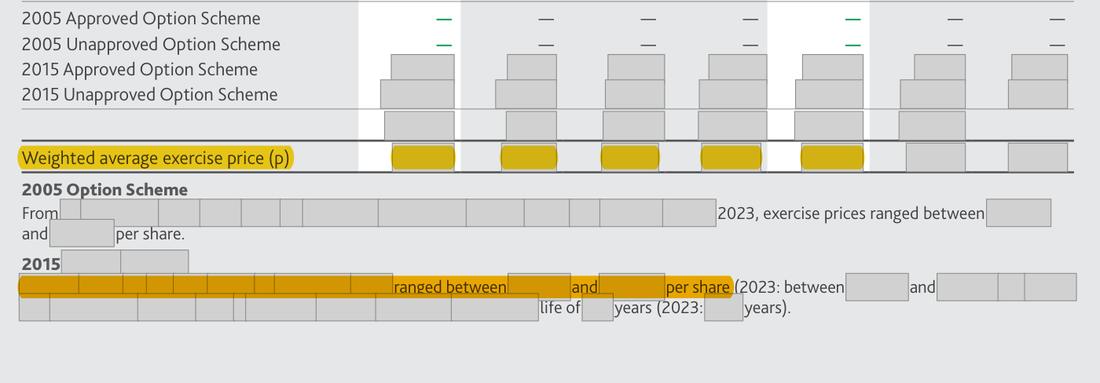
Further pages withheld to protect the company’s identity (three): Annual Report 2025, page 93; Annual Report 2025, page 92; Annual Report 2025, page 55. Their wording or layout could lead back to the company even with names and figures masked; the evidence list below records what each page shows.
Names, figures, dates, logos and any wording that could be searched back to the company are boxed out in grey; the point is highlighted in yellow.
What the report shows, and what the rule requires
| What the annual report shows | What the rule requires |
|---|---|
| What the annual report shows One range, [amount] to [amount], headed as the exercise prices for the year; closing weighted average exercise price [n] pence; no weighted average grant-date fair value; share price at exercise given only as a range of [amount] to [amount]. | What the rule requires For options outstanding at the year end, the range of exercise prices (in meaningful groups if wide) with the weighted average remaining life; for options exercised, the weighted average share price at exercise (or for the year); for options granted, the weighted average grant-date fair value with the share price and exercise price inputs. |
The rule
IFRS 2 Share-based Payment, paragraph 45(d)
Version relied on: UK-adopted international accounting standards (UK Endorsement Board), as in force for financial years beginning in or after January 2025
For options still outstanding at the year end, the accounts must show the spread of exercise prices and, on a weighted average basis, how long the options have left to run.
IFRS 2 Share-based Payment, paragraph 45(c)
Version relied on: UK-adopted international accounting standards (UK Endorsement Board), as in force for financial years beginning in or after January 2025
For options exercised in the year, the accounts must give the weighted average share price at exercise (or the average price for the period if exercises were spread evenly).
IFRS 2 Share-based Payment, paragraph 47(a)
Version relied on: UK-adopted international accounting standards (UK Endorsement Board), as in force for financial years beginning in or after January 2025
For options granted in the year, the accounts must give their weighted average fair value at the measurement date and explain how that fair value was measured.
Why it applies here: the sentence describes options exercised, so the range required for options outstanding is not given in either year; the weighted average share price at exercise and the grant-date fair value are also not given.
Why it matters
- Readers cannot see the price spread, dilution and cash-on-exercise profile of the [n] options outstanding, nor how the share-based payment charge was measured.
Readers cannot see the price spread, dilution and cash-on-exercise profile of the [n] options outstanding, nor how the share-based payment charge (an item removed to reach adjusted earnings) was measured.
Exposure
A Corporate Reporting Review enquiry by the FRC could ask for the missing particulars and an undertaking to give them in the 2026 accounts.
Our workings
note [n] gives a movement table whose weighted average exercise price row reads [n] pence at [date].9 pence for grants, [n] pence for exercises and [n] pence at [date], and then says exercise prices for the year ranged between [amount] and [amount]. It lists the Black Scholes assumptions (interest rate, volatility, dividend yield, life, leavers) but no fair value per option, share price or exercise price input. Note 25 says the [n] options were exercised on [n] occasions [wording masked] [amount] to [amount].
the closing weighted average exceeds the top of the stated range by [n] pence and 2025 grants by [n] pence, so options priced above [amount] must be outstanding; the exercised average of [n] pence sits inside the range (workings). In 2024 grants carried a weighted average of [n] pence against a stated top of [amount].
| Test | Figures | Result |
|---|---|---|
| Closing weighted average exercise price vs top of stated range | [n] - [n] = [n] | above the range |
| Options granted in 2025 vs top of stated range | [n] - [n] = [n] | above the range |
| Options exercised in 2025 | [n] < [n] < [n] | inside the range |
| 2024 grants vs top of 2024 stated range | [n] - [n] = [n] | above the range |
| Share-based payment charge against statutory profit before tax | [n] / [n] = [n]% | material to users |
Management’s best defence, and our reply
The finance team would say the charge is small against the group's balance sheet, that IAS 1 paragraph 31 relieves disclosure of immaterial information, and that the range sentence was intended to describe the options exercised in the year, which it does accurately. The auditor accepted the note in both years, and the remuneration report lists the directors' options with their exercise prices of [amount] to [amount]. Those options are [n] of the [n] outstanding, sit outside the notes and all lie above the stated top of [amount], so they confirm the gap rather than fill it. However, the charge equals [n]% of statutory profit before tax and is one of the items removed to reach adjusted earnings, so how it is measured is information users need; and a sentence that a reader will take as the range for options outstanding, but which cannot be that range, misleads rather than abbreviates.
The fix
- In note [n] replace the range sentence with the range of exercise prices of options outstanding at [date] (banded if wide) and add the weighted average share price at exercise and the weighted average grant-date fair value of 2025 grants with the share price and exercise price inputs.
Evidence relied on
| # | What it shows | Type | Where |
|---|---|---|---|
| 1 | The only range of exercise prices the note gives | Document | Annual Report 2025, page 93 |
| 2 | Weighted averages: closing [amount], granted [amount], exercised [amount] | Document | Annual Report 2025, page 93 |
| 3 | [n] options granted in 2025; [n] outstanding at the year end | Document | Annual Report 2025, page 93 |
| 4 | Model and assumptions listed; no fair value per option, share price or exercise price input | Document | Annual Report 2025, page 93 |
| 5 | Size of the charge the disclosures support | Document | Annual Report 2025, page 93 |
| 6 | Share price at exercise given only as a range | Document | Annual Report 2025, page 92 |
| 7 | Directors' options outstanding at the year end include grants at [amount], above the stated top of the range | Document | Annual Report 2025, page 55 |
| 8 | 2024 report: same form of range sentence | Document | Annual Report 2024, page 90 |
| 9 | 2024 grants at a weighted average [amount], above the 2024 stated top of [amount] | Document | Annual Report 2024, page 90 |
Absence check
- Document
- Annual Report 2025
- Where it would appear
- In accordance with IFRS 2, a Black Scholes valuation model
- What is missing
- the weighted average grant-date fair value of the options granted in 2025, with the share price and exercise price inputs
- Pages looked at
- p.73-75 (accounting policies), p.78 (staff costs), p.92-93 (notes 25-26), p.108 (parent note [n])
- Result
- No term hits anywhere in the report.
Absence check
- Document
- Annual Report 2025
- Where it would appear
- Allotments of Ordinary shares in 2025
- What is missing
- the weighted average share price at the dates of exercise (or for the year)
- Pages looked at
- p.92-93 (notes 25-26), p.80 (earnings per share), p.108 (parent note [n])
- Result
- No term hits anywhere in the report.
Absence check
- Document
- Annual Report 2025
- Where it would appear
- 2015 Option Scheme
- What is missing
- the range of exercise prices of the options outstanding at [date]
- Pages looked at
- p.92-93 (notes 25-26), p.108 (parent note [n])
- Result
- 'ranged between' hits only this page, in the sentence giving [amount] to [amount], which cannot be the range of options whose weighted average is [amount]; the other terms do not hit.
Prepared by Pramanex from the company’s published annual reports, without the company’s involvement, to show how an annual report review reads. The company is not named, and nothing on this page is a statement about any identifiable company. Observations are not an audit, review or other assurance engagement, and not legal advice. A regulator-style question is a question, not a conclusion.
Want this on your own annual report, before it is published?
Start with three free findings on your latest published annual report, or talk to us about a fixed-fee pre-publication review.
Your annual report will be in draft before the year-end audit.
Have it read before it is published.
Under NDA, with our reviewer on your insider list under UK MAR.