1.05 The interest-rate sensitivity shows no profit effect from a 1% move in [reference rate], but leaves out the swaps the group carries at fair value through profit or loss
UK Company C · an AIM-quoted scientific instruments group · Compliance or disclosure gap
In brief
The group fixes most of its [reference rate]-linked borrowing with interest-rate swaps that are not hedge accounted, so every change in their fair value goes straight to profit or loss ([amount] charge in 2025). The sensitivity table only multiplies the small unhedged loan balance ([amount]; 2024: [amount]) by 1% and so reports a nil effect on profit. A 1% move in [reference rate] would change the swaps' fair value, and therefore profit, by roughly [amount] to [amount], so the analysis IFRS 7 requires is incomplete in both years.
The evidence, as filed
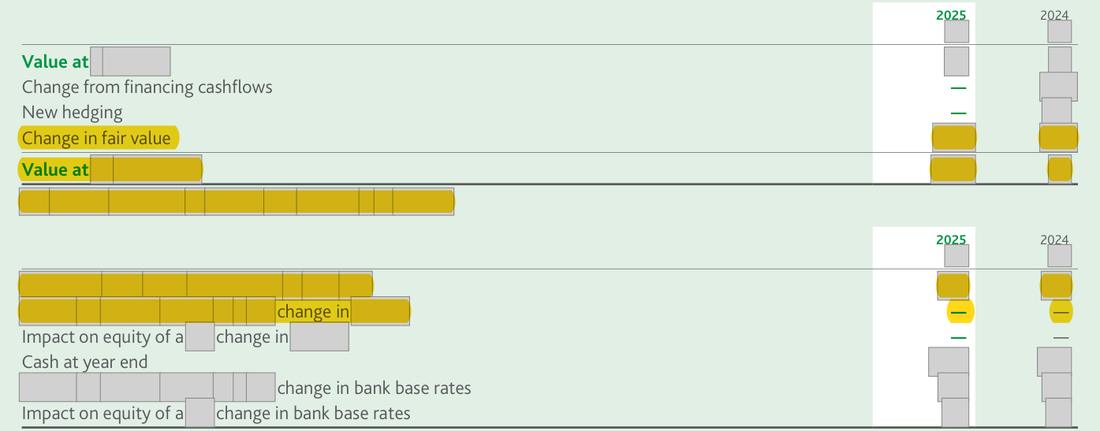
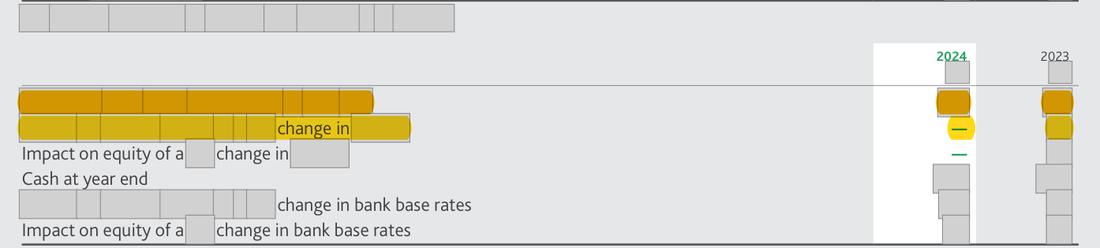
Further pages withheld to protect the company’s identity (four): Annual Report 2025, page 74; Annual Report 2025, page 92; Annual Report 2025, page 87; Annual Report 2025, page 79. Their wording or layout could lead back to the company even with names and figures masked; the evidence list below records what each page shows.
Names, figures, dates, logos and any wording that could be searched back to the company are boxed out in grey; the point is highlighted in yellow.
What the report shows, and what the rule requires
| What the annual report shows | What the rule requires |
|---|---|
| What the annual report shows Note 28: unhedged bank loans [amount] (2024: [amount]); [wording masked] 1% change in [reference rate] nil (2024: nil). No sensitivity is given for the swaps, whose fair-value change of [amount] (2024: [amount]) is charged to profit. | What the rule requires A sensitivity showing the effect on profit before tax and equity of a reasonably possible change in [reference rate], including the change in fair value of the swaps measured at fair value through profit or loss, with the method and assumptions stated. |
What we checked: Interest-rate risk table and swap movement in both reports; the derivative accounting policy; the swap terms; the borrowings note and facility maturity; the finance-cost line for swaps.
The rule
IFRS 7 Financial Instruments: Disclosures, paragraph 40(a)
Version relied on: UK-adopted international accounting standards (UK Endorsement Board), as in force for financial years beginning in or after January 2025
For each type of market risk, the accounts must give a sensitivity analysis showing how profit or loss and equity would have been affected by reasonably possible changes at the year end.
Why it applies here: The fair-value sensitivity of swaps on about [amount] of borrowing is missing from the market-risk analysis.
Why it matters
- The table tells readers that interest-rate moves do not touch profit, while the swap revaluation alone moved reported profit before tax by [amount] in 2025.
- For swaps carried at fair value through profit or loss, the immediate effect on profit is their revaluation; netting it against future loan interest describes the economic hedge, not the accounting effect.
The table tells readers that interest-rate moves do not touch profit, while the swap revaluation alone moved reported profit before tax by [amount] in 2025.
Exposure
An incomplete IFRS 7 market-risk disclosure; the usual outcome of an FRC enquiry is an undertaking to extend the analysis in the next report.
Our workings
the group's policy is that interest rate swaps are derivatives 'accounted for at fair value through profit and loss', and note 9 charges their revaluation to profit as a finance cost below the adjusted line, so no hedge accounting is applied. The swaps fix [reference rate] for the remainder of the facility term (maturity [date]). Their fair value moved by [amount] in 2025, charged as an adjusting finance cost. The sensitivity table applies 1% only to unhedged loans of [amount] (2024: [amount]) and shows nil effect on profit and equity.
hedged borrowing is about [n] - [n] = [n]; the swaps' value changes by roughly 1% of that notional for each year of remaining life, giving about [n] for the first year and up to about [n] over the [n] years to [date], before discounting and any amortising of notional (workings).
IFRS 7.40(a) asks how profit or loss and equity would have been affected by a reasonably possible change in the risk variable. For a group whose swaps are carried at fair value through profit or loss, the immediate effect on profit is the swaps' revaluation; netting it against future loan interest describes the economic hedge, not the accounting effect. The precise figure needs the swap schedule, which the report does not give, so the amounts are an order of magnitude.
| Item | Computation | Result |
|---|---|---|
| Hedged borrowing at [date] | [n] - [n] | [n] |
| One year of a 1% [reference rate] move on hedged notional | [n] x 1% | [n] |
| Remaining swap term to [date] (years) | [date] to [date] | [n] |
| Upper estimate of fair-value change for 1% | [n] x 1% x [n] | [n] |
| Hedged borrowing at [date] | [n] - [n] | [n] |
| Upper estimate at [date] ([n] years left) | [n] x 1% x [n] | [n] |
| Lower estimate as % of 2025 profit before tax | [n] / [n] | [n]% |
Management’s best defence, and our reply
The company could say the swaps are an economic hedge of the loans, so over the life of the facility a rise in [reference rate] raises loan interest and swap receipts equally, and the table shows that the group's cash interest cost is insensitive to rates; that is the risk the directors manage. It could add that swap revaluations are excluded from Adjusted profit. However, IFRS 7.40(a) asks for the effect on profit or loss and equity, and because the swaps are not hedge accounted their fair-value change is recognised in profit immediately, as the [amount] 2025 charge shows; the adjusting-item presentation does not remove it from statutory profit.
The fix
- Add '[wording masked] 1% change in [reference rate] on the fair value of interest rate swaps: £x.xm (2024: £y.ym)' and state the method (parallel shift of the [reference rate] curve, swap notional and maturity).
Evidence relied on
| # | What it shows | Type | Where |
|---|---|---|---|
| 1 | The sensitivity covers only unhedged loans and shows nil profit effect in both years | Document | Annual Report 2025, page 94 |
| 2 | The swaps' fair value moved by [amount] in 2025 | Document | Annual Report 2025, page 94 |
| 3 | Policy: swaps at fair value through profit or loss | Document | Annual Report 2025, page 74 |
| 4 | Swaps fix [reference rate] for the rest of the facility term | Document | Annual Report 2025, page 92 |
| 5 | Facility (and swap) term ends [date] | Document | Annual Report 2025, page 87 |
| 6 | Drawn borrowing used to derive the hedged amount | Document | Annual Report 2025, page 87 |
| 7 | The swap revaluation is charged to profit before tax | Document | Annual Report 2025, page 79 |
| 8 | 2024 report: the same method, no swap fair-value sensitivity | Document | Annual Report 2024, page 92 |
Absence check
- Document
- Annual Report 2025
- Where it would appear
- [wording masked]:
- What is missing
- the effect on profit and equity of a change in [reference rate] on the fair [wording masked] carried at fair value through profit or loss
- Pages looked at
- p.56-57, [n], 87-95
- Result
- 'sensitivity' hits the pension note, goodwill (p.71, [n]), going concern and audit pages (p.40, [n]) and this table, none on swap fair values; '1% change in [reference rate]' hits only this table's unhedged-loan rows; 'fair value of interest rate swaps' hits p.94 giving the carrying amount ([amount] liability), not a sensitivity; 'basis point' has no hits.
Prepared by Pramanex from the company’s published annual reports, without the company’s involvement, to show how an annual report review reads. The company is not named, and nothing on this page is a statement about any identifiable company. Observations are not an audit, review or other assurance engagement, and not legal advice. A regulator-style question is a question, not a conclusion.
Want this on your own annual report, before it is published?
Start with three free findings on your latest published annual report, or talk to us about a fixed-fee pre-publication review.
Your annual report will be in draft before the year-end audit.
Have it read before it is published.
Under NDA, with our reviewer on your insider list under UK MAR.