6.05 Labels and wording slips in the notes on assets, leases, associates and borrowings
UK Company B · a UK-listed technology and logistics group · Drafting slip
In brief
Five wording slips in the notes: a customer's name misspelt; the same transfer of assets to [former subsidiary] labelled differently in the cost and depreciation sections of the same table; a statement that no material leases have escalation clauses or renewal options while the policy says the leases have them; a footnote calling [former subsidiary]'s full figures the Group's share; and balances headed as a period rather than a date.
The evidence, as filed
Further pages withheld to protect the company’s identity (three): Annual Report 2025, page 218; Annual Report 2025, page 220; Annual Report 2025, page 223. Their wording or layout could lead back to the company even with names and figures masked; the evidence list below records what each page shows.
Names, figures, dates, logos and any wording that could be searched back to the company are boxed out in grey; the point is highlighted in yellow.
What the report shows, and what the rule requires
| What the annual report shows | What the rule requires |
|---|---|
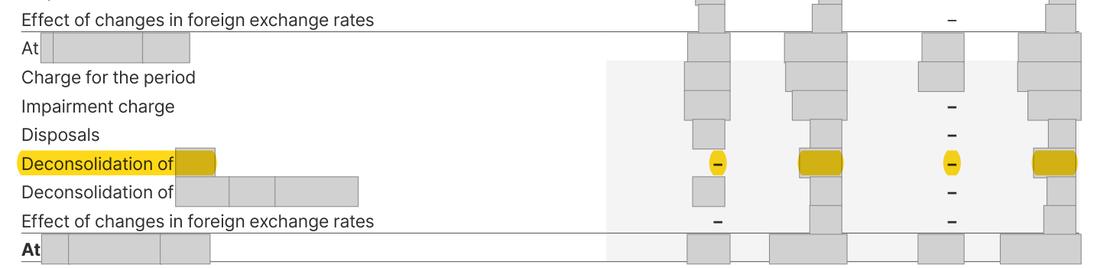
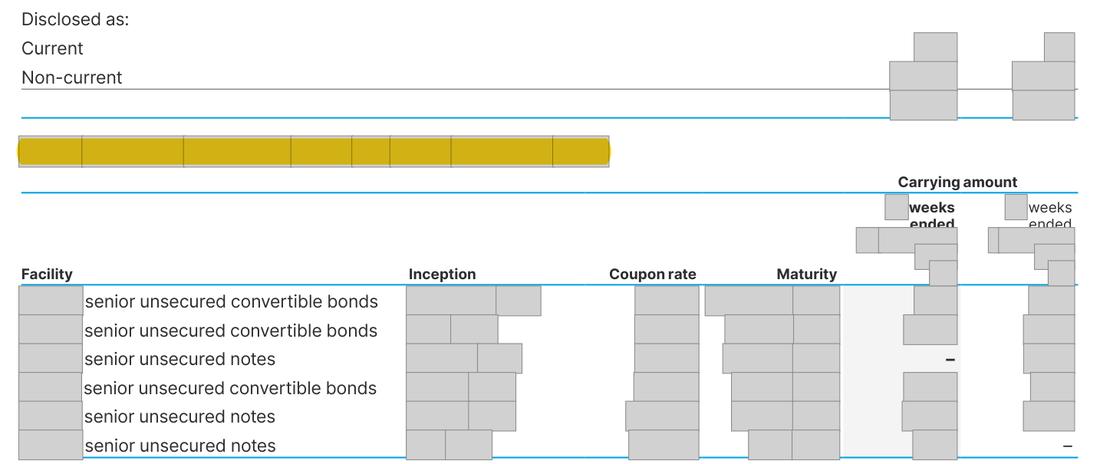
| What the annual report shows p.218 "Group [customer] CGU"; p.217 cost row "[wording masked]" against depreciation row "Deconsolidation of [former subsidiary]"; p.220 "[wording masked] ... renewal or purchase options and escalation clauses" against p.218 "escalation clauses and renewal rights"; p.223 footnote "[wording masked]" on a table of [former subsidiary]'s full amounts; p.231 carrying amounts headed as periods ("weeks ended") rather than dates | What the rule requires "[customer] CGU"; one label for the transfer in both sections; wording consistent with the lease policy; a footnote saying the figures are [former subsidiary]'s results (full amounts) from [date]; carrying amounts headed "As at [date]" |
Why it matters
None on the figures; the slips make the notes harder to read and in two places contradict the adjacent text.
Exposure
Drafting points only.
Our workings
Each slip is a label or wording point that changes no figure. The [customer] slip sits in the sentence after which the note uses the correct name. The [wording masked] appears in the cost section under one caption and in the accumulated depreciation section under another, for the same assets leased to [former subsidiary]. The lease sentence on p.220 contradicts the policy sentence on p.218 unless 'material' is doing all the work. The footnote on p.223 describes the figures as the Group's share although the table shows [former subsidiary]'s own revenue and results and the Group's share on a separate line. The borrowings facility table gives balance-sheet carrying amounts under period headings.
Management’s best defence, and our reply
The finance team would say each item is cosmetic and that the surrounding text makes the meaning clear in every case. That is why these are listed only as drafting points; they still deserve correction, because two of them contradict the adjacent text.
The fix
- Correct the five items in the 2026 report as set out in the should-be column.
Evidence relied on
| # | What it shows | Type | Where |
|---|---|---|---|
| 1 | the customer's name is misspelt ('Group [customer]'); the next sentence uses '[customer]' | Document | Annual Report 2025, page 218 |
| 2 | the accumulated depreciation row for the assets leased to [former subsidiary] is labelled 'Deconsolidation of [former subsidiary]', while the cost row for the same assets reads '[wording masked]' | Document | Annual Report 2025, page 217 |
| 3 | the lease note says no material leases have renewal options or escalation clauses | Document | Annual Report 2025, page 220 |
| 4 | the lessee policy says the leases have escalation clauses and renewal rights | Document | Annual Report 2025, page 218 |
| 5 | the footnote calls the 100% figures in the table the Group's share | Document | Annual Report 2025, page 223 |
| 6 | the facility table gives balance-sheet carrying amounts under '52 weeks ended' column headings | Document | Annual Report 2025, page 231 |
Prepared by Pramanex from the company’s published annual reports, without the company’s involvement, to show how an annual report review reads. The company is not named, and nothing on this page is a statement about any identifiable company. Observations are not an audit, review or other assurance engagement, and not legal advice. A regulator-style question is a question, not a conclusion.
Want this on your own annual report, before it is published?
Start with three free findings on your latest published annual report, or talk to us about a fixed-fee pre-publication review.
Your annual report will be in draft before the year-end audit.
Have it read before it is published.
Under NDA, with our reviewer on your insider list under UK MAR.