6.04 Revenue note: the UK share of 2025 revenue is printed as [n]%, the 2024 figure, which the 2025 table amounts do not give
UK Company B · a UK-listed technology and logistics group · Drafting slip
In brief
The sentence under the revenue by geography table in Note 2.1 prints the UK share of revenue as [n]% for both years. [n]% is the 2024 share; the 2025 table amounts (UK [n] of total [n]) give a lower share. The table amounts are right.
The evidence, as filed
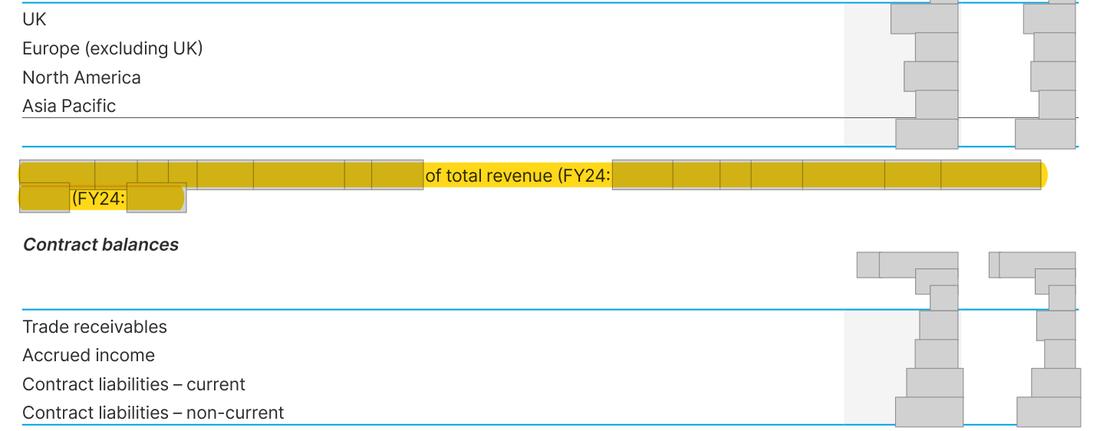
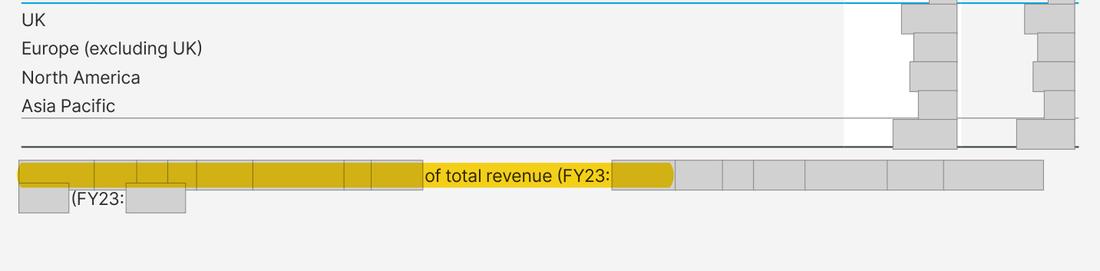
Annual Report 2024, page 177 · Prior year: The 2024 report gave the UK share as [n]% for 2024, which agrees with its own table; the 2025 report repeats that percentage for 2025.
Names, figures, dates, logos and any wording that could be searched back to the company are boxed out in grey; the point is highlighted in yellow.
What the report shows, and what the rule requires
| What the annual report shows | What the rule requires |
|---|---|
| What the annual report shows p.197: '[wording masked] [n]% of total revenue (FY24: [n]%)' | What the rule requires '[wording masked] [n]% of total revenue (FY24: [n]%)' |
Why it matters
A one-line correction to a narrative percentage; the audited amounts are unaffected.
Exposure
No regulatory consequence; a correction in the next report.
Our workings
the Note 2.1 table on p.197 shows UK revenue of [n] out of total revenue of [n] for 2025 and [n] out of [n] for 2024; the sentence under it gives the UK share as [n]% in both years.
Management’s best defence, and our reply
Management would say the percentage is a voluntary narrative aid and the audited amounts in the table are right. IFRS 8 requires the revenue amounts by geography, not a percentage of the total. They would add that a difference of under one percentage point in a ratio would not change any reader's view of the Group. The answer: once the Group chooses to state the percentage in the audited notes it must agree with the table it describes, and as printed it reverses the direction of the movement (no change instead of a fall); the point is kept as a low-severity presentation slip, not as a breach.
The fix
- Print '[wording masked] [n]% of total revenue (FY24: [n]%)' and tie narrative percentages to the table at the close.
Evidence relied on
| # | What it shows | Type | Where |
|---|---|---|---|
| 1 | The sentence gives the UK share as [n]% in both years | Document | Annual Report 2025, page 197 |
| 2 | UK revenue in the geography table, 2025 and 2024 | Document | Annual Report 2025, page 197 |
| 3 | Asia Pacific revenue and total revenue in the same table, 2025 and 2024 | Document | Annual Report 2025, page 197 |
Prepared by Pramanex from the company’s published annual reports, without the company’s involvement, to show how an annual report review reads. The company is not named, and nothing on this page is a statement about any identifiable company. Observations are not an audit, review or other assurance engagement, and not legal advice. A regulator-style question is a question, not a conclusion.
Want this on your own annual report, before it is published?
Start with three free findings on your latest published annual report, or talk to us about a fixed-fee pre-publication review.
Your annual report will be in draft before the year-end audit.
Have it read before it is published.
Under NDA, with our reviewer on your insider list under UK MAR.