1.26 Revenue said to come from opening contract liabilities exceeds what the movement table allows once the [customer] Letter of Credit revenue is taken out
UK Company B · a UK-listed technology and logistics group · Regulator-style question
In brief
Note 2.1 says [amount] of the year's revenue [wording masked] the start of the year. The movement table releases [amount] to revenue in total, of which [amount] came from the [customer] Letter of Credit, which was only drawn in [date] and so cannot have been in the opening balance. That leaves at most [amount] from the opening balance, [amount] less than the figure disclosed.
The evidence, as filed
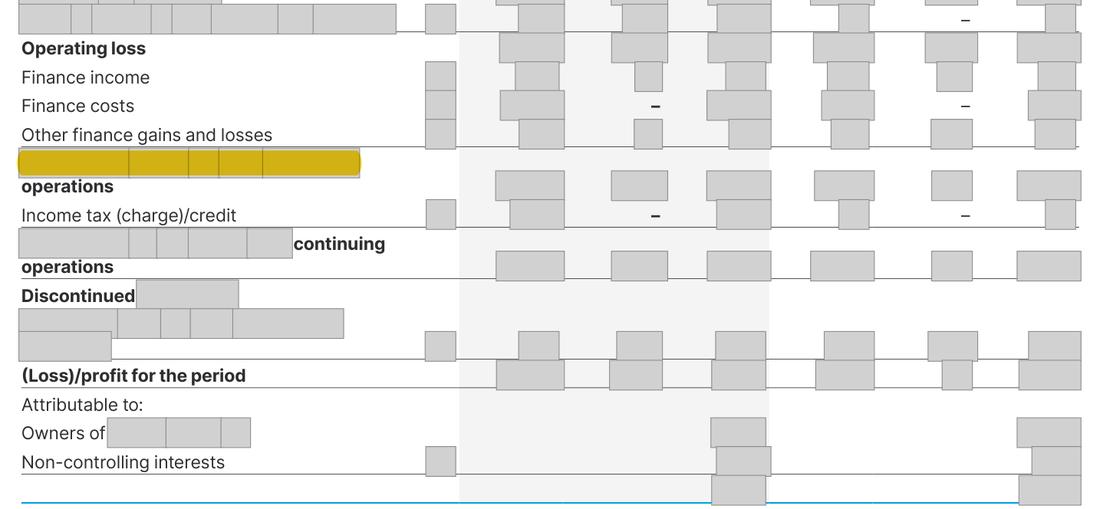
Further pages withheld to protect the company’s identity (one): Annual Report 2025, page 198. Their wording or layout could lead back to the company even with names and figures masked; the evidence list below records what each page shows.
Names, figures, dates, logos and any wording that could be searched back to the company are boxed out in grey; the point is highlighted in yellow.
What the report shows, and what the rule requires
| What the annual report shows | What the rule requires |
|---|---|
| What the annual report shows Revenue from opening contract liabilities stated as [n]; total released to revenue [n], including [n] from the Letter of Credit drawn in the year (added to contract liabilities as [n]) | What the rule requires Revenue from the opening balance of at most [n] on the note's own figures, or an explanation of which opening balances the [n] includes (for example liabilities with [former subsidiary] that were intra-group at the start of the year) |
The rule
IFRS 15 Revenue from Contracts with Customers, paragraph 116(b)
Version relied on: UK-adopted international accounting standards (UK Endorsement Board), as in force for financial years beginning in or after January 2025
The accounts must disclose how much of the year's revenue was in the contract liability balance at the start of the year.
Why it applies here: either the [n] counts revenue from liabilities that were not in the group's opening balance (the [n] with [former subsidiary], eliminated until [date], is the obvious candidate), or part of the [n] is treated as coming from earlier balances.
Why it matters
If the [n] includes liabilities that were intra-group at the start of the year, the required measure of how much of the opening deferred revenue was earned in the year is overstated by up to [n].
Exposure
A question for the company; no sanction applies unless the figure proves wrong.
Our workings
the contract-liabilities movement shows an opening balance of ([n]), invoicing of ([n]), the [customer] Letter of Credit of ([n]), an amount recognised as revenue of [n], the effect of deconsolidating [former subsidiary] of ([n]) and a closing balance of ([n]). The footnote says [amount] of the Letter of Credit was [wording masked], and the paragraph below says [amount] of revenue [wording masked] the beginning of the period. In 2024 the two figures were equal at [n].
[n] - [n] = [n] is the most that can have come from the opening balance; [n] - [n] = [n] is unexplained ([n]% of the loss before tax).
The note does not say which, and IFRS 15 measures the disclosure from the group's own opening balance.
| Step | Computation | Result |
|---|---|---|
| Movement table foots | -[n] - [n] - [n] + [n] - [n] + [n] = -[n] | agrees to closing ([n]) |
| Maximum revenue from the opening balance | [n] - [n] = [n] | [n] |
| Stated revenue from the opening balance | [n] | [n] |
| Unexplained excess | [n] - [n] = [n] | [n] |
| Size | [n] / [n] = [n]% of the loss before tax | [n]% |
Management’s best defence, and our reply
The company may say that the [n] is measured contract by contract, and that the [former subsidiary] contracts existed at the start of the year at entity level, so the revenue from them is revenue from balances that existed at the beginning of the period. It may also say part of the Letter of Credit was allocated to performance obligations whose upfront fees were already in the opening balance, and that the cumulative catch-up of [n] relates to earlier periods. That reading is tenable for a preparer, which is why this is a question; the answer still matters because the group's opening balance excluded the intra-group liabilities, and the movement table itself shows the [n] arriving only on deconsolidation.
The fix
- State in Note 2.1 how the [n] is measured and, if it includes the [former subsidiary] balances, give the figure for the group's own opening balance.
Question for the company
How is the [amount] of revenue from opening contract liabilities made up, given that [amount] of the [amount] released came from the Letter of Credit drawn in [date]? Does it include revenue from the [amount] of [former subsidiary] balances that were intra-group at the start of the year?
Evidence relied on
| # | What it shows | Type | Where |
|---|---|---|---|
| 1 | Total released from contract liabilities to revenue | Document | Annual Report 2025, page 198 |
| 2 | Letter of Credit added to contract liabilities during the year | Document | Annual Report 2025, page 198 |
| 3 | Opening balance | Document | Annual Report 2025, page 198 |
| 4 | Liabilities with [former subsidiary] that became external on deconsolidation | Document | Annual Report 2025, page 198 |
| 5 | Closing balance | Document | Annual Report 2025, page 198 |
| 6 | Invoicing in the year | Document | Annual Report 2025, page 198 |
| 7 | Exchange movement | Document | Annual Report 2025, page 198 |
| 8 | Revenue from the Letter of Credit drawn in [date] | Document | Annual Report 2025, page 198 |
| 9 | Stated revenue from the opening balance | Document | Annual Report 2025, page 198 |
| 10 | Loss before tax from continuing operations, the materiality benchmark | Document | Annual Report 2025, page 183 |
Prepared by Pramanex from the company’s published annual reports, without the company’s involvement, to show how an annual report review reads. The company is not named, and nothing on this page is a statement about any identifiable company. Observations are not an audit, review or other assurance engagement, and not legal advice. A regulator-style question is a question, not a conclusion.
Want this on your own annual report, before it is published?
Start with three free findings on your latest published annual report, or talk to us about a fixed-fee pre-publication review.
Your annual report will be in draft before the year-end audit.
Have it read before it is published.
Under NDA, with our reviewer on your insider list under UK MAR.