1.23 Cash paid for property, plant and equipment exceeds the year's additions by [amount]
UK Company C · an AIM-quoted scientific instruments group · Regulator-style question
In brief
The 2024 cash flow statement shows [amount] paid for property, plant and equipment, and the segment note and strategic report call [amount] the year's capital expenditure, but note [n] records additions of only [amount]. The [amount] gap equals the stock transferred into fixed assets in the year, which is a non-cash movement. In 2023 (additions [amount], cash [amount]) and 2025 (additions [amount], cash [amount]) the two agree. The report does not say what the extra [amount] of cash was spent on.
The evidence, as filed
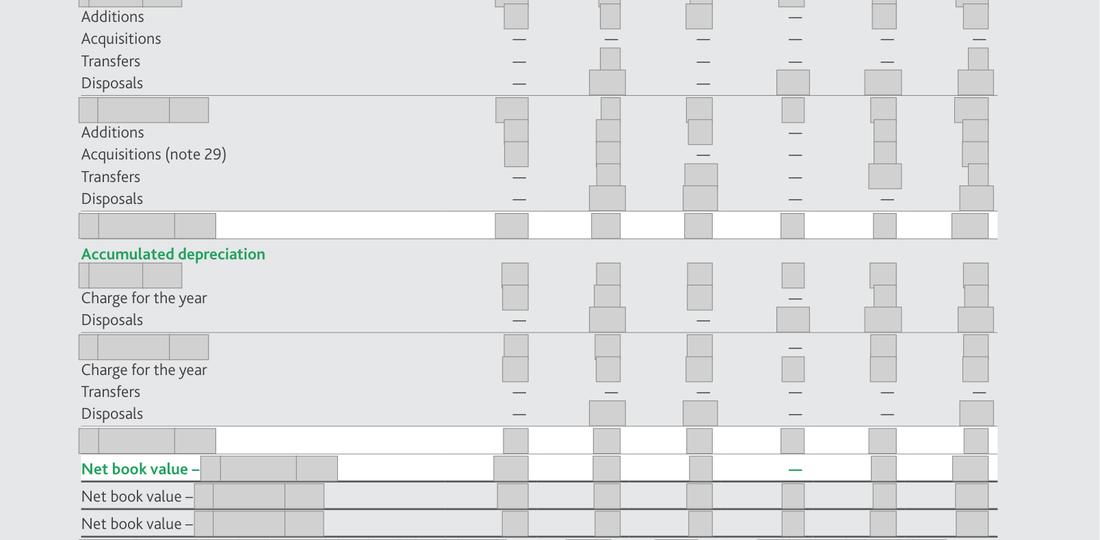
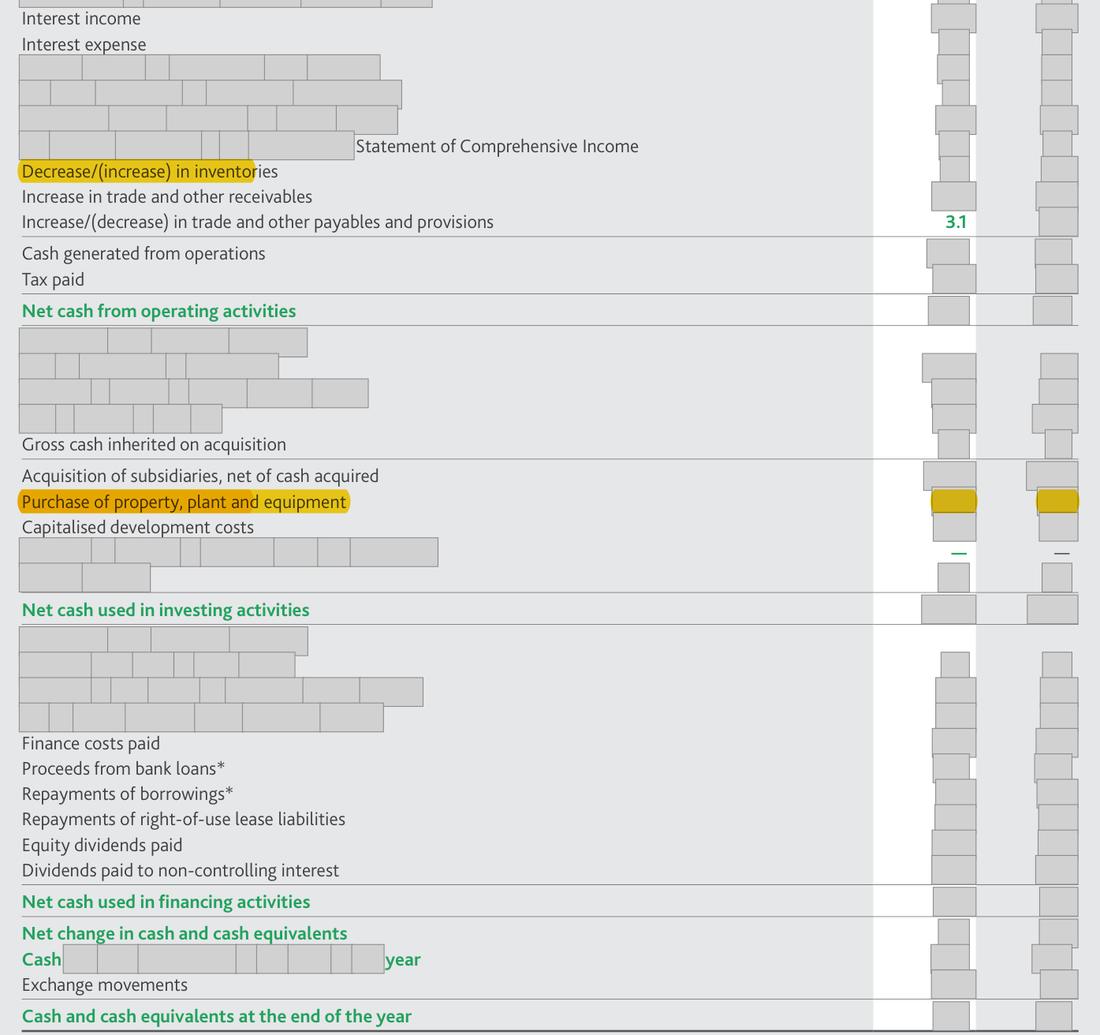
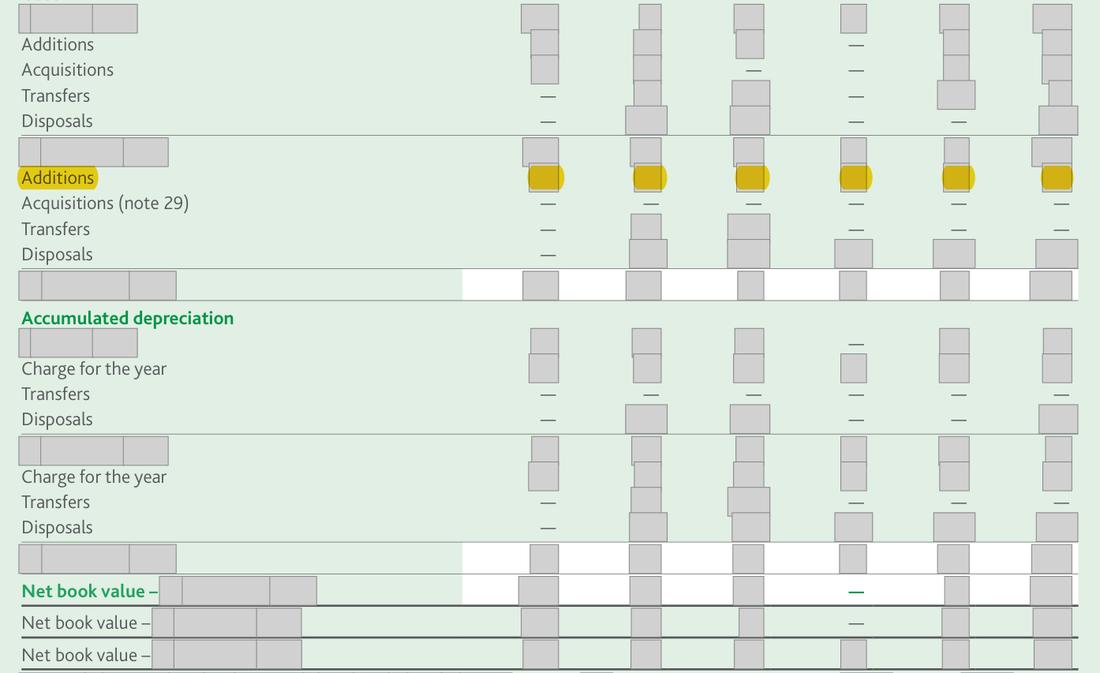
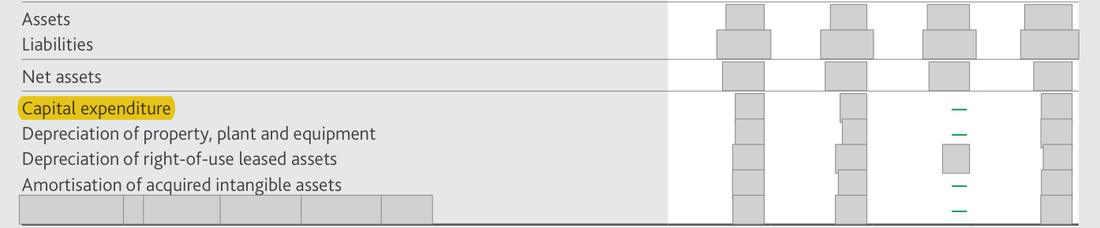
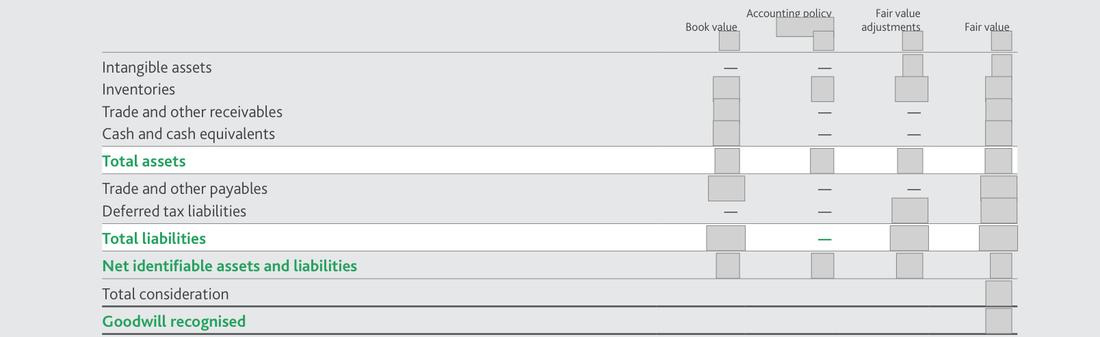
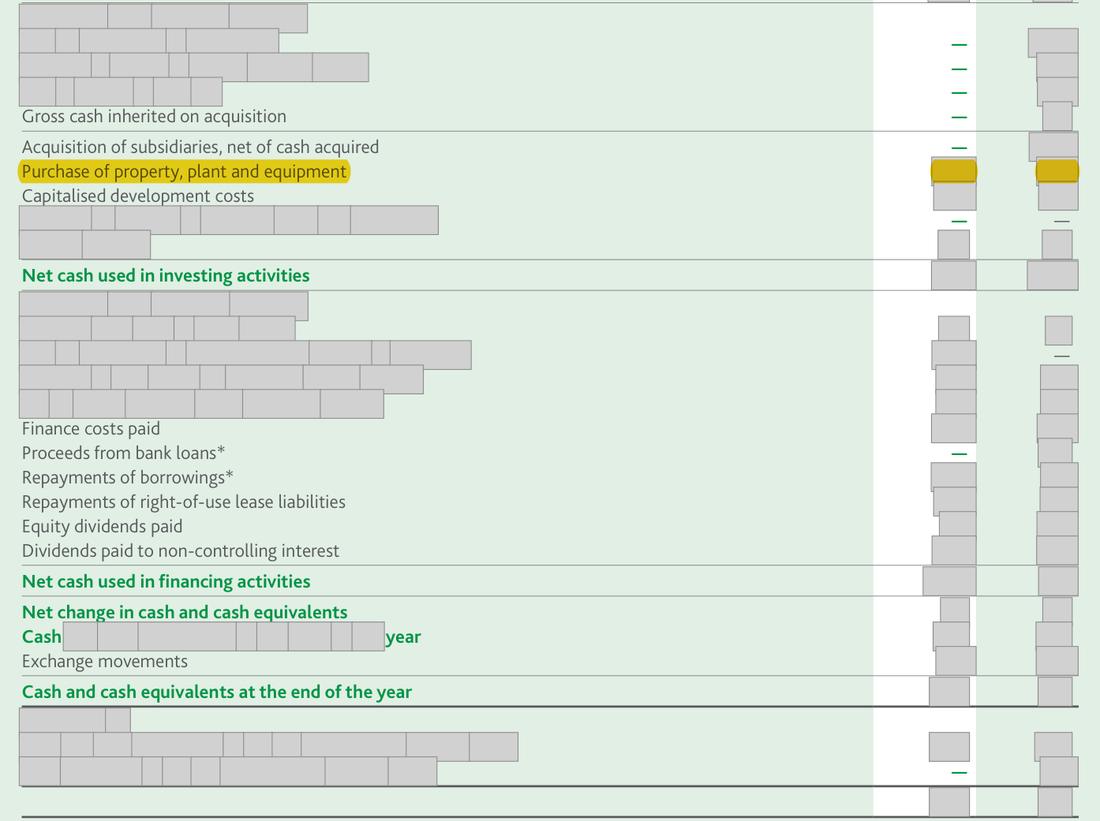
Further pages withheld to protect the company’s identity (two): Annual Report 2024, page 19; Annual Report 2024, page 84. Their wording or layout could lead back to the company even with names and figures masked; the evidence list below records what each page shows.
Names, figures, dates, logos and any wording that could be searched back to the company are boxed out in grey; the point is highlighted in yellow.
What the report shows, and what the rule requires
| What the annual report shows | What the rule requires |
|---|---|
| What the annual report shows Purchase of property, plant and equipment [amount] (cash flow); capital expenditure [amount] (segment note, strategic report); additions [amount] plus transfers from stock [amount] (note [n]) | What the rule requires Cash paid for property, plant and equipment that ties to additions, adjusted for any capital creditors, with non-cash transfers from stock excluded from investing cash flows (or the reconciling item explained) |
What we checked: Note 15 movement table on the page image for 2023 and 2024; the 2024 and 2025 cash flow statements; segment capital expenditure; the strategic report cash flow section
The rule
IAS 7 Statement of Cash Flows, paragraph 43
Version relied on: UK-adopted international accounting standards (UK Endorsement Board), as in force for financial years beginning in or after January 2025
Investing and financing transactions that use no cash or cash equivalents are excluded from the cash flow statement (and disclosed elsewhere).
IAS 7 Statement of Cash Flows, paragraph 16
Version relied on: UK-adopted international accounting standards (UK Endorsement Board), as in force for financial years beginning in or after January 2025
Only spending that results in a recognised asset may be classified as an investing cash flow.
Why it applies here: either [amount] of 2023 capital creditors was paid in 2024 (the payables note gives no capital creditor figure), or the stock transfer was presented as if it were a cash purchase, which would overstate investing outflows and operating inflows by the same [amount].
Why it matters
If the transfer from stock was included in the cash purchase line, investing outflows and operating inflows for 2024 are each overstated by [amount] and the capital expenditure figure in the strategic report and segment note is overstated by the same amount; if capital creditors explain it, the report gives no figure from which a reader could see that.
Exposure
A question for management; no breach is asserted unless the [amount] is the non-cash transfer.
Our workings
note [n] shows 2024 additions of [amount] and transfers of [amount], explained as '[wording masked]'. The cash flow statement shows purchase of property, plant and equipment of [amount] (2023: [amount]); the segment note shows capital expenditure of [amount] and the strategic report says [wording masked] amounted to [amount].
[n] - [n] = [n], exactly the transfers line ([n] + [n] = [n]). In 2023 the transfers were also [amount] but the cash outflow equalled additions ([n] - [n] = [n]); in the 2025 report, additions of [amount] equal cash of [amount].
IAS 7 excludes non-cash investing transactions from the cash flow statement. The report gives no reconciling item, so only management can say which.
| Year | Additions (note [n]) | Cash paid for PPE (cash flow) | Difference | Transfers from stock |
|---|---|---|---|---|
| 2023 | [n] | [n] | [n] - [n] = [n] | [n] |
| 2024 | [n] | [n] | [n] - [n] = [n] | [n] |
| 2025 (2025 report) | [n] | [n] | [n] - [n] = [n] | nil net |
| 2024 additions plus transfers | [n] + [n] = [n] | |||
| Size against 2024 PBT | [n] / [n] = [n]% |
Management’s best defence, and our reply
The finance team would say that [amount] of capital items accrued at the end of 2023 was paid in 2024, so the cash outflow legitimately exceeds the year's additions, and that capital creditor movements are routinely netted in the cash flow statement without separate disclosure. That explanation is reasonable and could be right. The answer: the exact match with the [amount] transfer from stock, and the fact that the 2023 and 2025 cash outflows equal additions, make the alternative reading equally possible, and the report gives no capital creditor figure to tell the two apart; hence a question rather than a finding.
The fix
- Reconcile additions to the cash outflow in the note (for example 'Additions [n]; decrease in capital creditors [n]; cash paid [n]'), or, if the transfer was included, remove non-cash transfers from investing cash flows and state capital expenditure as [amount].
Question for the company
What makes up the [amount] 'Purchase of property, plant and equipment' in the 2024 cash flow statement, when note [n] records additions of [amount]: payment of capital creditors brought forward from 2023, or the [amount] of stock transferred into fixed assets? If it is the stock transfer, how is a non-cash transfer consistent with presentation as an investing cash outflow, and with describing [amount] as capital expenditure in the segment note and strategic report?
Evidence relied on
| # | What it shows | Type | Where |
|---|---|---|---|
| 1 | 2024 [wording masked] total [amount] | Document | Annual Report 2024, page 82 |
| 2 | 2024 transfers into property, plant and equipment of [amount] | Document | Annual Report 2024, page 82 |
| 3 | The transfers are stock moved into fixed assets, a non-cash movement | Document | Annual Report 2024, page 82 |
| 4 | 2023 additions of [amount], equal to the 2023 cash outflow | Document | Annual Report 2024, page 82 |
| 5 | Cash flow statement: [amount] paid in 2024 (2023: [amount]) | Document | Annual Report 2024, page 70 |
| 6 | Segment note: capital expenditure of [amount] in 2024 | Document | Annual Report 2024, page 76 |
| 7 | Strategic report: [wording masked] of [amount] | Document | Annual Report 2024, page 19 |
| 8 | 2025 cash outflow [amount]; the 2024 comparative is unchanged at [amount] | Document | Annual Report 2025, page 68 |
| 9 | 2025 additions of [amount] equal the 2025 cash outflow | Document | Annual Report 2025, page 83 |
| 10 | 2024 decrease in inventories [n] equals the whole balance-sheet movement ([n] + [n] + [n] - [n] = [n]), so it includes the [n] transferred out to plant | Document | Annual Report 2024, page 70 |
| 11 | Inventories [n] at end-2024 and [n] at end-2023 | Document | Annual Report 2024, page 84 |
| 12 | Inventories acquired with [subsidiary] [n] | Document | Annual Report 2024, page 93 |
| 13 | Inventories acquired with [name] [subsidiary] [n] | Document | Annual Report 2024, page 95 |
| 14 | 2023 additions [n] equal 2023 cash purchases [n]: the 2023 transfer from stock of [n] was kept out of the purchase line | Document | Annual Report 2024, page 82 |
| 15 | Purchases [n] in 2024 (additions [n] + transfer [n]) against [n] in 2023 (additions only) | Document | Annual Report 2024, page 70 |
Prepared by Pramanex from the company’s published annual reports, without the company’s involvement, to show how an annual report review reads. The company is not named, and nothing on this page is a statement about any identifiable company. Observations are not an audit, review or other assurance engagement, and not legal advice. A regulator-style question is a question, not a conclusion.
Want this on your own annual report, before it is published?
Start with three free findings on your latest published annual report, or talk to us about a fixed-fee pre-publication review.
Your annual report will be in draft before the year-end audit.
Have it read before it is published.
Under NDA, with our reviewer on your insider list under UK MAR.