1.18 The 2024 balance sheet shows all provisions as current although note [n] shows [amount] due after more than one year, and the 2025 report keeps that comparative (both years)
UK Company C · an AIM-quoted scientific instruments group · Regulator-style question
In brief
The 2024 consolidated balance sheet presents the whole [amount] of provisions within current liabilities and none within non-current liabilities. Note 21 on the same accounts splits the [amount] into [amount] falling due before one year and [amount] of dilapidations falling due after more than one year. In the 2025 report the company splits its 2025 provisions on the balance sheet ([amount] current, [amount] non-current) but leaves the 2024 comparative, in a column headed 'Restated', at [amount] current and nil non-current. The [amount] is [n]% of 2024 profit before tax and [n]% of current liabilities.
The evidence, as filed
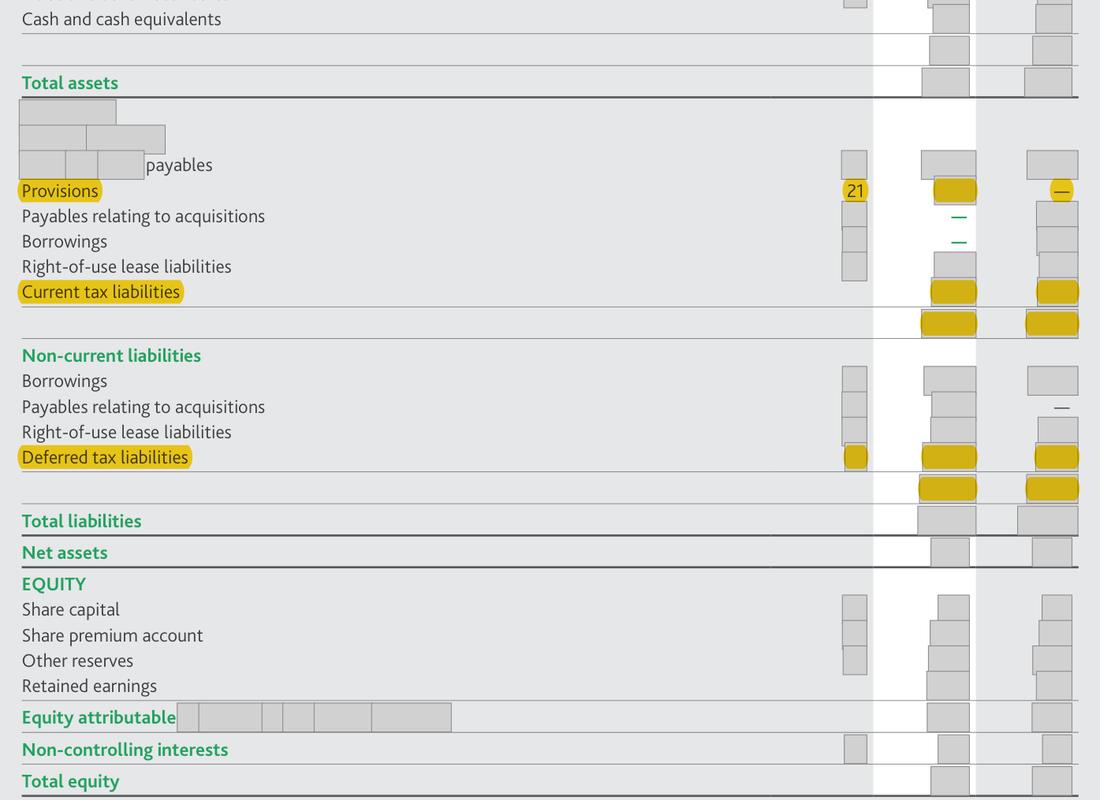
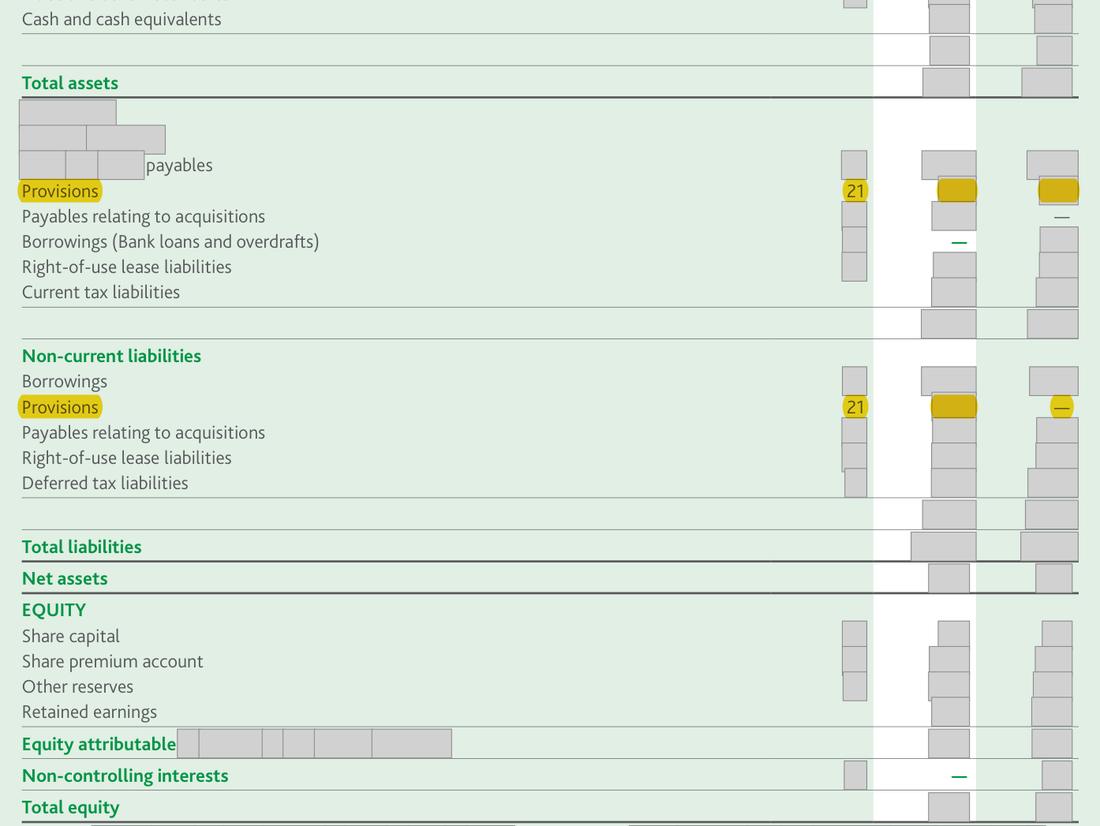
Further pages withheld to protect the company’s identity (two): Annual Report 2024, page 85; Annual Report 2025, page 86. Their wording or layout could lead back to the company even with names and figures masked; the evidence list below records what each page shows.
Names, figures, dates, logos and any wording that could be searched back to the company are boxed out in grey; the point is highlighted in yellow.
What the report shows, and what the rule requires
| What the annual report shows | What the rule requires |
|---|---|
| What the annual report shows 2024 balance sheet: provisions ([n]) in current liabilities, nil in non-current liabilities; note [n]: [wording masked] one year [n] (dilapidations); 2025 report: provisions ([n]) current and ([n]) non-current for 2025, comparative ([n]) current and nil non-current | What the rule requires The [amount] of dilapidations due after more than one year presented in non-current liabilities (current provisions [amount]), or the reason for keeping it current stated; and the 2024 comparative in the 2025 report reclassified on the same basis as 2025, with the nature, amount and reason given |
What we checked: Balance sheets and note [n] of both reports on the page images; IAS 1 paragraphs 41, 60, 61 and 69; materiality against 2024 profit before tax of [amount]
The rule
IAS 1 Presentation of Financial Statements, paragraph 60
Version relied on: UK-adopted international accounting standards (UK Endorsement Board), as in force for financial years beginning in or after January 2025
Current and non-current assets and liabilities must be shown as separate classifications on the balance sheet (unless a liquidity presentation is more relevant).
IAS 1 Presentation of Financial Statements, paragraph 69
Version relied on: UK-adopted international accounting standards (UK Endorsement Board), as in force for financial years beginning in or after January 2025
A liability is current if it is expected to be settled in the normal operating cycle, held for trading or due within twelve months of the year end (or the entity lacks the right to defer settlement); all others are non-current.
IAS 1 Presentation of Financial Statements, paragraph 41
Version relied on: UK-adopted international accounting standards (UK Endorsement Board), as in force for financial years beginning in or after January 2025
When presentation or classification changes, the comparatives must be reclassified (unless impracticable), with disclosure of what was reclassified, how much and why.
Why it applies here: IAS 1 paragraph 69 makes a liability current only if it is settled in the operating cycle, held for trading, due within twelve months or not deferrable; a dilapidations obligation due at the end of a lease is none of these on the note's own description, so the [amount] falls to be non-current.
Why it matters
The 2024 balance sheet shows working-capital liabilities [amount] higher and long-term liabilities [amount] lower than the company's own maturity analysis, and the 2025 report compares a split 2025 figure with an unsplit 2024 figure.
Exposure
A presentation question; total liabilities, net assets and profit are unaffected.
Our workings
the 2024 balance sheet shows provisions of [amount] among current liabilities (total [amount]) and lists borrowings, payables relating to acquisitions, lease liabilities and deferred tax as the non-current liabilities (total [amount]). Note 21 gives [wording masked] of [amount] (all warranties) and after more than one year of [amount] (all dilapidations), which relate to restoring leased property at the end of the lease. The 2025 report presents 2025 provisions as [amount] current and [amount] non-current, matching its note [n], while its 2024 comparative stays at [amount] current and nil non-current.
on the note's own split, 2024 current liabilities would be [n] - [n] = [amount] and non-current liabilities [n] + [n] = [amount]; the amount is [n] / [n] = [n]% of 2024 profit before tax and [n] / [n] = [n]% of current liabilities. Total liabilities and net assets are unchanged.
When the company began splitting provisions in 2025, IAS 1 paragraph 41 called for the comparative to be reclassified, which the note's own figures made practicable.
| Item (£m) | Figure |
|---|---|
| 2024 provisions due after more than one year (note [n]) | [n] |
| 2024 provisions presented as current (note [n] split) | [n] + [n] = [n] |
| 2024 current liabilities on the note's split | [n] - [n] = [n] |
| 2024 non-current liabilities on the note's split | [n] + [n] = [n] |
| Against 2024 profit before tax | [n] / [n] = [n]% |
| Against 2024 current liabilities | [n] / [n] = [n]% |
| 2025 balance sheet provisions (current + non-current) = note [n] | [n] + [n] = [n] |
Management’s best defence, and our reply
The finance team would say [amount] is immaterial to a balance sheet of over [amount], to current liabilities ([n]%) and to working-capital analysis, so IAS 1 and IAS 8 did not require the split, and note [n] already gives the paragraph 61 disclosure of the amount due after twelve months. They would add that the Financial Reporting Council reviewed the 2024 accounts and raised only the overdraft offset and an investment impairment. That case has weight: the amount is below a typical overall materiality for a profit of [amount], which is why the point is put as a question. Against it, the company's own 2025 balance sheet presents a smaller [amount] non-current amount, showing the split is practicable and that the company treats it as worth presenting, and paragraph 41 then asks for the comparative to follow.
The fix
- Present long-dated dilapidations within non-current provisions, and when the classification changes reclassify the comparative, for example: '2024 provisions of [amount] due after more than one year have been reclassified from current to non-current liabilities to conform with the current-year presentation.'
Question for the company
Why were the [amount] of dilapidations provisions that note [n] shows as falling due after more than one year presented within current liabilities on the 2024 balance sheet, and, when the 2025 balance sheet split provisions into current and non-current, why was the 2024 comparative not reclassified on the same basis (or the reason disclosed)?
Evidence relied on
| # | What it shows | Type | Where |
|---|---|---|---|
| 1 | 2024 balance sheet: the whole [amount] of provisions sits in current liabilities | Document | Annual Report 2024, page 68 |
| 2 | 2024 current liabilities total [amount] | Document | Annual Report 2024, page 68 |
| 3 | 2024 non-current liabilities end with deferred tax and total [amount], with no provisions line | Document | Annual Report 2024, page 68 |
| 4 | Note 21: [amount] of provisions (all warranties) due within a year | Document | Annual Report 2024, page 85 |
| 5 | Note 21: [amount] of dilapidations due after more than one year | Document | Annual Report 2024, page 85 |
| 6 | The dilapidations obligation falls due at the end of the lease, not in the operating cycle | Document | Annual Report 2024, page 85 |
| 7 | 2025 report: current provisions [amount] for 2025, comparative [amount] (column headed Restated) | Document | Annual Report 2025, page 66 |
| 8 | 2025 report: non-current provisions [amount] for 2025 and nil for the 2024 comparative | Document | Annual Report 2025, page 66 |
| 9 | 2025 note [n]: the [amount] non-current figure is the long-dated dilapidations, the split the 2024 balance sheet did not follow | Document | Annual Report 2025, page 86 |
Prepared by Pramanex from the company’s published annual reports, without the company’s involvement, to show how an annual report review reads. The company is not named, and nothing on this page is a statement about any identifiable company. Observations are not an audit, review or other assurance engagement, and not legal advice. A regulator-style question is a question, not a conclusion.
Want this on your own annual report, before it is published?
Start with three free findings on your latest published annual report, or talk to us about a fixed-fee pre-publication review.
Your annual report will be in draft before the year-end audit.
Have it read before it is published.
Under NDA, with our reviewer on your insider list under UK MAR.