3.04 'Underlying cash flow' is defined four different ways and the label is used for two figures [amount] apart
UK Company B · a UK-listed technology and logistics group · Presentation point
In brief
Underlying cash flow is a headline KPI and a pay measure. The 2025 report defines it in four places with four different lists of exclusions (the fourth in the performance share plan targets), and none of them mentions the [amount] Letter of Credit proceeds that the headline figure of [amount] excludes. The same label is used for [amount] (including the Letter of Credit) in the Financial Review and [amount] in the remuneration report. The 'costs of financing' that every definition excludes are in fact [amount] of net borrowing proceeds and [amount] of share proceeds. The 2024 report also defined the measure differently in the Financial Review and the APM section.
The evidence, as filed
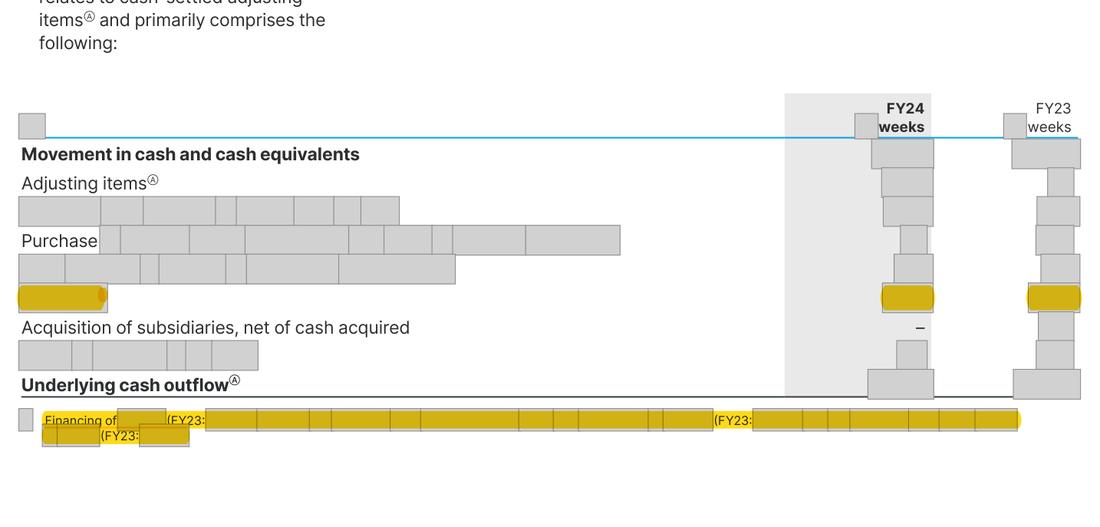
Further pages withheld to protect the company’s identity (seven): Annual Report 2025, page 1; Annual Report 2024, page 40; Annual Report 2025, page 42; Annual Report 2024, page 241; Annual Report 2025, page 273; Annual Report 2025, page 133; Annual Report 2025, page 146. Their wording or layout could lead back to the company even with names and figures masked; the evidence list below records what each page shows.
Names, figures, dates, logos and any wording that could be searched back to the company are boxed out in grey; the point is highlighted in yellow.
What the report shows, and what the rule requires
| What the annual report shows | What the rule requires |
|---|---|
| What the annual report shows p.1: excludes adjusting items, held-for-sale disposals, loans to investee companies, contingent consideration, 'costs of financing', unlisted equity disposal proceeds and FX; p.42: adds purchases of unlisted equity investments and acquisitions of subsidiaries ('costs of new financing activity'); p.273: lists neither loans to investee companies nor unlisted equity disposal proceeds; p.146 (performance share plan target footnote): excludes adjusting items, transaction costs of refinancing, mergers and acquisitions activity and foreign exchange only. Reconciliation: '[wording masked])' ([n]), less Letter of Credit ([n]) = 'Underlying cash flow' ([n]). p.133: '[amount]' including the Letter of Credit. | What the rule requires One definition, repeated word for word wherever the measure is defined, that lists every item the reconciliation excludes (including the Letter of Credit proceeds and net borrowing and share proceeds, described as such); and a distinct label for the version that includes the Letter of Credit, with the remuneration report saying which version it uses and why. |
What we checked: Every definition and use of the measure in both reports (highlights, KPI page, CFO letter, Financial Review, APM section, remuneration report); the reconciliation recomputed for both years.
The rule
ESMA Guidelines on Alternative Performance Measures, paragraphs 20-21
Version relied on: ESMA Guidelines on Alternative Performance Measures, ESMA/2015/1415, published October 2015, applying from July 2016; the FCA expects UK issuers to continue to apply them after EU exit
Issuers or persons responsible for the prospectus should define the APMs used and their components as well as the basis of calculation adopted
ESMA Guidelines on Alternative Performance Measures, paragraph 41
Version relied on: ESMA Guidelines on Alternative Performance Measures, ESMA/2015/1415, published October 2015, applying from July 2016; the FCA expects UK issuers to continue to apply them after EU exit
The definition and calculation of an APM should be consistent over time.
FRC Guidance on the Strategic Report ([date]), paragraphs 7A.73 and 7A.75
Version relied on: FRC Guidance on the Strategic Report, July 2014, revised July 2018 and June 2022 (non-mandatory guidance)
Similar KPIs should be clearly distinguishable from each other.
Why it applies here: the arithmetic is transparent, so nothing is hidden, but a reader cannot tell from any definition which items are excluded or which of the two numbers is 'underlying cash flow'; the FRC guidance asks that similar KPIs be clearly distinguishable and that terms be unique and used consistently, including between the strategic report and the remuneration report.
Why it matters
The headline cash KPI cannot be reproduced from any one of its definitions, and the label covers two numbers [amount] apart, one used in the KPI chart and one in the remuneration report. This weakens the comparability the APM is meant to give and invites an FRC question on APM definitions and labelling.
What the regulator has said on this point
The same FRC thematic review (October 2021) asks for complete and transparent reconciliations of alternative performance measures, and for terms such as 'underlying' to be explained.
Source: FRC review of Alternative Performance Measures by UK companies finds room for improvement, thematic review, October 2021
Exposure
No fine. Possible FRC Corporate Reporting Review letter on APM definitions and an undertaking to align them in the next Annual Report.
Our workings
the 2025 report defines underlying cash flow on p.1 (highlights footnote), p.42 (Financial Review) and p.273 (APM section). The performance share plan target footnote gives a fourth list (adjusting items, transaction costs of refinancing, mergers and acquisitions activity and foreign exchange). The lists differ (see the matrix in the further workings for the first three): p.273 does not exclude loans to investee companies or proceeds from disposals of unlisted equity investments, which the reconciliation does exclude ([amount] and part of [amount] in 2025); p.1 does not mention purchases of unlisted equity investments. All three exclude 'costs of financing' or 'costs of new financing activity', but the reconciliation's 'Financing' line of [amount] is net proceeds from borrowings ([amount]) and from share issues ([amount]). None of the definitions excludes the Letter of Credit proceeds, yet the headline figure on p.1, the KPI chart on p.11 and the Financial Review deduct [amount] to reach [amount], while the line above it, also marked as the APM, is [amount] 'incl. Letter of Credit'. The remuneration report reports the [wording masked] [customer] Letter of Credit drawdown, [amount]. The 2024 report likewise defined the measure differently on p.40 and p.241.
the reconciliation foots (workings): [n] - [n] - [n] - [n] - [n] + [n] = ([n]); ([n]) - [n] = ([n]). The two figures labelled as the APM differ by [amount], 30% of the loss before tax.
| Underlying cash flow reconciliation (£m) | 2025 | 2024 |
|---|---|---|
| Movement in cash and cash equivalents (pro-forma) | [n] | ([n]) |
| Less adjusting items, disposals, investments, contingent consideration, financing, add FX | [n] - [n] - [n] - [n] - [n] + [n] = ([n]) | ([n]) - [n] - [n] + [n] - [n] - [n] + [n] = ([n]) |
| '[wording masked])' as printed | ([n]) | ([n]) |
| Less Letter of Credit proceeds | ([n]) - [n] = ([n]) | n/a |
| Financing line = net borrowing + share proceeds | [n] + [n] = [n] | [n] + [n] = [n] |
| Gap between the two figures labelled as the APM, as % of loss before tax | [n] / [n] = 30% |
| Item | p.1 definition | p.42 definition | p.273 definition | Reconciliation 2025 (£m) |
|---|---|---|---|---|
| Adjusting items | Yes | Yes | Yes | ([n]) |
| Proceeds from disposal of unlisted equity investments | Yes | Yes | No | ([n]) |
| Purchase of unlisted equity investments | No | Yes | Yes | within ([n]) |
| Loans to investee companies | Yes | Yes | No | within ([n]) |
| Financing | 'costs of financing' | 'costs of new financing activity' | 'costs of financing' | ([n]) = net borrowing and share proceeds |
| Acquisition of subsidiaries | No | Yes | Yes | nil |
| Letter of Credit proceeds | No | No | No | ([n]) to reach ([n]) |
Management’s best defence, and our reply
Management would say the Financial Review definition sits next to a line-by-line reconciliation, so every excluded item and the Letter of Credit deduction is visible, and that the shorter definitions on pp.1 and [n] are summaries. They would add that the headline says in terms that it excludes the [amount] Letter of Credit, and that the remuneration report deliberately uses the version including it because the Committee set its targets on that basis. However, four definitions with different item lists cannot all be the definition, none of them mentions the Letter of Credit, the 'costs of financing' wording describes something different from the [amount] of net proceeds actually excluded, and the FRC guidance asks for unique terms used consistently between the strategic report and the remuneration report.
The fix
- Adopt one definition, e.g. 'movement [wording masked] disposals [wording masked] unlisted equity investments, purchases [wording masked], contingent consideration received, acquisitions of subsidiaries, net proceeds from borrowings and share issues, Letter of Credit proceeds and FX', repeat it verbatim on pp.1, [n] and [n], and rename the [amount] figure (e.g. 'underlying cash flow including Letter of Credit') with the remuneration report stating which measure it uses.
Evidence relied on
| # | What it shows | Type | Where |
|---|---|---|---|
| 1 | Definition 1 (highlights footnote) | Document | Annual Report 2025, page 1 |
| 2 | Headline figure excludes the Letter of Credit | Document | Annual Report 2025, page 1 |
| 3 | Definition 2 (Financial Review) | Document | Annual Report 2025, page 42 |
| 4 | Starting point of the reconciliation | Document | Annual Report 2025, page 42 |
| 5 | Excluded in the reconciliation but not in the APM-section definition | Document | Annual Report 2025, page 42 |
| 6 | Loans to investee companies excluded in the reconciliation but not in the APM-section definition | Document | Annual Report 2025, page 42 |
| 7 | The 'financing' excluded is net proceeds, not costs | Document | Annual Report 2025, page 42 |
| 8 | First figure labelled as the APM | Document | Annual Report 2025, page 42 |
| 9 | Deduction not mentioned in any definition | Document | Annual Report 2025, page 42 |
| 10 | Second figure under the same label | Document | Annual Report 2025, page 42 |
| 11 | Definition 3 (APM section) | Document | Annual Report 2025, page 273 |
| 12 | Remuneration report uses the version including the Letter of Credit | Document | Annual Report 2025, page 133 |
| 13 | 2024 Financial Review definition | Document | Annual Report 2024, page 40 |
| 14 | 2024 APM-section definition differs from the 2024 Financial Review (no loans to investee companies) | Document | Annual Report 2024, page 241 |
| 15 | The 2024 reconciliation of cash movement to underlying cash outflow removes a 'Financing' line of [amount] | Document | Annual Report 2024, page 39 |
| 16 | The footnote shows the excluded 'Financing' is net borrowing proceeds and share-issue proceeds, not costs | Document | Annual Report 2024, page 39 |
| 17 | The definition next to the reconciliation describes the exclusion as 'costs of new financing activity' | Document | Annual Report 2024, page 40 |
| 18 | The underlying cash flow bridge deducts all financing flows of [amount] (2024: [amount]) | Document | Annual Report 2025, page 42 |
| 19 | The deducted financing is net borrowing proceeds and share issue proceeds, not only financing costs | Document | Annual Report 2025, page 42 |
| 20 | The definition printed beneath the bridge excludes only the costs of new financing activity | Document | Annual Report 2025, page 42 |
| 21 | The 2025 performance share award measures a variant of underlying cash flow | Document | Annual Report 2025, page 146 |
| 22 | A fourth list of exclusions: transaction costs of refinancing and mergers and acquisitions, with no held-for-sale disposals, loans to investee companies, contingent consideration or Letter of Credit | Document | Annual Report 2025, page 146 |
Prepared by Pramanex from the company’s published annual reports, without the company’s involvement, to show how an annual report review reads. The company is not named, and nothing on this page is a statement about any identifiable company. Observations are not an audit, review or other assurance engagement, and not legal advice. A regulator-style question is a question, not a conclusion.
Want this on your own annual report, before it is published?
Start with three free findings on your latest published annual report, or talk to us about a fixed-fee pre-publication review.
Your annual report will be in draft before the year-end audit.
Have it read before it is published.
Under NDA, with our reviewer on your insider list under UK MAR.