3.02 The Financial Review gives pro-forma profit before tax and earnings per share under the statutory names, without the audited figures beside them
UK Company B · a UK-listed technology and logistics group · Presentation point
In brief
The Financial Review says 'Profit before tax was [amount]' and shows a 'Basic earnings/(loss) per share' of [amount] (2024: ([n])p); both are pro-forma figures, with [former subsidiary] equity accounted for the whole year, but neither carries the pro-forma marker. The audited income statement shows a loss before tax from continuing operations of [amount] and a basic profit per share of [amount] (2024: ([n])p), and the pro-forma reconciliation in the alternative performance measures (APM) section stops at the pre-adjusting loss before tax of [amount]. The 2024 Financial Review gave the statutory loss per share first and marked each alternative row.
The evidence, as filed
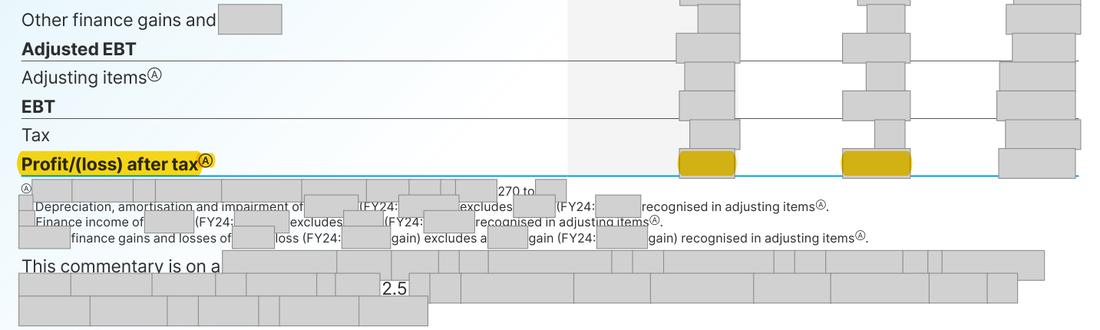
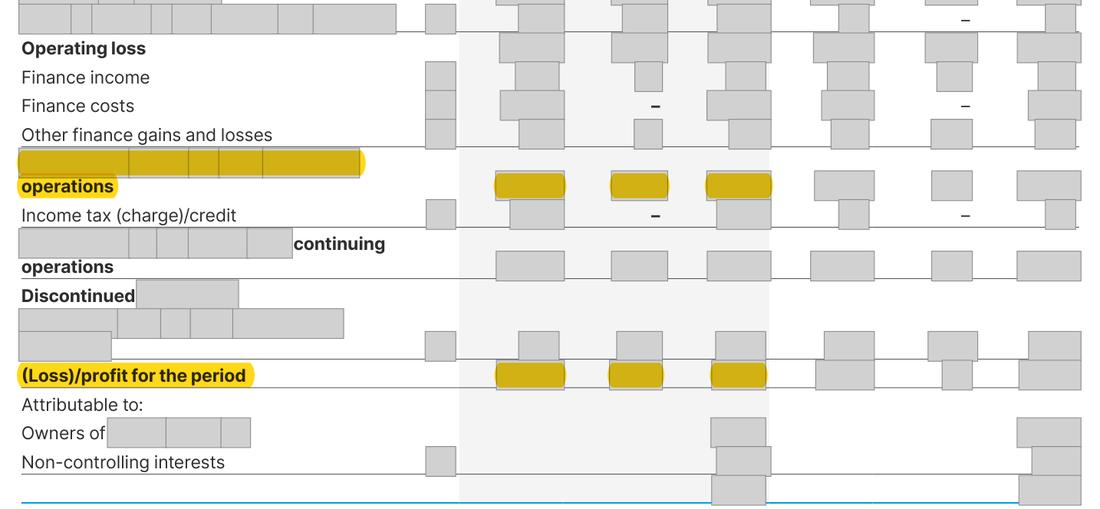
Further pages withheld to protect the company’s identity (four): Annual Report 2025, page 27; Annual Report 2024, page 30; Annual Report 2025, page 272; Annual Report 2025, page 1. Their wording or layout could lead back to the company even with names and figures masked; the evidence list below records what each page shows.
Names, figures, dates, logos and any wording that could be searched back to the company are boxed out in grey; the point is highlighted in yellow.
What the report shows, and what the rule requires
| What the annual report shows | What the rule requires |
|---|---|
| What the annual report shows Financial Review p.27: 'Profit before tax was [amount] (FY24: [amount] loss)' and 'Basic earnings/(loss) per share [n] ([n])', with no pro-forma or APM marker; income statement p.183: loss before tax from continuing operations ([n]), basic profit per share [n] (2024: ([n])). Highlights p.1 give adjusting items as [amount] in the statutory profit bullet and as [amount] (the pro-forma total) in footnote 6, without saying which basis each uses. | What the rule requires Each pro-forma figure in the Financial Review labelled 'pro-forma' with the APM marker and shown beside the audited figure of the same name (loss before tax from continuing operations; basic earnings per share under IAS 33), with the pro-forma reconciliation carried down to profit for the period; highlights footnote 6 to state that [amount] is the pro-forma total. |
The rule
ESMA Guidelines on Alternative Performance Measures, paragraph 24
Version relied on: ESMA Guidelines on Alternative Performance Measures, ESMA/2015/1415, published October 2015, applying from July 2016; the FCA expects UK issuers to continue to apply them after EU exit
Issuers or persons responsible for the prospectus should not use labels, titles or descriptions of measures defined in the applicable financial reporting framework that are the same or confusingly similar when referring to APMs.
ESMA Guidelines on Alternative Performance Measures, paragraph 27
Version relied on: ESMA Guidelines on Alternative Performance Measures, ESMA/2015/1415, published October 2015, applying from July 2016; the FCA expects UK issuers to continue to apply them after EU exit
Issuers or persons responsible for the prospectus should also present the most directly reconcilable line item, subtotal or total presented in the financial statements relevant for that specific APM.
FRC Guidance on the Strategic Report ([date]), paragraph 7A.76
Version relied on: FRC Guidance on the Strategic Report, July 2014, revised July 2018 and June 2022 (non-mandatory guidance)
Financial KPIs can be Alternative Performance measures (APMs) as defined in the European Securities and Markets Authority’s (ESMA) Guidelines on Alternative Performance Measures ... Even when not directly applicable, the guidelines set out principles for disclosure for APMs.
IAS 33 Earnings per Share, paragraph 10
Version relied on: UK-adopted international accounting standards (UK Endorsement Board), as in force for financial years beginning in or after January 2025
Basic earnings per share is profit or loss attributable to ordinary equity holders of the parent divided by the weighted average number of ordinary shares in issue in the period.
Companies Act 2006, section 414C(12)
Version relied on: Companies Act 2006, revised text on legislation.gov.uk as in force for the financial year reviewed
The report must, where appropriate, include references to, and additional explanations of, amounts included in the company’s annual accounts.
Why it applies here: 'basic earnings per share' is a measure defined by International Accounting Standard (IAS) [n] and 'profit before tax' is a line of the income statement.
Why it matters
A reader comparing the Financial Review with the accounts meets a different basic earnings per share and a profit before tax where the accounts show a loss from continuing operations, under the same names, and cannot reconcile them from the report.
What the regulator has said on this point
The FRC's thematic review of alternative performance measures (October 2021) expects them to be clearly defined and reconciled, and not to be given more prominence than their statutory equivalents.
Source: FRC review of Alternative Performance Measures by UK companies finds room for improvement, thematic review, October 2021
Exposure
A Financial Reporting Council Corporate Reporting Review question on the labelling of alternative performance measures, usually closed by an undertaking to change the next report.
Our workings
the Group summary table on p.24 is headed 'FY25 pro-forma' and ends with profit after tax of [n]. On p.27 the narrative repeats the pro-forma result as 'Profit before tax was [amount]' and the earnings per share table is headed 'Basic earnings/(loss) per share' with [n] and ([n]); neither line carries the pro-forma marker. The audited income statement on p.183 shows a loss before tax from continuing operations of ([n]), a profit for the period of [n], adjusting items of [n] and basic profit per share of [n] (2024: ([n])). The APM section on p.272 defines the pro-forma income statement as an APM and reconciles it only as far as the loss before tax before adjusting items, ([n]).
the two basic earnings per share figures differ by [amount] in 2025 and [amount] in 2024; the two adjusting-item totals on p.1 differ by [n].
The European Securities and Markets Authority (ESMA) guidelines, which the Financial Reporting Council (FRC) says apply to strategic reports, ask issuers not to use the names of measures defined in the reporting framework for APMs, to present the directly reconcilable statutory line and to reconcile to it. Here the pro-forma figures take the statutory names, the statutory figures are not placed beside them, and no reconciliation reaches the [amount] or the [amount]. The 2024 report followed the practice the guidelines describe, so this is a change in the company's own presentation.
| Measure | Financial Review (pro-forma) | Income statement (statutory) | Difference |
|---|---|---|---|
| Basic earnings per share 2025 (pence) | [n] | [n] | [n] - [n] = [n] |
| Basic earnings per share 2024 (pence) | ([n]) | ([n]) | [n] - [n] = [n] |
| Adjusting items 2025 (£m) | [n] | [n] | [n] - [n] = [n] |
Management’s best defence, and our reply
The Financial Review says its commentary is on a pre-adjusting, pro-forma basis, the Group summary table on p.24 is headed 'pro-forma' with the APM symbol, and p.272 defines the pro-forma income statement as an APM; the full statutory income statement with its earnings per share follows in the accounts. Management would say that equity accounting [former subsidiary] for the whole of both years gives the more useful comparison and that a reader of the review knows the basis. However, the sentence on profit before tax and the earnings per share table on p.27 carry no marker, use the names of the audited measures and differ from them, and the p.272 reconciliation stops before adjusting items, so neither the profit before tax nor the earnings per share in the review is reconciled anywhere. The 2024 report labelled every such row and led with the statutory figure, which shows the fix costs nothing.
The fix
- Label the line 'Pro-forma basic earnings per share' and the sentence 'Pro-forma profit before tax' with the APM marker, show the statutory loss before tax from continuing operations and basic profit per share beside them, carry the p.272 reconciliation down to profit for the period, and state in highlights footnote 6 that [amount] is the pro-forma total.
Evidence relied on
| # | What it shows | Type | Where |
|---|---|---|---|
| 1 | The Financial Review states the pro-forma result under the statutory name 'profit before tax', with no pro-forma marker | Document | Annual Report 2025, page 27 |
| 2 | The earnings per share table uses the IAS 33 name for the pro-forma figures [amount] and ([n])p, with no marker | Document | Annual Report 2025, page 27 |
| 3 | The Group summary table, headed 'FY25 pro-forma', gives pro-forma profit after tax of [n] | Document | Annual Report 2025, page 24 |
| 4 | The audited income statement shows a loss before tax from continuing operations of ([n]) | Document | Annual Report 2025, page 183 |
| 5 | Audited profit for the period is [n], with adjusting items of [n] | Document | Annual Report 2025, page 183 |
| 6 | Audited basic profit per share is [amount] (2024: ([n])p) | Document | Annual Report 2025, page 183 |
| 7 | The pro-forma reconciliation in the APM section ends at the loss before tax before adjusting items, ([n]) | Document | Annual Report 2025, page 272 |
| 8 | The highlights bullet uses the statutory adjusting-items total ([n] rounded) | Document | Annual Report 2025, page 1 |
| 9 | Footnote 6 on the same page uses the pro-forma total, without saying so | Document | Annual Report 2025, page 1 |
Prepared by Pramanex from the company’s published annual reports, without the company’s involvement, to show how an annual report review reads. The company is not named, and nothing on this page is a statement about any identifiable company. Observations are not an audit, review or other assurance engagement, and not legal advice. A regulator-style question is a question, not a conclusion.
Want this on your own annual report, before it is published?
Start with three free findings on your latest published annual report, or talk to us about a fixed-fee pre-publication review.
Your annual report will be in draft before the year-end audit.
Have it read before it is published.
Under NDA, with our reviewer on your insider list under UK MAR.