1.30 The share-based payment add-back in the cash flow reconciliation is the total charge for 2025 but only the equity-settled charge for 2024
UK Company B · a UK-listed technology and logistics group · Regulator-style question
In brief
The reconciliation of [wording masked] adds back a share-based payments charge of [amount] for 2025 and [amount] for 2024. Note 4.7 shows that [amount] is the total 2025 expense including [amount] that is cash-settled, while [amount] is only the 2024 equity-settled expense (the 2024 total was [amount]). The two years are therefore on different bases, and the Financial Review repeats the mixed pair.
The evidence, as filed
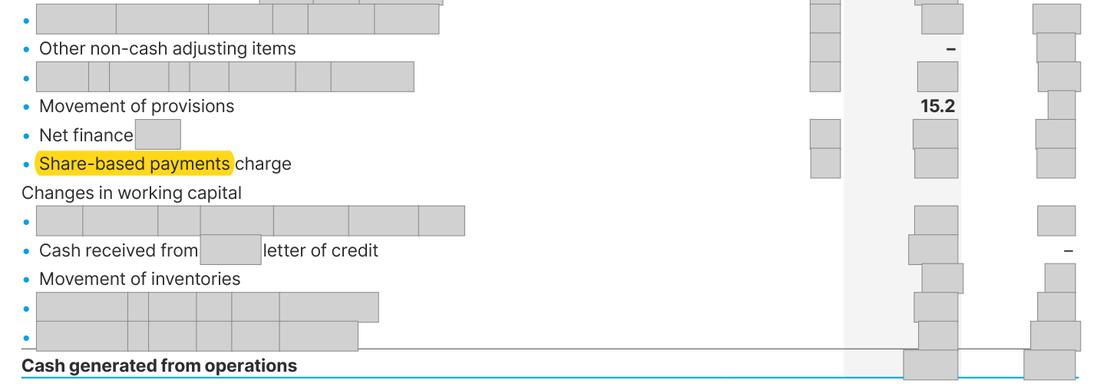
Further pages withheld to protect the company’s identity (three): Annual Report 2025, page 246; Annual Report 2025, page 41; Annual Report 2025, page 245. Their wording or layout could lead back to the company even with names and figures masked; the evidence list below records what each page shows.
Names, figures, dates, logos and any wording that could be searched back to the company are boxed out in grey; the point is highlighted in yellow.
What the report shows, and what the rule requires
| What the annual report shows | What the rule requires |
|---|---|
| What the annual report shows Cash flow reconciliation: share-based payments charge [amount] (2025) and [amount] (2024). Note 4.7: 2025 equity-settled [amount] + cash-settled [amount] = [amount]; 2024 equity-settled [amount] + cash-settled [amount] = [amount]. | What the rule requires The same basis in both years: either the equity-settled charge ([amounts]), with the cash-settled element in the movement of provisions or payables, or the total charge ([amounts]) with the matching liability movement shown elsewhere. |
The rule
IAS 1 Presentation of Financial Statements, paragraph 45
Version relied on: UK-adopted international accounting standards (UK Endorsement Board), as in force for financial years beginning in or after January 2025
Presentation and classification must stay the same from one year to the next, unless one of the stated exceptions applies.
Why it applies here: if the cash-settled liability movement is also within 'Movement of provisions' or payables, the 2025 add-back counts the [amount] twice and another line is reduced to compensate; if not, the 2024 comparative leaves the [amount] in a different line.
Why it matters
The operating cash flow reconciliation is not comparable between years on this line, and one year may show the cash-settled element twice within operating adjustments.
Exposure
A classification point inside the cash flow reconciliation; no penalty attaches. A correction or explanation in the next Annual Report is the remedy.
Our workings
Note 4.9 on p.253 adds back [amounts], each referenced to Note 4.7. Note 4.7 on p.246 splits the expense into equity-settled ([amount]; [amount]) and cash-settled ([amount]; [amount]). The 2024 report used [amount] as well. The accounting policy says the cash-settled cost, including employer taxes on equity-settled awards, is recognised with a corresponding provision.
the 2025 add-back equals the total expense ([n] + [n] = [n]); the 2024 add-back equals the equity-settled expense only ([n] - [n] = [n]).
Cash generated from operations is unaffected in total, so the question is about classification and consistency, which only the company can answer.
| Step | Computation | Result (GBP m) |
|---|---|---|
| 2025 total expense | [n] + [n] = [n] | [n] |
| 2024 total expense | [n] + [n] = [n] | [n] |
| 2024 add-back vs total expense | [n] - [n] = [n] | [n] |
| 2025 add-back vs equity-settled expense | [n] - [n] = [n] | [n] |
Management’s best defence, and our reply
Management could say that the cash-settled element is a non-cash expense until paid, so adding back the total charge is correct, and that in 2024 the [amount] was captured within the movement of provisions instead. They would add that the amounts are small and cash generated from operations is the same either way. That defence has merit on materiality, which is why the point is put as a question; it does not explain why the basis changed between the two years without comment.
The fix
- Use one basis for the add-back in both years and, if the comparative changes, footnote the change.
Question for the company
Why does the 2025 share-based payments add-back ([amount]) include the [amount] cash-settled expense when the 2024 add-back ([amount]) excludes the [amount] cash-settled expense, and in which line of the reconciliation is the movement in the cash-settled liability shown in each year?
Evidence relied on
| # | What it shows | Type | Where |
|---|---|---|---|
| 1 | Cash flow reconciliation add-back: [amount] for 2025, [amount] for 2024 | Document | Annual Report 2025, page 253 |
| 2 | Equity-settled expense: [amount] (2025), [amount] (2024) | Document | Annual Report 2025, page 246 |
| 3 | Cash-settled expense: [amount] (2025), [amount] (2024) | Document | Annual Report 2025, page 246 |
| 4 | The Financial Review repeats the same pair of figures | Document | Annual Report 2025, page 41 |
| 5 | Policy: the cash-settled employer tax cost is booked against a provision | Document | Annual Report 2025, page 245 |
Prepared by Pramanex from the company’s published annual reports, without the company’s involvement, to show how an annual report review reads. The company is not named, and nothing on this page is a statement about any identifiable company. Observations are not an audit, review or other assurance engagement, and not legal advice. A regulator-style question is a question, not a conclusion.
Want this on your own annual report, before it is published?
Start with three free findings on your latest published annual report, or talk to us about a fixed-fee pre-publication review.
Your annual report will be in draft before the year-end audit.
Have it read before it is published.
Under NDA, with our reviewer on your insider list under UK MAR.