1.32 The deferred tax movement table and the tax charge note give different deferred tax credits to profit or loss and opposite signs for the tax-rate effect
UK Company B · a UK-listed technology and logistics group · Regulator-style question
In brief
The tax charge note shows a total deferred tax credit of [n] in the income statement for 2024, including a [n] credit for the effect of a change in tax rate. The deferred tax movement table shows [n] credited to the income statement and a separate [n] reduction headed '[wording masked]', on UK-type balances, although the note says the 25% UK rate has applied since [date]. The two notes do not show how [n] and the [n] become [n], while for 2023 the two notes agree at [n].
The evidence, as filed
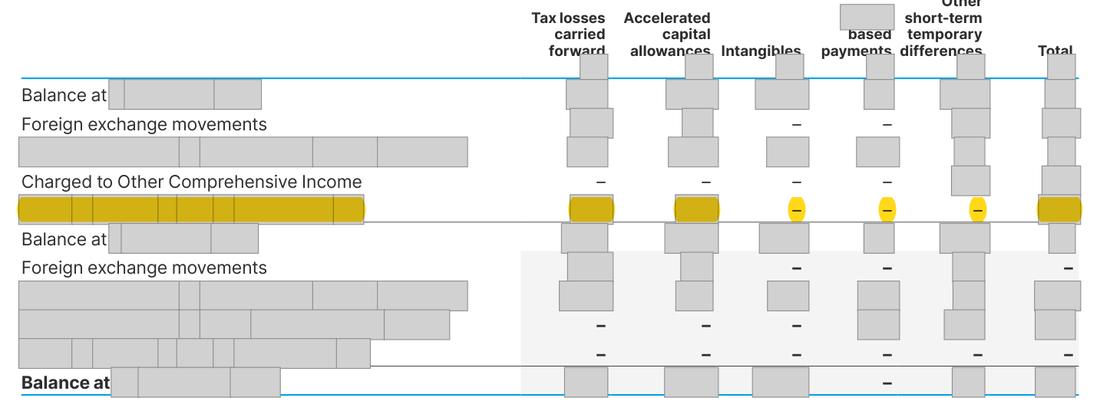
Further pages withheld to protect the company’s identity (two): Annual Report 2024, page 185; Annual Report 2024, page 186. Their wording or layout could lead back to the company even with names and figures masked; the evidence list below records what each page shows.
Names, figures, dates, logos and any wording that could be searched back to the company are boxed out in grey; the point is highlighted in yellow.
What the report shows, and what the rule requires
| What the annual report shows | What the rule requires |
|---|---|
| What the annual report shows Tax charge note: origination and reversal of temporary differences credit [n], [wording masked] credit [n], prior-year adjustments charge [n], total deferred tax credit [n]. Deferred tax movement table: credited to the income statement [n]; [wording masked] ([n]), split ([n]) tax losses and ([n]) accelerated capital allowances. | What the rule requires A movement table whose income statement line (with any rate-change line shown as passing through profit or loss) agrees with the [n] deferred tax credit in the tax charge note, and a rate-change effect described consistently in both notes, with a word on which rate changed. |
The rule
IAS 12 Income Taxes, paragraph 80(d)
Version relied on: UK-adopted international accounting standards (UK Endorsement Board), as in force for financial years beginning in or after January 2025
The accounts must disclose the deferred tax expense or income arising from changes in tax rates or new taxes.
IAS 12 Income Taxes, paragraph 81(g)(ii)
Version relied on: UK-adopted international accounting standards (UK Endorsement Board), as in force for financial years beginning in or after January 2025
For each type of temporary difference and unused tax loss or credit, the accounts must give the deferred tax recognised in profit or loss, if this is not apparent from the balance sheet movements.
Why it applies here: either the prior-year adjustment of [n] and the rate effect have been placed in different lines of the two notes, or part of the [n] was recognised outside profit or loss; the report does not say which.
Why it matters
A reader cannot tie the deferred tax movement by type to the deferred tax line in the income statement, which IAS 12 expects to be apparent, and cannot tell which tax rate change produced the [n].
Exposure
No regulatory consequence expected for an amount of this size; a disclosure question on the audited tax note.
Our workings
the tax charge note analyses the 2024 deferred tax credit of [n] into origination and reversal of temporary differences [n] credit, [wording masked] [n] credit and prior-year adjustments [n] charge; the rate reconciliation shows 'impact of tax rate changes' as a [n] credit. The deferred tax movement table shows [n] credited to the income statement and [n] charged as the effect of a change in the rate of corporation tax, against tax losses ([n]) and accelerated capital allowances ([n]); it does not say where the [n] was recognised. The same page says deferred tax is recognised at 25%, the UK rate in force from [date], so the UK rate did not change in 2024. For 2023 the movement table's income statement credit of [n] equals the tax charge note. The 2025 report repeats the 2024 rows unchanged.
see workings; the table's income statement line alone differs from the tax charge by [n], and with the rate-change line it differs by [n] but with the rate effect as a [n] charge instead of a [n] credit.
| Measure | Computation | Result |
|---|---|---|
| Deferred tax credit in the tax charge note | [n] + [n] - [n] = [n] | [n] credit |
| Movement table, income statement line alone | [n] - [n] = [n] | [n] more credit than the tax charge note |
| Movement table, income statement line with rate-change line | [n] - [n] = [n]; [n] - [n] = [n] | close, but the rate effect is a [n] charge here against a [n] credit in the tax charge note |
| 2023 comparison | [n] = [n] | the two notes agree for 2023 |
Management’s best defence, and our reply
Management could say the movement table presents the year's movements by type and is not meant to mirror the income statement analysis line by line, and that the [n] difference after including the rate-change line is rounding. They could add that the [n] relates to an overseas rate change on balances shown in the tax-loss and capital-allowance columns, and that the amount is far below materiality. That may well be the answer, which is why this is put as a question; but the signs of the rate effect differ between the two notes ([n] charge against [n] credit) and the [n] prior-year charge appears in neither line of the movement table, so the reconciliation cannot be made from the report.
The fix
- Show the prior-year adjustment and the rate-change effect as separate lines of the movement table, each marked as recognised in profit or loss or elsewhere, so that the income statement lines total the [n] in the tax charge note; name the jurisdiction whose rate changed.
Question for the company
How does the 2024 deferred tax movement table ([n] credited to the income statement and [n] charged as the effect of a change in the rate of corporation tax) reconcile to the deferred tax credit of [n] in the tax charge note, which shows the rate-change effect as a [n] credit and a prior-year charge of [n]? Which rate changed, and where was the [n] recognised?
Evidence relied on
| # | What it shows | Type | Where |
|---|---|---|---|
| 1 | Tax charge note: origination and reversal credit [n] in 2024 | Document | Annual Report 2024, page 185 |
| 2 | Tax charge note: rate-change effect is a [n] credit | Document | Annual Report 2024, page 185 |
| 3 | Tax charge note: deferred tax prior-year adjustment charge of [n] | Document | Annual Report 2024, page 185 |
| 4 | Tax charge note: total deferred tax credit [n] (2023: [n]) | Document | Annual Report 2024, page 185 |
| 5 | Movement table: [n] credited to the income statement in 2024 | Document | Annual Report 2024, page 186 |
| 6 | Movement table: a further [n] charged for a rate change, with no statement of where it was recognised | Document | Annual Report 2024, page 186 |
| 7 | Movement table: 2023 income statement credit [n] equals the tax charge note | Document | Annual Report 2024, page 186 |
| 8 | The UK rate was unchanged in 2024 | Document | Annual Report 2024, page 186 |
| 9 | The 2025 report repeats the 2024 rows unchanged | Document | Annual Report 2025, page 207 |
Prepared by Pramanex from the company’s published annual reports, without the company’s involvement, to show how an annual report review reads. The company is not named, and nothing on this page is a statement about any identifiable company. Observations are not an audit, review or other assurance engagement, and not legal advice. A regulator-style question is a question, not a conclusion.
Want this on your own annual report, before it is published?
Start with three free findings on your latest published annual report, or talk to us about a fixed-fee pre-publication review.
Your annual report will be in draft before the year-end audit.
Have it read before it is published.
Under NDA, with our reviewer on your insider list under UK MAR.