1.20 Neither report says whether borrowing costs are capitalised on [facility] equipment and software under construction, and the 2024 policy wording on qualifying assets has been deleted
UK Company B · a UK-listed technology and logistics group · Regulator-style question
In brief
The group carries about [amount] of interest-bearing borrowings and [amount] of property, plant and equipment and intangible assets still under construction, and says a [facility] took 12 months to build. IAS 23 requires borrowing costs on assets that take a substantial period to get ready to be capitalised, with the amount and the capitalisation rate disclosed. Neither report gives an amount, a rate or a statement that no asset qualifies; the 2024 borrowings policy said interest could be 'capitalised as [wording masked]', and the 2025 policy no longer says so.
The evidence, as filed
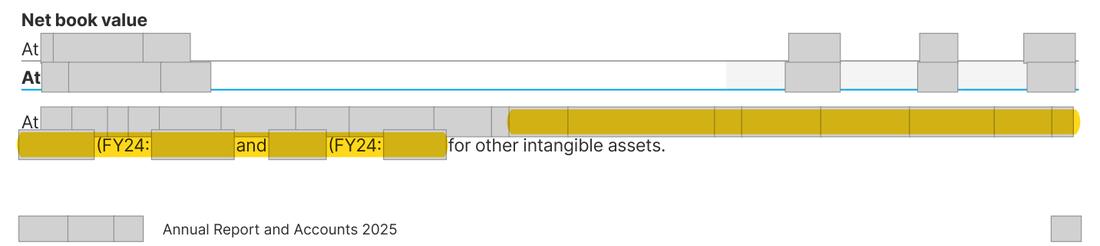

Further pages withheld to protect the company’s identity (five): Annual Report 2024, page 206; Annual Report 2025, page 231; Annual Report 2025, page 218; Annual Report 2025, page 216; Annual Report 2025, page 1. Their wording or layout could lead back to the company even with names and figures masked; the evidence list below records what each page shows.
Names, figures, dates, logos and any wording that could be searched back to the company are boxed out in grey; the point is highlighted in yellow.
What the report shows, and what the rule requires
| What the annual report shows | What the rule requires |
|---|---|
| What the annual report shows 2025 borrowings policy: interest recognised in the income statement using the effective interest method, with no reference to qualifying assets; no amount of borrowing costs capitalised and no capitalisation rate in either year; capital work-in-progress of [n] in property, plant and equipment and [n] in intangible assets | What the rule requires A borrowing-cost policy and, for each year, the amount of borrowing costs capitalised and the capitalisation rate (IAS 23.26), or a statement that the group has no qualifying assets or that the amounts are immaterial |
The rule
IAS 23 Borrowing Costs, paragraph 8
Version relied on: UK-adopted international accounting standards (UK Endorsement Board), as in force for financial years beginning in or after January 2025
Borrowing costs directly attributable to acquiring, constructing or producing a qualifying asset must be capitalised as part of its cost.
IAS 23 Borrowing Costs, paragraph 26
Version relied on: UK-adopted international accounting standards (UK Endorsement Board), as in force for financial years beginning in or after January 2025
The accounts must disclose the borrowing costs capitalised in the period and the capitalisation rate used.
Why it applies here: IAS 23.8 makes capitalisation mandatory for qualifying assets (those that necessarily take a substantial period to get ready, IAS 23.5), using the weighted average rate on general borrowings where funds are not specific (IAS 23.14), and IAS 23.26 requires the amount and rate to be disclosed. [facility] [equipment], [equipment] and materials-handling equipment built over a year, and software developed over several periods, are the kind of assets that can qualify.
Why it matters
If qualifying assets exist and borrowing costs were not capitalised, finance costs are overstated and asset costs understated; in either case readers cannot see the group's treatment of a material borrowing cost on a construction-heavy asset base.
Exposure
A question for the directors
Our workings
Note 4.1's 2024 policy said the [wording masked] of borrowings is recognised in the income statement [wording masked]'; the 2025 policy keeps the first limb and drops the second. Neither report contains the words 'borrowing costs', 'capitalised interest' or 'qualifying asset' anywhere else, nor a capitalisation rate. At [date] property, plant and equipment includes capital work-in-progress of [n] (land and buildings), [n] ([wording masked] [n] (motor vehicles), and intangible assets include [n] of internally generated and [n] of other assets in progress. The net debt note shows interest charged on borrowings of [n] against closing borrowings of [n]. The strategic report says a three-module [facility] was built and opened in 12 months.
Work-in-progress totals [n] + [n] + [n] + [n] + [n] = [n]. The interest charge is [n] / [n] = [n]% of closing borrowings. An upper indication, if all of that work-in-progress qualified for a full year at that rate, is [n] x [n]% = [n], which is [n] / [n] = [n]% of the loss before tax; the true figure depends on which assets qualify and for how long, which only the company knows.
The 2024 policy implied capitalisation could occur; the silent deletion in 2025, with no amounts in either year, leaves readers unable to tell whether borrowing costs have been capitalised, expensed by choice or judged immaterial.
| Test | Computation | Result |
|---|---|---|
| Property, plant and equipment work-in-progress | [n] + [n] + [n] = [n] | [n] |
| Intangible assets work-in-progress | [n] + [n] = [n] | [n] |
| Capital work-in-progress at [date] | [n] + [n] + [n] + [n] + [n] = [n] | [n] |
| Interest charge on borrowings against closing borrowings | [n] / [n] = [n]% | [n]% |
| Upper indication of borrowing costs on that work-in-progress for a year | [n] x [n]% = [n] | [n] |
| Upper indication against the loss before tax | [n] / [n] = [n]% | [n]% |
Management’s best defence, and our reply
Management can say that its [facility] equipment is built in modules that are each ready for use in less than a substantial period. It can add that development work is capitalised in short sprints that go live quickly, and that any borrowing cost eligible for capitalisation is immaterial, so IAS 23 has no measurable effect and IAS 1.31 relieves the disclosure. Those arguments are tenable, which is why this is a question. But the 2024 policy contemplated capitalisation, the work-in-progress balances are large and persistent, and the group's own report describes year-long [facility] builds, so a one-line statement of the position is the least the reader needs.
The fix
- In the 2026 report, add a borrowing-cost policy to Note 4.1 or Section 3 and disclose the amount capitalised and the capitalisation rate for both years, or state that no asset qualified and why.
Question for the company
Does the group have qualifying assets under IAS 23 (for example [facility] [equipment], [equipment] and materials-handling equipment, and internally developed software that takes more than a year to complete)? If so, how much borrowing cost was capitalised in 2024 and 2025 and at what capitalisation rate; if not, or if the amounts are immaterial, why was the 2024 policy wording on qualifying assets removed in 2025?
Evidence relied on
| # | What it shows | Type | Where |
|---|---|---|---|
| 1 | 2024 policy: interest may be capitalised on qualifying assets | Document | Annual Report 2024, page 206 |
| 2 | 2025 policy: the reference to qualifying assets has gone | Document | Annual Report 2025, page 231 |
| 3 | Property, plant and equipment under construction | Document | Annual Report 2025, page 218 |
| 4 | Intangible assets under development | Document | Annual Report 2025, page 215 |
| 5 | The cost policy for assets under construction does not mention borrowing costs | Document | Annual Report 2025, page 216 |
| 6 | Interest charged on borrowings of [n] and closing borrowings of [n] | Document | Annual Report 2025, page 234 |
| 7 | A [facility] takes about a year to build | Document | Annual Report 2025, page 1 |
Absence check
- Document
- Annual Report 2025
- Where it would appear
- Accounting policies
- What is missing
- a borrowing-cost policy, the amount of borrowing costs capitalised and the capitalisation rate (or a statement that none qualify)
- Pages looked at
- p.184-260 (group notes); Annual Report [amount].170-233
- Result
- None of the four terms appears anywhere in the 2025 report; in the 2024 report only 'qualifying asset' appears, once, in the borrowings policy quoted above.
Prepared by Pramanex from the company’s published annual reports, without the company’s involvement, to show how an annual report review reads. The company is not named, and nothing on this page is a statement about any identifiable company. Observations are not an audit, review or other assurance engagement, and not legal advice. A regulator-style question is a question, not a conclusion.
Want this on your own annual report, before it is published?
Start with three free findings on your latest published annual report, or talk to us about a fixed-fee pre-publication review.
Your annual report will be in draft before the year-end audit.
Have it read before it is published.
Under NDA, with our reviewer on your insider list under UK MAR.