1.15 The Joint Share Ownership Scheme closing weighted average exercise price of [amount] cannot be reached from the [amount] opening price and the [amount] exercises
UK Company B · a UK-listed technology and logistics group · Presentation point
In brief
In 2024, [n] Joint Share Ownership Scheme interests at a weighted average exercise price of [amount] were outstanding at the start of the year and [n] were exercised at [amount]. The [n] remaining interests should then carry a weighted average price of about [amount], but the table prints [amount]. The same [amount] was printed in the 2024 report and is carried through every 2025 line, as nothing moved in 2025.
The evidence, as filed
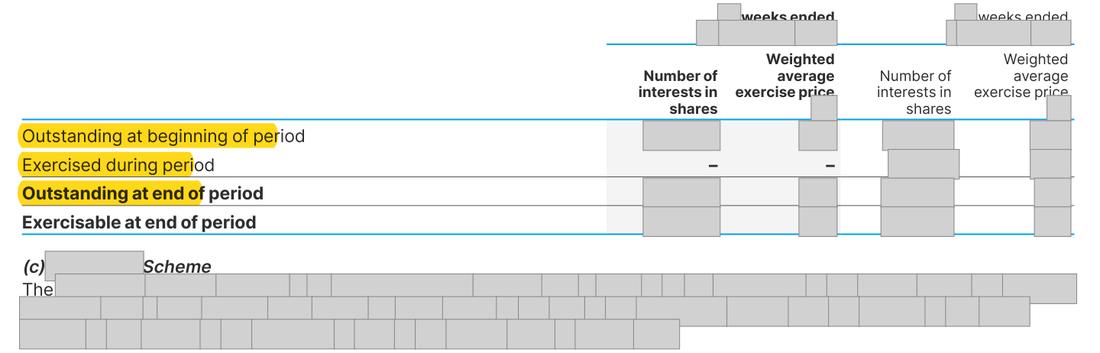
Further pages withheld to protect the company’s identity (one): Annual Report 2024, page 221. Their wording or layout could lead back to the company even with names and figures masked; the evidence list below records what each page shows.
Names, figures, dates, logos and any wording that could be searched back to the company are boxed out in grey; the point is highlighted in yellow.
What the report shows, and what the rule requires
| What the annual report shows | What the rule requires |
|---|---|
| What the annual report shows 2024: opening [n] at [amount]; exercised [n] at [amount]; closing and exercisable [n] at [amount]. 2025: opening, closing and exercisable [n] at [amount]. | What the rule requires A closing weighted average exercise price that follows from the opening price and the exercises (about [amount], or a corrected opening or exercise price if one of those is the figure in error. |
The rule
IFRS 2 Share-based Payment, paragraph 45(b)
Version relied on: UK-adopted international accounting standards (UK Endorsement Board), as in force for financial years beginning in or after January 2025
The accounts must give the number and weighted average exercise price of options outstanding at the start of the year, exercised during it and outstanding at the end, among other movements.
Why it applies here: one of the printed 2024 prices is not right; because nothing moved in 2025, the 2025 opening, closing and exercisable prices inherit the same figure.
Why it matters
The table IFRS 2 requires does not add up on its own figures; a reader cannot tell the true exercise price of the [n] interests still outstanding. The monetary effect is about [amount] of aggregate exercise price.
Exposure
A disclosure correction in the next Annual Report; no penalty attaches.
Our workings
the movement table on p.248 shows the 2024 and 2025 figures quoted in the evidence rows, and the 2024 report printed the same 2024 figures on its p.221.
removing [n] interests at [amount] from [n] interests at [amount] leaves [n] interests whose weighted average price is [amount], as the workings show. The same method reproduces the 2023 closing price printed in the 2024 report, so the method is the company's own.
The monetary effect is small; the point is the arithmetic integrity of a table that IFRS 2 requires.
| Step | Computation | Result |
|---|---|---|
| Opening value of interests | [n] x [n] = [n] | [n] |
| Closing weighted average price | ([n] - [n] x [n]) / [n] = [n] | [n] |
| Difference in aggregate exercise price | ([n] - 2.12) x [n] = [n] | [n] |
Management’s best defence, and our reply
Management could say that the exercise price of a Joint Share Ownership Scheme interest is a threshold amount that can differ by tranche, and that the interests exercised in 2024 may have been recorded at a rounded average. They would add that the amounts are trivial and no reader would decide differently. The answer: a weighted average follows mechanically from the tranche prices, so whatever the tranches, removing interests at [amount] from a [amount] pool cannot lower the average of the remainder to [amount]; materiality explains the low severity, not the arithmetic.
The fix
- Recompute the weighted average exercise price of the outstanding interests and correct the 2025 and comparative figures (with a footnote that the comparative has been corrected).
Evidence relied on
| # | What it shows | Type | Where |
|---|---|---|---|
| 1 | Opening interests: 2025 [n] at [amount]; 2024 [n] at [amount] | Document | Annual Report 2025, page 248 |
| 2 | 2024 exercises: [n] interests at [amount] | Document | Annual Report 2025, page 248 |
| 3 | Closing interests: [n] at [amount] in both years | Document | Annual Report 2025, page 248 |
| 4 | The 2024 report as published: 2024 opening [n] at [amount] | Document | Annual Report 2024, page 221 |
| 5 | The 2024 report as published: 2024 exercises [n] at [amount] | Document | Annual Report 2024, page 221 |
| 6 | The 2024 report as published: 2024 closing [n] at [amount] | Document | Annual Report 2024, page 221 |
Prepared by Pramanex from the company’s published annual reports, without the company’s involvement, to show how an annual report review reads. The company is not named, and nothing on this page is a statement about any identifiable company. Observations are not an audit, review or other assurance engagement, and not legal advice. A regulator-style question is a question, not a conclusion.
Want this on your own annual report, before it is published?
Start with three free findings on your latest published annual report, or talk to us about a fixed-fee pre-publication review.
Your annual report will be in draft before the year-end audit.
Have it read before it is published.
Under NDA, with our reviewer on your insider list under UK MAR.