1.13 The borrowings maturity table puts the [date] notes in the two-to-five-year column
UK Company B · a UK-listed technology and logistics group · Presentation point
In brief
Note 4.1 shows the [amount] senior unsecured notes (carrying amount [amount]) maturing in [date], less than two years after the [date] balance sheet date. The maturity table in the same note puts all [amount] of senior unsecured notes 'between two and five years' and none 'between one and two years'. The IFRS 7 liquidity table in Note 4.5 places these notes in the one-to-two-year column ([amount] of contractual cash flows), so the two notes disagree; the 2025 report repeats the same comparative.
The evidence, as filed
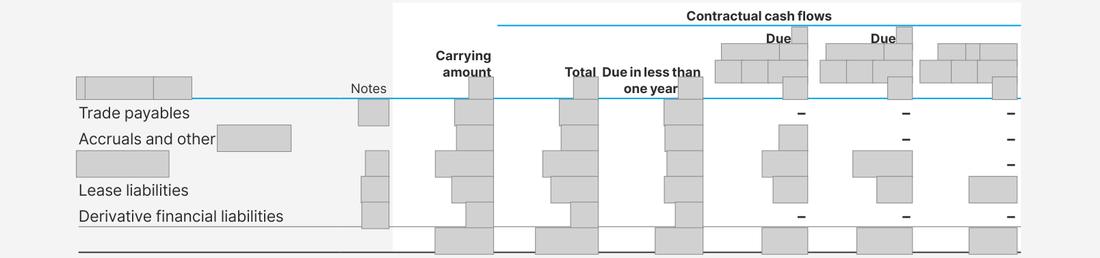
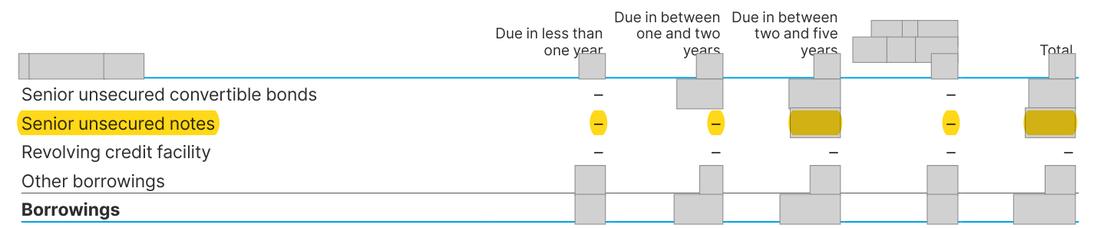
Further pages withheld to protect the company’s identity (two): Annual Report 2024, page 207; Annual Report 2024, page 208. Their wording or layout could lead back to the company even with names and figures masked; the evidence list below records what each page shows.
Names, figures, dates, logos and any wording that could be searched back to the company are boxed out in grey; the point is highlighted in yellow.
What the report shows, and what the rule requires
| What the annual report shows | What the rule requires |
|---|---|
| What the annual report shows Note 4.1 maturity table at [date]: senior unsecured notes [amount] all 'between two and five years'; 'between one and two years' totals [amount] and 'between two and five years' [amount]. | What the rule requires The [amount] [date] notes shown 'between one and two years': that column [amount] and 'between two and five years' [amount], consistent with the Note 4.5 liquidity table. |
What we checked: Facility table, tender table and maturity table in Note 4.1; contractual cash-flow table in Note 4.5; the same table as published in the 2025 report.
The rule
IFRS 7 Financial Instruments: Disclosures, paragraph 39(a)
Version relied on: UK-adopted international accounting standards (UK Endorsement Board), as in force for financial years beginning in or after January 2025
The accounts must include a maturity analysis of non-derivative financial liabilities showing their remaining contractual maturities.
Why it applies here: the Note 4.1 table misplaces the 2026 notes by one column.
Why it matters
A reader using the Note 4.1 table sees [amount] of borrowings due within two years instead of [amount], at a time when the maturity of the revolving credit facility depends on refinancing the [date] and [date] maturities.
Exposure
A presentation inconsistency in the audited notes; the realistic consequence is a Financial Reporting Council review question and a corrected comparative in the next report, not a revision of the accounts.
Our workings
the facility table gives the [amount] senior unsecured notes a maturity of [date] and a carrying amount of [amount] at [date]; after the [date] tender [amount] of principal remained. The maturity table on the next page shows senior unsecured notes of [amount] entirely 'between two and five years', and borrowings of [amount] 'between one and two years'. The Note 4.5 liquidity table shows [amount] of borrowing cash flows 'between one and two years', which can only hold if the remaining 2025 bonds and 2026 notes ([amount] of principal) fall in that column.
[date] falls within 24 months of [date]; moving the notes gives [amount] in the one-to-two-year column and [amount] in the two-to-five-year column (workings).
The balance sheet classification (non-current) is right, but the note understates the debt due within two years by [amount], and the 2025 report reprints the same comparative unchanged.
| Item | Computation | Result (GBP m) |
|---|---|---|
| Notes due [date], carrying amount | Note 4.1 facility table | [n] |
| One-to-two-year column as corrected | [n] + [n] = [n] | [n] |
| Two-to-five-year column as corrected | [n] - [n] = [n] | [n] |
Management’s best defence, and our reply
The finance team could argue that the table is a supplementary analysis of carrying amounts, that the contractual liquidity table required by IFRS 7 in Note 4.5 already shows the notes in the right column, and that the [date] maturity date is printed in the same note, so no reader is misled. They could add that the balance sheet classification as non-current is correct and that the notes were already being refinanced. However, the table is part of the audited notes and states a time column that contradicts the maturity date one page earlier and the Note 4.5 table; placing a fixed maturity date in a time column involves no judgement, and the 2025 report repeated it unchanged. A refinancing intention does not change a contractual maturity.
The fix
- Show the [amount] [date] notes 'between one and two years' in the [date] column (one to two years [amount]; two to five years [amount]) and correct the comparative in the next report.
Evidence relied on
| # | What it shows | Type | Where |
|---|---|---|---|
| 1 | The 2026 notes mature in [date] and are carried at [n] at [date] | Document | Annual Report 2024, page 207 |
| 2 | After the tender [n] of principal of the 2026 notes remained | Document | Annual Report 2024, page 207 |
| 3 | Remaining principal of the 2025 bonds and 2026 notes together is [n] | Document | Annual Report 2024, page 207 |
| 4 | At [date] the maturity table puts all [n] of notes [wording masked]' | Document | Annual Report 2024, page 208 |
| 5 | Column totals as printed: [n] in one to two years, [n] in two to five years, borrowings [n] | Document | Annual Report 2024, page 208 |
| 6 | The IFRS 7 liquidity table places [n] of borrowing cash flows [wording masked]' | Document | Annual Report 2024, page 216 |
| 7 | The 2025 report reprints the [date] comparative with the notes still [wording masked]' | Document | Annual Report 2025, page 233 |
Prepared by Pramanex from the company’s published annual reports, without the company’s involvement, to show how an annual report review reads. The company is not named, and nothing on this page is a statement about any identifiable company. Observations are not an audit, review or other assurance engagement, and not legal advice. A regulator-style question is a question, not a conclusion.
Want this on your own annual report, before it is published?
Start with three free findings on your latest published annual report, or talk to us about a fixed-fee pre-publication review.
Your annual report will be in draft before the year-end audit.
Have it read before it is published.
Under NDA, with our reviewer on your insider list under UK MAR.