1.09 The segment note names three customers above 10% of revenue but gives only two segment totals, not the revenue from each customer
UK Company B · a UK-listed technology and logistics group · Compliance or disclosure gap
In brief
Note 2.2 says the Group relies on three major customers which each contribute more than 10% of revenue, and gives [n] for the [segment] segment and [n] for the [segment] segment. IFRS 8 requires the total revenue from each such customer. With three customers and two figures, the reader cannot tell how much comes from any one customer. The 2024 report used the same wording.
The evidence, as filed
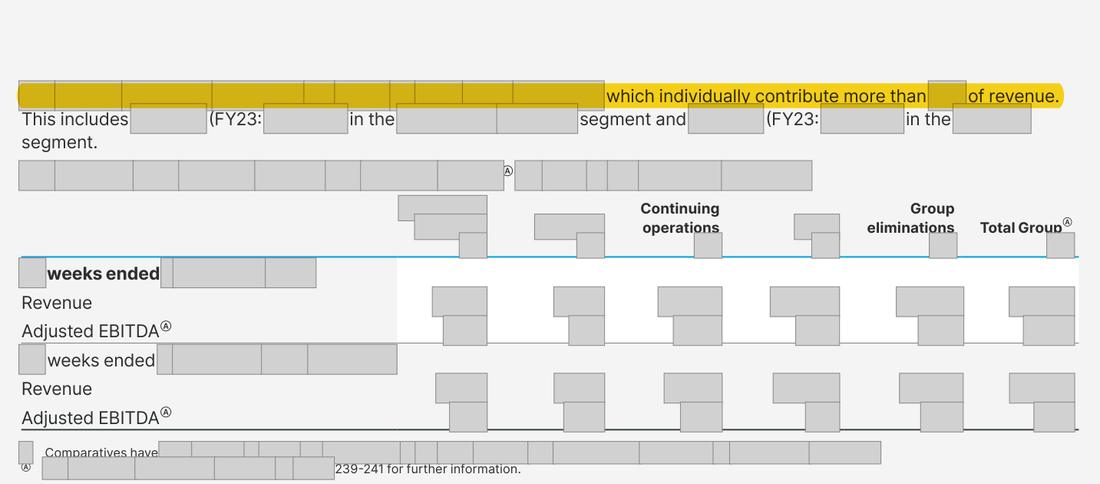
Annual Report 2024, page 179 · Prior year: The 2024 report gave the same two segment totals for three major customers ([n] [segment], [n] [segment]) and no amount per customer, so the point applies to both years.
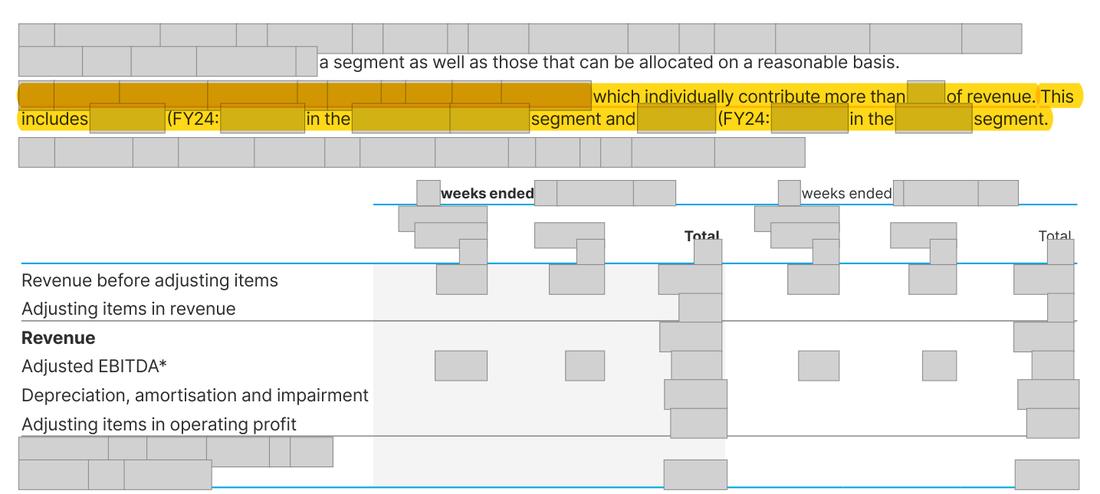
Further pages withheld to protect the company’s identity (one): Annual Report 2025, page 23. Their wording or layout could lead back to the company even with names and figures masked; the evidence list below records what each page shows.
Names, figures, dates, logos and any wording that could be searched back to the company are boxed out in grey; the point is highlighted in yellow.
What the report shows, and what the rule requires
| What the annual report shows | What the rule requires |
|---|---|
| What the annual report shows p.199: '[wording masked] 10% of revenue. This includes [n] ... in the [segment] segment and [n] ... in the [segment] segment.' The 2024 comparatives are given the same way. | What the rule requires The total revenue from each of the three customers (named or not, e.g. 'Customer A'), with the segment or segments that report it, for both years. |
The rule
IFRS 8 Operating Segments, paragraph 34
Version relied on: UK-adopted international accounting standards (UK Endorsement Board), as in force for financial years beginning in or after January 2025
Where revenue from a single external customer is 10 per cent or more of the total, the accounts must say so and give that revenue and the segments reporting it (the customer need not be named).
Why it applies here: the note gives the segment view, which the standard makes optional, in place of the customer view, which it requires.
Why it matters
- Investors cannot measure the group's concentration on any single partner, the information paragraph 34 exists to give, for a group whose continuing revenue depends on a handful of customers.
Investors cannot measure the Group's concentration on any single partner, which is the information IFRS 8 paragraph 34 exists to give and which matters for a group whose continuing revenue depends on a handful of customers. Customer concentration disclosures are a recurring subject of FRC Corporate Reporting Review enquiries.
Exposure
No fine. Possible FRC Corporate Reporting Review enquiry and an undertaking to give the amounts in the next Annual Report.
Our workings
Note 2.2 states that three customers each contribute more than 10% of revenue and gives the revenue from them as two segment totals, [n] ([segment]) and [n] ([segment]). Group revenue is [n]. The Financial Review gives cost recharges to [former subsidiary] and [customer] only as one combined figure. Nowhere else in the report is the revenue from an individual customer given.
the 10% threshold is [n] x 10% = [n]; three customers are above it, but only two amounts are given, so at least one figure combines two customers, or a customer's revenue is split across both. Law: IFRS 8 paragraph 34 requires, for each customer above 10% of revenue, the total amount of revenue from that customer and the segment or segments reporting it; it allows the identity of the customer to be withheld, and the split by segment to be omitted, but not the amount per customer.
The 2024 report used the same structure (two segment totals for three customers), so the point applies to both years.
| Measure | Computation | Result |
|---|---|---|
| 10% of revenue threshold | [n] x 10% = [n] | [n] |
| Customers above the threshold (stated) | 3 | 3 customers |
| Revenue amounts given | [n] ([segment]) + [n] ([segment]) = [n] | 2 aggregates for 3 customers |
Management’s best defence, and our reply
Management would say the reader can see the scale of reliance on major customers from the two segment totals, and that naming or quantifying individual partners' revenue is commercially sensitive. They would also argue that the [segment] total is in substance two partners and the Financial Review explains it. The answer: IFRS 8 paragraph 34 already deals with sensitivity by allowing the customer to stay anonymous and the segment split to be omitted, but it does not allow the amount per customer to be omitted, and there is no confidentiality exemption in IFRS; the per-customer amounts are therefore required in both years.
The fix
- Replace the sentence with a table: 'Customer A ([segment]) X; Customer B ([segment]) Y; Customer C ([segment] and [segment]) Z', with comparatives, keeping the customers anonymous if the Group wishes.
Evidence relied on
| # | What it shows | Type | Where |
|---|---|---|---|
| 1 | Three customers each exceed 10% of revenue | Document | Annual Report 2025, page 199 |
| 2 | Revenue from the three customers is given only as two segment totals | Document | Annual Report 2025, page 199 |
| 3 | Group revenue used for the 10% threshold | Document | Annual Report 2025, page 199 |
| 4 | The Financial Review also gives the two [segment] customers only in total | Document | Annual Report 2025, page 23 |
Absence check
- Document
- Annual Report 2025
- Where it would appear
- [wording masked]
- What is missing
- the total revenue from each of the three customers above 10% of revenue
- Pages looked at
- p.195-200 (Notes 2.1-2.3) and the Financial Review p.22-47
- Result
- 'major customer', '10% of revenue' and 'individually contribute' hit only the sentence on p.199, which gives two segment totals; 'single external customer', 'single customer' and 'largest customer' have no hits. The Financial Review on p.23 gives recharges to [former subsidiary] and [customer] only as a combined [n].
Prepared by Pramanex from the company’s published annual reports, without the company’s involvement, to show how an annual report review reads. The company is not named, and nothing on this page is a statement about any identifiable company. Observations are not an audit, review or other assurance engagement, and not legal advice. A regulator-style question is a question, not a conclusion.
Want this on your own annual report, before it is published?
Start with three free findings on your latest published annual report, or talk to us about a fixed-fee pre-publication review.
Your annual report will be in draft before the year-end audit.
Have it read before it is published.
Under NDA, with our reviewer on your insider list under UK MAR.