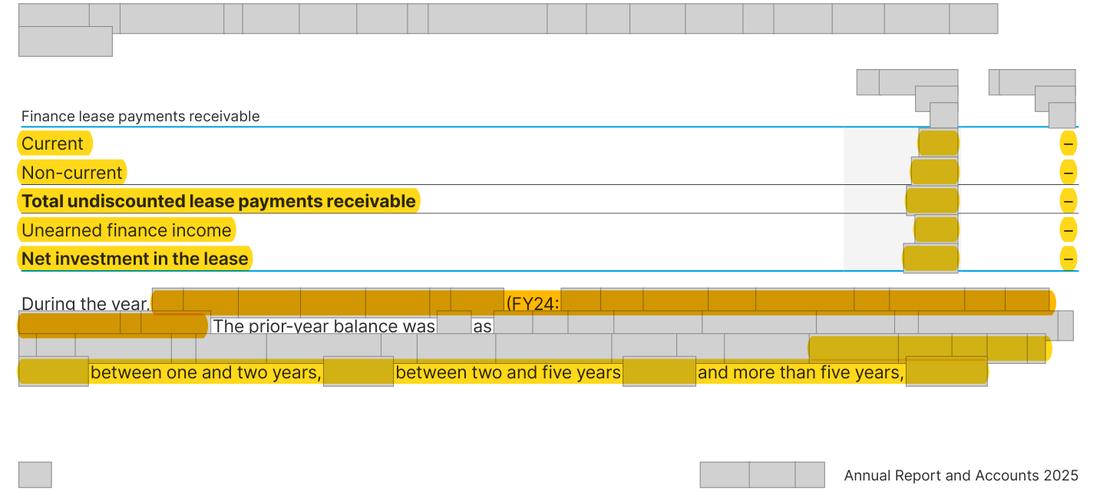
1.07 The lessor note labels the undiscounted lease payments as the net investment, groups years three to five together, and the related-party note's lease income and receipts do not roll the balance
UK Company B · a UK-listed technology and logistics group · Compliance or disclosure gap
In brief
After [former subsidiary] ([former subsidiary]) left the group, assets leased to it became a finance lease receivable of [amount] on the balance sheet. The required reconciliation in Note 3.4 prints [amount] as the 'total undiscounted lease payments receivable' and [amount] as the 'net investment in the lease', the reverse of the true position. The maturity analysis puts years three to five in one bucket although the standard asks for each of the first five years, and the related-party note gives finance income of [amount] and receipts of [amount] where Note 3.4 and the cash flow statement give [amounts].
The evidence, as filed
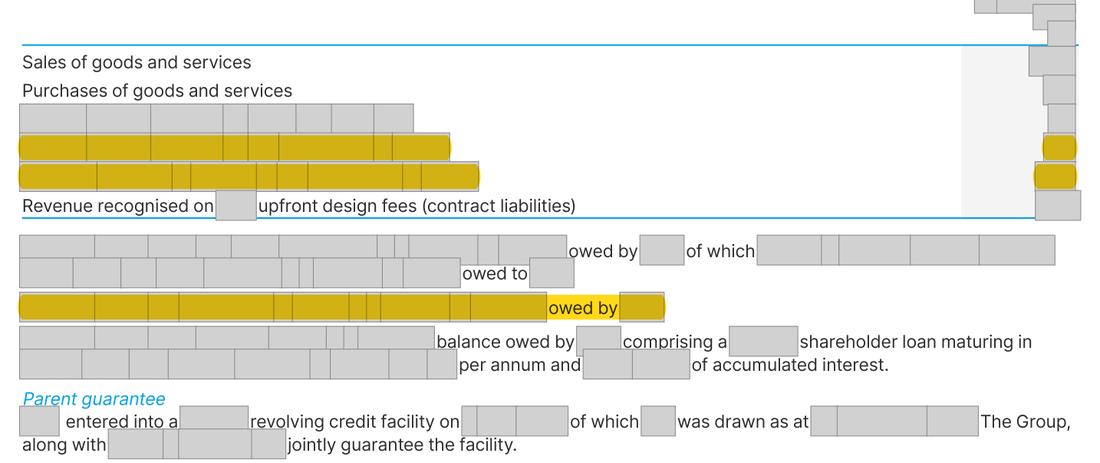
Further pages withheld to protect the company’s identity (one): Annual Report 2025, page 45. Their wording or layout could lead back to the company even with names and figures masked; the evidence list below records what each page shows.
Names, figures, dates, logos and any wording that could be searched back to the company are boxed out in grey; the point is highlighted in yellow.
What the report shows, and what the rule requires
| What the annual report shows | What the rule requires |
|---|---|
| What the annual report shows Reconciliation: undiscounted payments [n], unearned finance income [n], net investment [n]; maturity buckets within one year [n], one to two years [n], two to five years [n], over five years [n]; related-party note: interest income [n] and amounts received [n] | What the rule requires Undiscounted payments [n], less unearned finance income [n], net investment [n] (agreeing to the balance sheet); undiscounted payments for each of years one to five and a total thereafter; one set of finance income and receipts in both notes that rolls [n] to [n] |
The rule
IFRS 16 Leases, paragraph 94
Version relied on: UK-adopted international accounting standards (UK Endorsement Board), as in force for financial years beginning in or after January 2025
A lessor must give a maturity analysis of undiscounted lease payments receivable for each of the next five years and the total thereafter, reconciled to the net investment in the lease.
IFRS 16 Leases, paragraph 93
Version relied on: UK-adopted international accounting standards (UK Endorsement Board), as in force for financial years beginning in or after January 2025
A lessor must explain, in words and numbers, the significant changes in the carrying amount of its net investment in finance leases.
Why it applies here: IFRS 16.94 asks for two things: a maturity analysis of undiscounted lease payments 'on an annual basis for a minimum of each of the first five years' and a reconciliation of the undiscounted payments to the net investment identifying the unearned finance income.
Why it matters
- The receivable is a new [amount] asset that arose from the deconsolidation of [former subsidiary], and the note readers rely on to understand it reverses its two main figures.
- The related-party note and Note 3.4 give two different accounts of the income and cash from the same receivable.
The audited lease note misstates the net investment by [n] in its own reconciliation, gives the maturity analysis in a coarser form than the standard requires, and gives two different accounts of the income and cash from the same receivable; a reader cannot rely on the note to understand a new [n] asset that arose from the [former subsidiary] deconsolidation.
Exposure
A Financial Reporting Council Corporate Reporting Review question and a corrected note in the 2026 report
Our workings
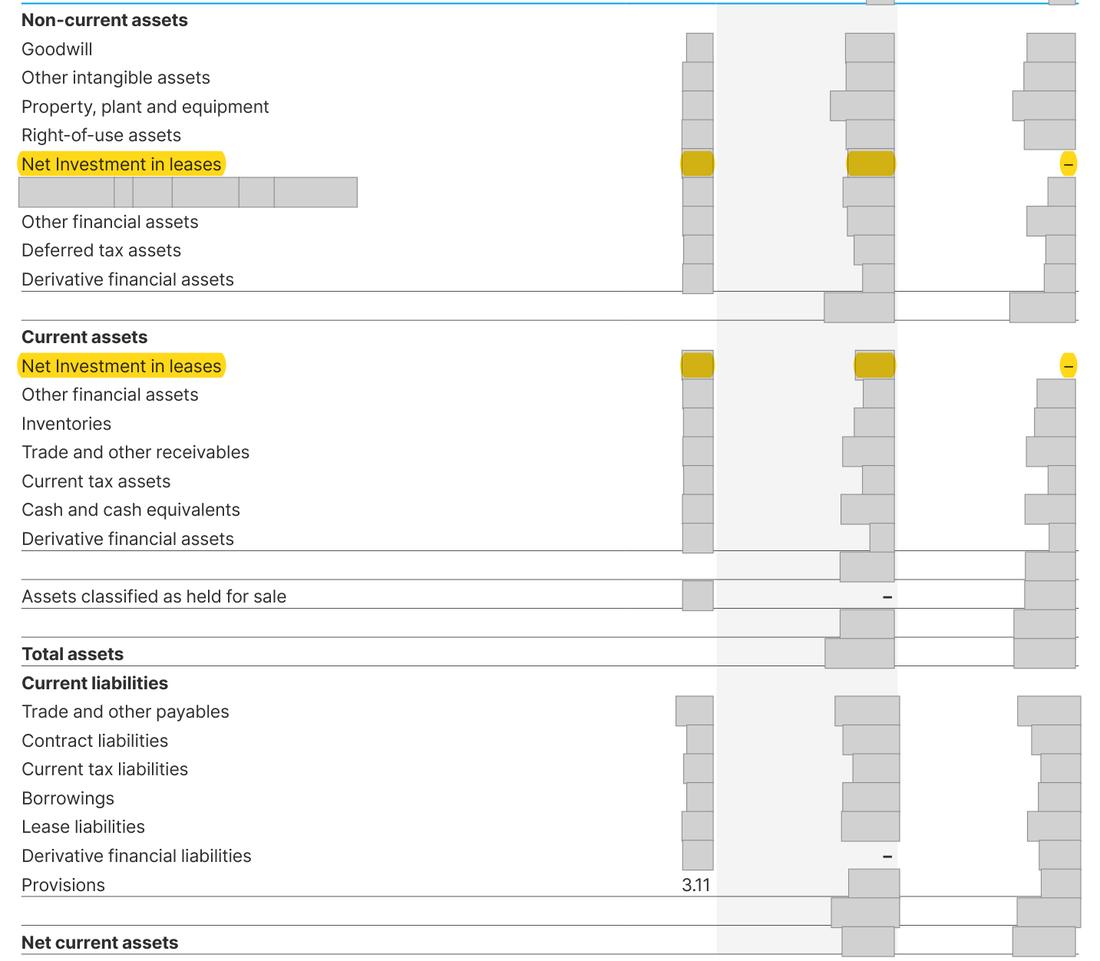
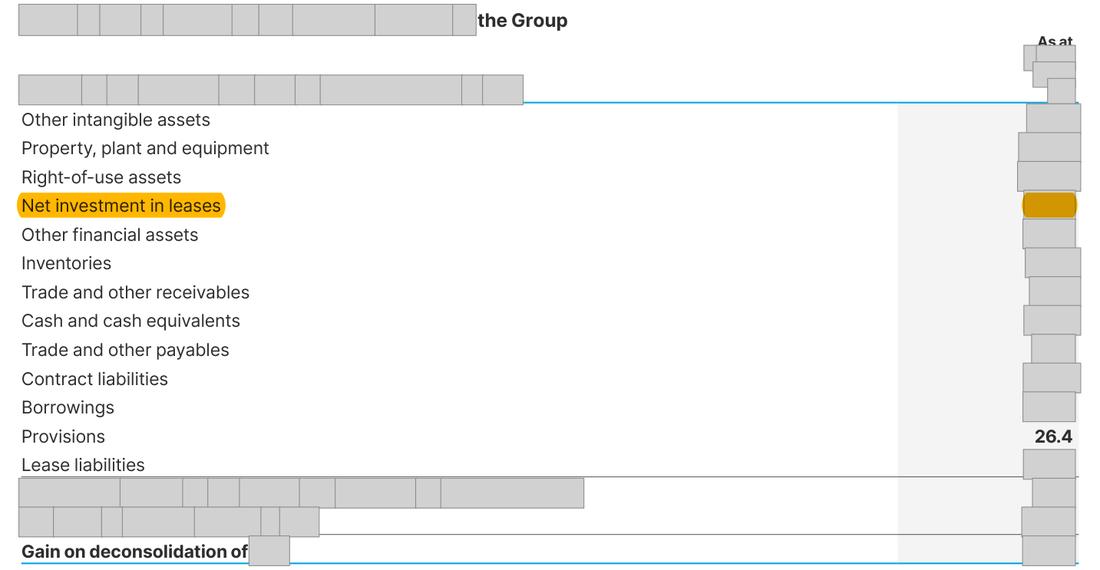
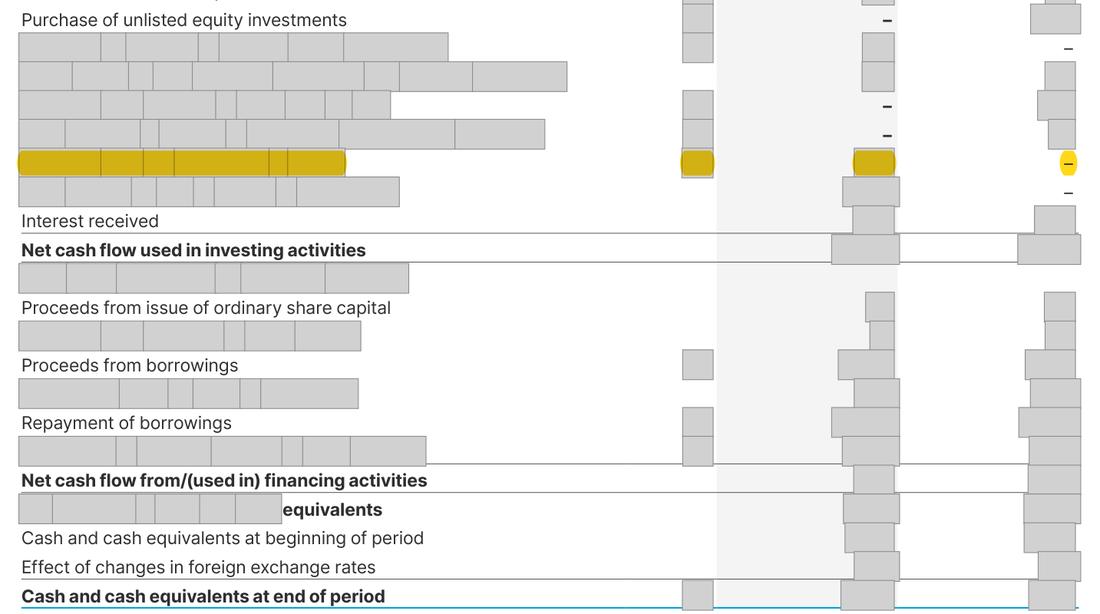
The balance sheet carries net investment in leases of [n] (current) and [n] (non-current). Note 2.9 recognises the net investment at [n] on deconsolidation, and Note 3.4 says [wording masked] [n] and received cash of [n] in the year; the cash flow statement shows '[wording masked]' of [n] and the finance income note shows interest on the finance lease receivable of [n]. Note 3.4's reconciliation table, however, labels [n] as 'Total undiscounted lease payments receivable' and [n] as 'Net investment in the lease', and the narrative below it gives undiscounted payments by period: within one year [n], one to two years [n], two to five years [n], more than five years [n]. The related-party note for [former subsidiary] gives '[wording masked]' of [n] and '[wording masked]' of [n], and says the whole [n] is owed by [former subsidiary].
The four buckets add to [n] + [n] + [n] + [n] = [n], so [n] is the undiscounted total; less unearned finance income, [n] - [n] = [n] is the net investment, agreeing to the balance sheet ([n] + [n] = [n]) and to the roll-forward [n] + [n] - [n] = [n]. The table has added the unearned finance income to the net investment ([n] + [n] = [n]) and called the result the net investment, overstating it by [n] - [n] = [n]. Using the related-party figures, [n] + [n] - [n] = [n], which is [n] - [n] = [n] away from the balance the same note says [former subsidiary] owes.
The first is only partly given (years three to five are grouped together); the second is given with its two key figures transposed. IFRS 16.93 then asks for a quantitative explanation of significant changes in the net investment; Note 3.4 gives one (recognition, income, receipts) but the related-party note gives a different one for the same balance with the same counterparty. The balance sheet figure itself is right; the defect is in required disclosure, which is why the severity is low, but a reader using the note would take the net investment to be [n] and could not tell which income figure is right.
| Test | Computation | £m |
|---|---|---|
| Net investment on the balance sheet | [n] + [n] = [n] | [n] |
| Roll-forward from deconsolidation (Note 2.9, Note 3.4) | [n] + [n] - [n] = [n] | [n] |
| Undiscounted payments from the maturity buckets | [n] + [n] + [n] + [n] = [n] | [n] |
| Correct reconciliation: undiscounted less unearned finance income | [n] - [n] = [n] | [n] |
| Table as printed: net investment plus unearned finance income | [n] + [n] = [n] | [n] |
| Overstatement of the 'net investment' line in the table | [n] - [n] = [n] | [n] |
| Roll-forward using the related-party note figures | [n] + [n] - [n] = [n] | [n] |
| Gap to the balance owed by [former subsidiary] | [n] - [n] = [n] | [n] |
| Paragraph | Requirement | Where | Status |
|---|---|---|---|
| [n](a)(ii) | Finance income on the net investment | Note 2.6 and Note 3.4: [n] (p.205, [n]) | Given (but [n] in Note 5.4) |
| [n](a)(i) | Selling profit or loss | Note 2.9: gain of [n] on the assets transferred (p.211) | Given |
| [n] | Quantitative explanation of significant changes in the net investment | Note 3.4: income [n], receipts [n]; Note 2.9: [n] recognised | Given; contradicted by Note 5.4 ([n]) |
| [n] | Undiscounted payments for each of the first five years and a total thereafter | Note 3.4 narrative: [n]; [n]; [n] for years three to five; [n] | Partial |
| [n] | Reconciliation of undiscounted payments to net investment, identifying unearned finance income | Note 3.4 table | Given with the two totals transposed |
Management’s best defence, and our reply
Management could say the transposition is an obvious typographical slip: the balance sheet shows [n] and the narrative buckets add to [n], so no reader is misled about the asset. It could also argue that the lessor book is small against total assets of [amount], so grouping years three to five is immaterial, and that the related-party figures are prepared on a contractual basis that differs from the accounting income. However, the reconciliation is itself the disclosure IFRS 16.94 requires and it states the wrong net investment; the year-by-year analysis is the form the paragraph prescribes for a balance that is all owed by one related party and runs mostly beyond five years; and no basis is given for the related-party figures, which roll the balance to [n] rather than [n].
The fix
- In the 2026 report, show 'Total undiscounted lease payments receivable [n]; less unearned finance income ([n]); net investment in the lease [n]', give undiscounted payments for each of years one to five and a total thereafter, and align the related-party note's lease income and receipts with Note 3.4 (or explain the difference).
Evidence relied on
| # | What it shows | Type | Where |
|---|---|---|---|
| 1 | The table calls the balance-sheet amount of [n] the undiscounted lease payments | Document | Annual Report 2025, page 220 |
| 2 | The table calls [n] the net investment, adding the unearned finance income instead of deducting it | Document | Annual Report 2025, page 220 |
| 3 | Finance income [n] and receipts [n] in the lessor note | Document | Annual Report 2025, page 220 |
| 4 | Maturity buckets add to [n], and years three to five are one bucket | Document | Annual Report 2025, page 220 |
| 5 | Non-current net investment on the balance sheet | Document | Annual Report 2025, page 185 |
| 6 | Current net investment on the balance sheet | Document | Annual Report 2025, page 185 |
| 7 | Net investment recognised on deconsolidation of [former subsidiary] | Document | Annual Report 2025, page 211 |
| 8 | Cash received on the net investment agrees with Note 3.4 | Document | Annual Report 2025, page 188 |
| 9 | Related-party note gives a different finance income figure for the same leases | Document | Annual Report 2025, page 258 |
| 10 | Related-party note gives different receipts for the same leases | Document | Annual Report 2025, page 258 |
| 11 | The whole net investment is owed by [former subsidiary], so both notes describe the same balance | Document | Annual Report 2025, page 258 |
| 12 | the Financial Review also gives the net investment as [amount] | Document | Annual Report 2025, page 45 |
| 13 | the net investment recognised when [former subsidiary] was deconsolidated | Document | Annual Report 2025, page 211 |
| 14 | Note 3.4's own finance income and receipts roll [amount] forward to [amount] ([n] + [n] - [n]) | Document | Annual Report 2025, page 220 |
Prepared by Pramanex from the company’s published annual reports, without the company’s involvement, to show how an annual report review reads. The company is not named, and nothing on this page is a statement about any identifiable company. Observations are not an audit, review or other assurance engagement, and not legal advice. A regulator-style question is a question, not a conclusion.
Want this on your own annual report, before it is published?
Start with three free findings on your latest published annual report, or talk to us about a fixed-fee pre-publication review.
Your annual report will be in draft before the year-end audit.
Have it read before it is published.
Under NDA, with our reviewer on your insider list under UK MAR.