1.06 The level 3 fair value reconciliation closes at [amount] but the level 3 column of the hierarchy table totals [amount], and the note says nothing moved out of level 3
UK Company B · a UK-listed technology and logistics group · Compliance or disclosure gap
In brief
Note 4.4 analyses the assets held at fair value by level and then reconciles the level 3 balance from the start to the end of the year. The hierarchy table puts [amount] in level 3 (derivative assets [amount]), but the reconciliation closes at [amount] (derivative assets [amount]). Level 2 derivative assets of [amount] equal the [amount] warrant expiring [date], which was in level 3 a year earlier, plus [amount] of commodity swaps, yet the note states there were no transfers from or to level 3.
The evidence, as filed

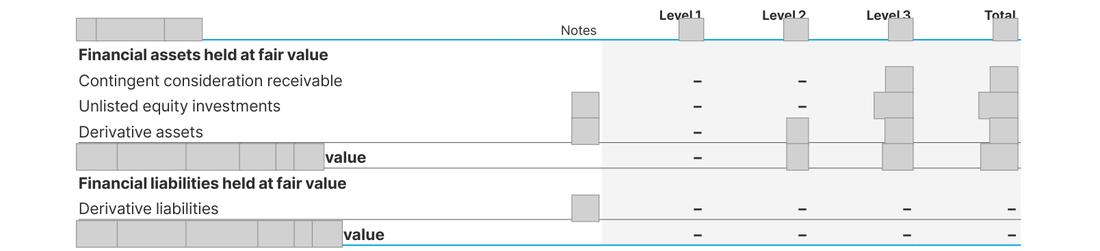
Further pages withheld to protect the company’s identity (two): Annual Report 2025, page 235; Annual Report 2025, page 46. Their wording or layout could lead back to the company even with names and figures masked; the evidence list below records what each page shows.
Names, figures, dates, logos and any wording that could be searched back to the company are boxed out in grey; the point is highlighted in yellow.
What the report shows, and what the rule requires
| What the annual report shows | What the rule requires |
|---|---|
| What the annual report shows Hierarchy table, [date]: level 3 total [amount], of which derivative assets [amount]; level 2 derivative assets [amount]. Level 3 reconciliation: closing balance [amount], of which derivative assets [amount] (opening [amount], recognised [amount], loss [amount]), with no transfer line. Narrative: no transfers from or to level 3. | What the rule requires A level 3 reconciliation whose closing balance equals the level 3 column of the hierarchy table, with any transfer of the [date] warrant out of level 3 shown as a separate line, with its reason and the policy for when transfers are deemed to occur; or, if the warrant stayed in level 3, a hierarchy table that shows it there. |
The rule
IFRS 13 Fair Value Measurement, paragraph 93(e) and (e)(iv)
Version relied on: UK-adopted international accounting standards (UK Endorsement Board), as in force for financial years beginning in or after January 2025
For recurring Level 3 fair value measurements, the accounts must reconcile opening to closing balances, showing separately any transfers into or out of Level 3 and the reasons.
Why it applies here: the [date] warrant has moved from level 3 to level 2 during the year.
Why it matters
- A reader cannot tell whether the warrant expiring in [date] is valued on observable or unobservable inputs, or which of the two closing level 3 figures is right.
- The reconciliation and the statement on transfers are audited IFRS 13 disclosures.
A reader cannot tell from the note whether the warrant expiring [date] is valued on observable or unobservable inputs, or which of the two closing level 3 figures is right. The reconciliation and the statement on transfers are audited disclosures required by IFRS 13.
Exposure
No fine attaches. The realistic consequence is a question in a Financial Reporting Council (FRC) Corporate Reporting Review and an undertaking to correct the disclosure in the next Annual Report.
Our workings
the hierarchy table on p.239 shows level 3 assets of [amount] contingent consideration, [amount] unlisted equity investments and [amount] derivative assets, total [amount], and level 2 derivative assets of [amount]. The reconciliation directly below closes at [amounts], total [amount]. The derivative column runs from [amount], adds [amount] recognised in the year and deducts a [amount] loss. Note 4.3 (printed pages 235-236) shows warrants over [investee] [investee] of [amount] (expiring [date], [amount] a year earlier) and [amount] (expiring [date], received in the [date] loan settlement), and commodity swap assets of [amount]. The Financial Review describes the [amount] as the [wording masked] [investee] and the [amount] separately as derivative financial instruments.
the reconciliation exceeds the hierarchy table by [amount], of which [amount] is in derivative assets and [amount] in unlisted equity investments (the second is rounding). The level 2 amount of [amount] is exactly the [amount] [date] warrant plus the [amount] commodity swaps; at [date] the level 3 derivative balance of [amount] was that same warrant.
The hierarchy table reflects that move, but the reconciliation does not show a transfer out, its derivative closing balance of [amount] agrees neither with the level 3 figure of [amount] nor with total warrants of [amount], and the sentence that there were no transfers from or to level 3 is not consistent with the table. IFRS 13 paragraph 93(e) requires the reconciliation to run from the opening to the closing level 3 balance, and [n](e)(iv) requires transfers out of level 3 to be given with their reasons. Which printed figure is wrong only the company can say; that at least one is wrong follows from the two tables on the same page. The prior-year reconciliation closes at the same total as the level 3 column for [date], so the difference is new this year.
| Step | Computation | Result (GBP m) |
|---|---|---|
| Level 3 per hierarchy table | [n] + [n] + [n] = [n] | [n] |
| Level 3 per reconciliation | [n] + [n] + [n] = [n] | [n] |
| Difference | [n] - [n] = [n] | [n] |
| Derivative column of reconciliation | [n] + [n] - [n] = [n] | [n] |
| Derivative difference | [n] - [n] = [n] | [n] |
| Warrants per Note 4.3 | [n] + [n] = [n] | [n] |
| Level 2 derivative assets | [n] + [n] = [n] | [n] |
| Materiality | [n] / [n] = [n]% of the loss before tax; [n] / [n] = [n]% of level 3 | [n]%; [n]% |
Management’s best defence, and our reply
Management would say that the warrant expiring in [date] is now valued by reference to the price of the latest [investee] fundraising, an observable input, so its level 2 classification is right, and that the transfer sentence is a roll-forward of last year's wording. They would add that [amount] is under [n]% of the loss before tax and that an immaterial disclosure difference does not make the accounts non-compliant. The answer: the first argument confirms that a transfer out of level 3 happened, which paragraph 93(e)(iv) requires to be shown with its reason, and it does not explain why the derivative column closes at [amount] rather than [amount]. Materiality sets the severity at low; it does not make two audited tables on the same page agree.
The fix
- Show the [date] warrant as a transfer out of level 3 in the reconciliation (or keep it in level 3 in the hierarchy table), make the closing balance equal the level 3 column, and replace the sentence on transfers with: "During the period a warrant of £[x]m was transferred from level 3 to level 2 because [reason]; transfers are deemed to occur at the end of the reporting period."
Evidence relied on
| # | What it shows | Type | Where |
|---|---|---|---|
| 1 | Hierarchy table at [date]: derivative assets [amount] in level 2 and [amount] in level 3 | Document | Annual Report 2025, page 239 |
| 2 | Level 3 assets total [amount] in the hierarchy table | Document | Annual Report 2025, page 239 |
| 3 | Unlisted equity investments of [amount] in level 3 | Document | Annual Report 2025, page 239 |
| 4 | Contingent consideration receivable of [amount] in level 3 | Document | Annual Report 2025, page 239 |
| 5 | The note states that nothing moved into or out of level 3 | Document | Annual Report 2025, page 239 |
| 6 | Opening level 3 balances: derivative assets [amount], total [amount] | Document | Annual Report 2025, page 239 |
| 7 | Recognised/(derecognised) during the year: [amount] of derivative assets added | Document | Annual Report 2025, page 239 |
| 8 | Loss of [amount] on derivative assets recognised in profit or loss | Document | Annual Report 2025, page 239 |
| 9 | The reconciliation closes at [amount], derivative assets [amount] | Document | Annual Report 2025, page 239 |
| 10 | Warrant over [investee] expiring [date]: [amount] ([amount] a year earlier) | Document | Annual Report 2025, page 236 |
| 11 | Warrant over [investee] expiring [date]: [amount], new in the year | Document | Annual Report 2025, page 236 |
| 12 | Commodity swap assets of [amount], which with the [amount] warrant make up the [amount] in level 2 | Document | Annual Report 2025, page 235 |
| 13 | The Financial Review attributes only the [amount] to the [investee] warrants | Document | Annual Report 2025, page 46 |
| 14 | The Financial Review shows the [amount] separately, matching the level 2 amount | Document | Annual Report 2025, page 46 |
Prepared by Pramanex from the company’s published annual reports, without the company’s involvement, to show how an annual report review reads. The company is not named, and nothing on this page is a statement about any identifiable company. Observations are not an audit, review or other assurance engagement, and not legal advice. A regulator-style question is a question, not a conclusion.
Want this on your own annual report, before it is published?
Start with three free findings on your latest published annual report, or talk to us about a fixed-fee pre-publication review.
Your annual report will be in draft before the year-end audit.
Have it read before it is published.
Under NDA, with our reviewer on your insider list under UK MAR.