1.05 The 2025 inventory write-down charged to the income statement is not given, although the provision rose from [amount] to [amount]
UK Company B · a UK-listed technology and logistics group · Compliance or disclosure gap
In brief
Note 3.7 says [wording masked] rose from [amount] to [amount], against inventories of [amount], almost all consumables. Neither Note 3.7 nor the operating costs note gives the write-down recognised as an expense in 2025, which IAS 2 requires; the 2024 report did give that year's charge ([amount]).
The evidence, as filed
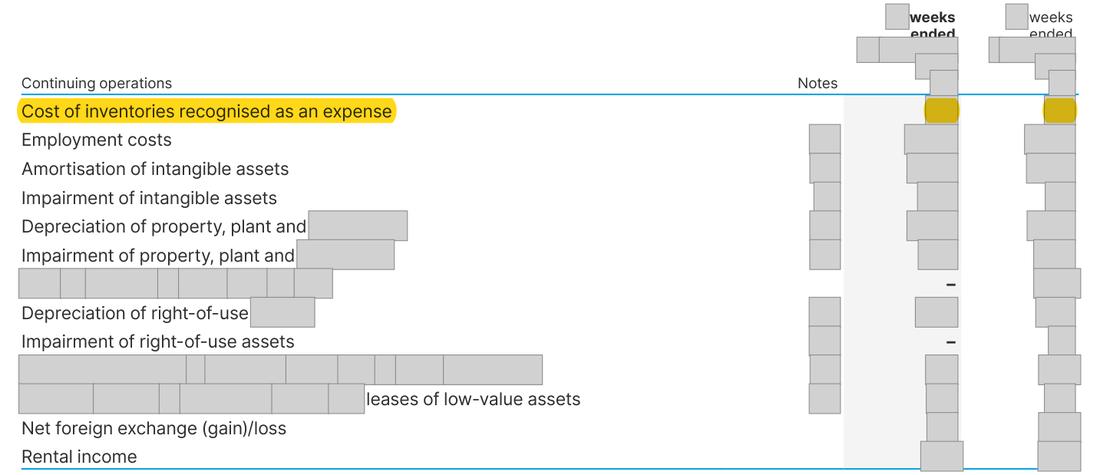
Further pages withheld to protect the company’s identity (two): Annual Report 2025, page 225; Annual Report 2024, page 201. Their wording or layout could lead back to the company even with names and figures masked; the evidence list below records what each page shows.
Names, figures, dates, logos and any wording that could be searched back to the company are boxed out in grey; the point is highlighted in yellow.
What the report shows, and what the rule requires
| What the annual report shows | What the rule requires |
|---|---|
| What the annual report shows p.225: "[wording masked] [date] is [amount] (FY24: [amount])." No write-down expense is stated; p.200 gives cost of inventories recognised as an expense of [amount] | What the rule requires A statement of the write-down of inventories recognised as an expense in 2025 (on the movement in the provision, at least [n] - [n] = [n] unless amounts were transferred into the provision from other balances), as the 2024 report gave |
The rule
IAS 2 Inventories, paragraph 36(e)
Version relied on: UK-adopted international accounting standards (UK Endorsement Board), as in force for financial years beginning in or after January 2025
The accounts must disclose the amount of any inventory write-down recognised as an expense in the period.
Why it applies here: unless part of the provision was transferred in from other balances, the write-down charged in 2025 was at least [amount] (more if amounts were released, used or derecognised with [investee]); the report does not say what it was.
Why it matters
- Readers cannot see how much of the 2025 operating loss came from writing down consumables ([equipment] spare parts and similar), or account for the tenfold rise in the provision.
- The 2024 report gave the figure, so the information is available.
Readers cannot see how much of the 2025 operating loss came from writing down consumables ([equipment] spare parts and similar), or reconcile the tenfold rise in the provision.
Exposure
A Financial Reporting Council Corporate Reporting Review enquiry could ask for the amount; the realistic outcome is an undertaking to give it in the next report.
Our workings
Note 3.7 gives inventories of [n] (goods for resale [n], consumables [n]) and a provision of [amount] against [amount] a year earlier. Note 2.3 gives cost of inventories recognised as an expense of [n] and no write-down line. The 2024 report explained that year's movement in the provision and the [amount] recognised in the income statement.
[n] - [n] = [n] increase; [n] / [n] = [n]% of the group loss before tax; [n] / ([n] + [n]) = 19% of gross inventories.
The rise sits alongside the impairment of [equipment], spare parts and [equipment] components described in the Financial Review.
| Item (£m) | Computation |
|---|---|
| Increase in the inventory provision | [n] - [n] = [n] |
| Gross inventories before provision | [n] + [n] = [n] |
| Provision as share of gross inventories | [n] / [n] = 19% |
| Increase as share of group loss before tax | [n] / [n] = [n]% |
Management’s best defence, and our reply
The finance team would say the write-down is small against the group's results and is visible from the movement in the provision that the note does give, so a reader can infer it; they could add that IAS 1.31 relieves immaterial disclosures. However, IAS 2.36(e) asks for the amount itself, the provision is now about a fifth of gross inventories, the 2024 report gave the figure, and the movement in the provision cannot show the charge because releases, amounts used and the [investee] deconsolidation are not given.
The fix
- Add to Note 3.7: "Inventory write-downs of £[x]m (FY24: [amount]) were recognised as an expense in the period, mainly relating to consumables superseded by upgraded designs."
Evidence relied on
| # | What it shows | Type | Where |
|---|---|---|---|
| 1 | inventories of [n] are almost all consumables ([n]) | Document | Annual Report 2025, page 225 |
| 2 | the provision rose from [amount] to [amount]; no expense figure follows | Document | Annual Report 2025, page 225 |
| 3 | the operating costs note gives the cost of inventories expensed but no write-down | Document | Annual Report 2025, page 200 |
Absence check
- Document
- Annual Report 2025
- Where it would appear
- [wording masked]
- What is missing
- the amount of the 2025 write-down of inventories recognised as an expense
- Pages looked at
- p.198-200 (Note 2.3 operating costs), [n] (Note 3.7 inventories), 272-273 (cash flow reconciliation)
- Result
- write-down / written down hit p.203 (contingent consideration from [partner]) and p.264 (the Company's investments in subsidiaries), neither about inventories; slow-moving and net realisable value hit only p.225 (the policy and the closing provision); 'inventories recognised as an expense' hits p.200, which gives the cost of inventories ([n]) but no write-down; provision for obsolete has no hit.
Prepared by Pramanex from the company’s published annual reports, without the company’s involvement, to show how an annual report review reads. The company is not named, and nothing on this page is a statement about any identifiable company. Observations are not an audit, review or other assurance engagement, and not legal advice. A regulator-style question is a question, not a conclusion.
Want this on your own annual report, before it is published?
Start with three free findings on your latest published annual report, or talk to us about a fixed-fee pre-publication review.
Your annual report will be in draft before the year-end audit.
Have it read before it is published.
Under NDA, with our reviewer on your insider list under UK MAR.