1.04 The notes do not say what caused the 2025 impairment losses of [amount] on property, plant and equipment and intangible assets
UK Company B · a UK-listed technology and logistics group · Compliance or disclosure gap
In brief
The 2025 movement tables record impairment charges of [amount] on property, plant and equipment and [amount] on internally generated intangible assets, [n] + [n] = [n] in total. The notes explain the 2024 impairments ([place], [format] sites, [customer]) but say nothing about what caused the 2025 losses; the only explanation, for the [amount], is in the Financial Review, outside the financial statements. IAS 36 requires the main events and circumstances behind impairment losses to be disclosed in the financial statements.
The evidence, as filed
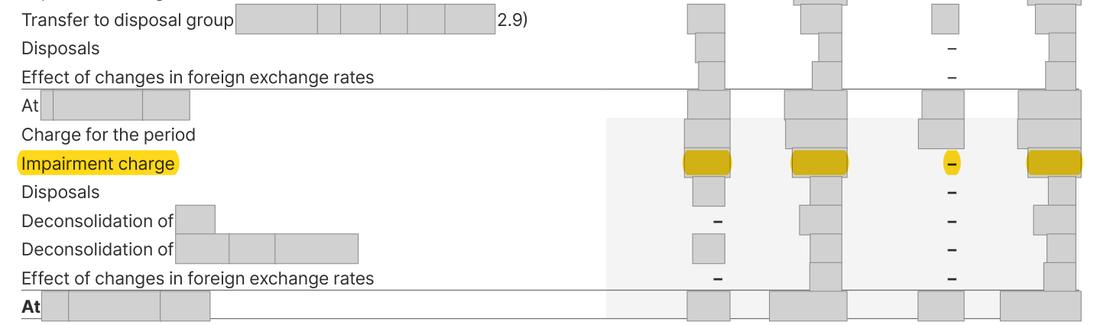
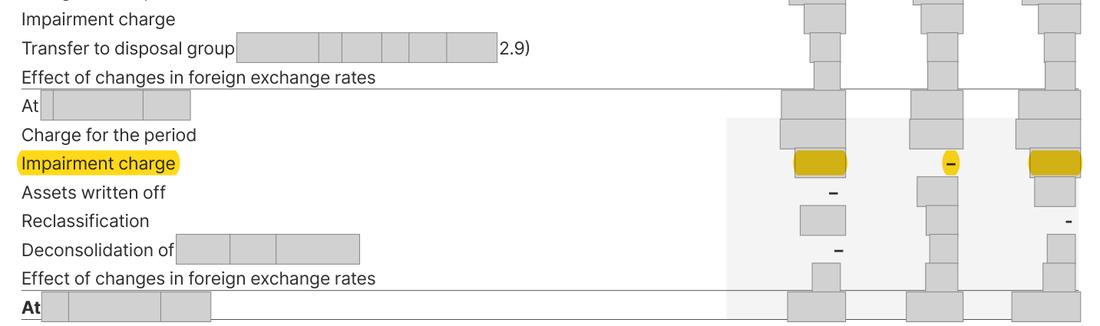
Further pages withheld to protect the company’s identity (four): Annual Report 2024, page 195; Annual Report 2025, page 218; Annual Report 2025, page 45; Annual Report 2025, page 26. Their wording or layout could lead back to the company even with names and figures masked; the evidence list below records what each page shows.
Names, figures, dates, logos and any wording that could be searched back to the company are boxed out in grey; the point is highlighted in yellow.
What the report shows, and what the rule requires
| What the annual report shows | What the rule requires |
|---|---|
| What the annual report shows Note 3.3 and Note 3.2 show impairment charges of ([n]) and ([n]); Note 3.3 explains only prior-period impairments and says the 2025 CGU assessments gave no impairment | What the rule requires A sentence in Note 3.3 / [n] giving the main classes of assets affected and the main events and circumstances behind the 2025 losses (for example, upgraded [equipment], spare parts and [equipment] components, and technology projects not pursued) |
The rule
IAS 36 Impairment of Assets, paragraph 131(a) and (b)
Version relied on: UK-adopted international accounting standards (UK Endorsement Board), as in force for financial years beginning in or after January 2025
For impairment losses (or reversals) not individually disclosed, the accounts must give the main classes of assets affected and the main events and circumstances that caused them.
Why it applies here: the movement tables meet the 'main classes of assets' limb of IAS 36.131, but the 'main events and circumstances' limb is not met in the financial statements; the Financial Review is outside the audited statements and the notes do not cross-refer to it.
Why it matters
- Readers of the audited accounts cannot see why [amount] of assets were impaired in 2025, whether the cause (upgraded technology, abandoned projects) may recur, or how it relates to the capitalisation judgements the auditor reported on.
- A sentence in each note is enough; no amount changes.
Readers of the audited financial statements cannot see why [amount] of assets were impaired in 2025, whether the cause (upgraded technology, abandoned projects) may recur, or how it relates to the capitalisation judgements the auditor reported on.
Exposure
A Financial Reporting Council Corporate Reporting Review enquiry could ask for the IAS 36.131 explanation; the realistic outcome is an undertaking to add it in the next report.
Our workings
the PPE table shows an impairment charge of ([n]) on land and buildings and ([n]) on fixtures, fittings, plant and machinery, ([n]) in total; the intangibles table shows ([n]) on internally generated intangible assets. The narrative on p.218 explains the prior-period charges ([place] [amount], [format] sites [amount], [customer] [amount]) and says the 2025 CGU assessments gave no impairment charge. The Financial Review says the [amount] was mainly in relation to [equipment], spare parts and [equipment] [wording masked] decided not to pursue; it gives no reason for the [amount].
[n] + [n] = [n], which is [n] / [n] = [n]% of the group loss before tax.
| Item (£m) | Amount | Source |
|---|---|---|
| Impairment of property, plant and equipment 2025 | [n] | Note 3.3, p.217 |
| Impairment of internally generated intangible assets 2025 | [n] | Note 3.2, p.215 |
| Total 2025 impairment losses | [n] + [n] = [n] | Financial Review p.26 gives [amount] |
| Share of group loss before tax | [n] / [n] = [n]% | benchmark |
Management’s best defence, and our reply
The finance team would say that the losses are many small write-downs of individual assets rather than one material impairment, that the movement tables already show the classes affected, and that the Financial Review in the same Annual Report explains the [amount], so readers are not left uninformed. They could add that IAS 1.31 relieves disclosures that are not material. However, the aggregate is [amount], about a tenth of the loss before tax; IAS 36.131(b) asks for the main events and circumstances in the financial statements, which the Financial Review is not part of and to which the notes do not cross-refer; and nothing anywhere explains the [amount] intangibles charge.
The fix
- Add to Note 3.3 and Note 3.2: "Impairment charges of [amount] (property, plant and equipment) and [amount] (internally generated intangible assets) relate mainly to [equipment], spare parts and [equipment] components superseded by upgraded designs and to technology projects the Group decided not to pursue."
Evidence relied on
| # | What it shows | Type | Where |
|---|---|---|---|
| 1 | Note 3.3 records a 2025 impairment charge of [amount] on property, plant and equipment | Document | Annual Report 2025, page 217 |
| 2 | Note 3.2 records a 2025 impairment charge of [amount] on internally generated intangible assets | Document | Annual Report 2025, page 215 |
| 3 | the note explains only the prior-period impairment charges | Document | Annual Report 2025, page 218 |
| 4 | the 2025 CGU assessments gave no charge, so the 2025 losses arose outside these tests and are not explained | Document | Annual Report 2025, page 218 |
| 5 | the only explanation is in the Financial Review, outside the financial statements | Document | Annual Report 2025, page 45 |
| 6 | the Financial Review gives the 2025 impairment charge as [amount] | Document | Annual Report 2025, page 26 |
Absence check
- Document
- Annual Report 2025
- Where it would appear
- [wording masked]
- What is missing
- the main events and circumstances that led to the 2025 impairment losses of [amount] on property, plant and equipment and [amount] on internally generated intangible assets
- Pages looked at
- p.194 (Note 1.4 key estimates), 200-206 (Notes 2.3-2.5 operating costs and adjusting items), 214-221 (Notes 3.1-3.4)
- Result
- spare parts, upgraded, not to pursue, [equipment] components and [amount] hit only p.45 (Financial Review, outside the financial statements; spare parts also p.64, a sustainability passage on recycling [equipment]); [amount] hits p.39 ([segment] capital expenditure), p.45 (Financial Review, amount only) and p.230 ([customer] dismantling provision), none an explanation; obsole hits p.174 (auditor's procedures on capitalised projects) and p.225 (inventory policy). No hit in the notes explains the 2025 impairment losses.
Prepared by Pramanex from the company’s published annual reports, without the company’s involvement, to show how an annual report review reads. The company is not named, and nothing on this page is a statement about any identifiable company. Observations are not an audit, review or other assurance engagement, and not legal advice. A regulator-style question is a question, not a conclusion.
Want this on your own annual report, before it is published?
Start with three free findings on your latest published annual report, or talk to us about a fixed-fee pre-publication review.
Your annual report will be in draft before the year-end audit.
Have it read before it is published.
Under NDA, with our reviewer on your insider list under UK MAR.