7.19 Foreign exchange sensitivity: the [amount] borrowings effect is attributed to Euro term loans the group no longer had
UK Company A · a UK-listed medical technology group · Drafting slip
In brief
Note 16.1 says a 10% weaker [currency] would raise net borrowings by [amount] principally because of Euro-denominated term loans. At [date] the only bank debt was a [amount] overdraft; the Euro debt was the [amount] EUR corporate bond. The 2025 report describes the same [amount] as due to the [amount] Euro corporate bond.
The evidence, as filed
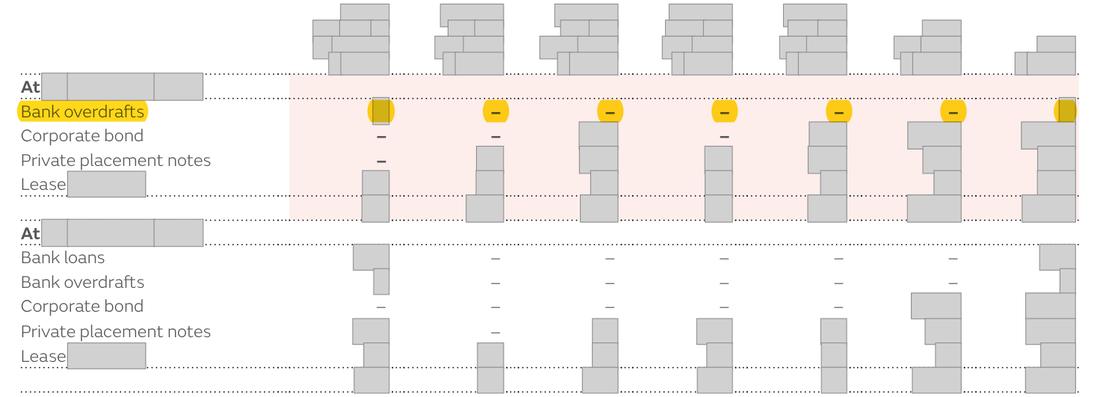
Further pages withheld to protect the company’s identity (three): Annual Report 2024, page 224; Annual Report 2025, page 244; Annual Report 2024, page 226. Their wording or layout could lead back to the company even with names and figures masked; the evidence list below records what each page shows.
Names, figures, dates, logos and any wording that could be searched back to the company are boxed out in grey; the point is highlighted in yellow.
What the report shows, and what the rule requires
| What the annual report shows | What the rule requires |
|---|---|
| What the annual report shows "... net borrowings would increase by [amount] (2023: [amount]) [wording masked]." | What the rule requires "... principally due to the [amount] EUR corporate bond", the wording the 2025 report uses for the same 2024 figure. |
The rule
IFRS 7 Financial Instruments: Disclosures, paragraph 40(b)
Version relied on: UK-adopted international accounting standards (UK Endorsement Board), as in force for financial years beginning in or after January 2025
A market-risk sensitivity analysis must explain the methods and assumptions used to prepare it.
Why it applies here: the 2024 wording was carried forward from an earlier year and names an instrument that did not exist at the reporting date; the sensitivity figure is unaffected.
Why it matters
A reader is told the exposure comes from bank term loans that had been repaid; the sensitivity amount is not affected.
Exposure
No consequence beyond the wording; corrected in the 2025 report.
Our workings
Note 15.1 shows no bank loans at [date] (bank overdrafts of [amount] only), and Note 16.4 identifies the Euro debt as the [amount] EUR corporate bond. The 2025 report gives the 2024 comparative of [amount] and attributes it to the [amount] Euro corporate bond.
Management’s best defence, and our reply
The company would say the [amount] figure is right and the description is a short-hand that no reader relies on, since the borrowings note shows exactly what Euro debt the group held. It would add that the wording was corrected in the 2025 report.
The fix
- Describe the source of the sensitivity as the [amount] EUR corporate bond, as the 2025 report does.
Evidence relied on
| # | What it shows | Type | Where |
|---|---|---|---|
| 1 | The 2024 report attributes the sensitivity to Euro-denominated term loans | Document | Annual Report 2024, page 224 |
| 2 | At [date] the only bank borrowing is a [amount] overdraft; the 2023 bank loans line is absent | Document | Annual Report 2024, page 221 |
| 3 | The Euro debt at the year end is the [amount] EUR corporate bond | Document | Annual Report 2024, page 226 |
| 4 | The 2025 report attributes the same 2024 figure to the [amount] Euro corporate bond | Document | Annual Report 2025, page 244 |
Prepared by Pramanex from the company’s published annual reports, without the company’s involvement, to show how an annual report review reads. The company is not named, and nothing on this page is a statement about any identifiable company. Observations are not an audit, review or other assurance engagement, and not legal advice. A regulator-style question is a question, not a conclusion.
Want this on your own annual report, before it is published?
Start with three free findings on your latest published annual report, or talk to us about a fixed-fee pre-publication review.
Your annual report will be in draft before the year-end audit.
Have it read before it is published.
Under NDA, with our reviewer on your insider list under UK MAR.