4.04 The Financial review names the [amount] bond buy-back as a cause of the rise in net debt, when buying back debt reduced net debt
UK Company A · a UK-listed medical technology group · Presentation point
In brief
The Financial review says net debt rose by [amount] in 2025 'mainly as a result of' the [amount] share buyback and the '[amount] repurchase of corporate bond'. Net debt is borrowings less cash: paying [amount] of cash to retire [amount] of bonds lowers borrowings by at least as much as it lowers cash. The net debt note shows the repurchase in the borrowings cash flow and a [amount] gain on it, so the repurchase reduced net debt rather than adding to it.
The evidence, as filed
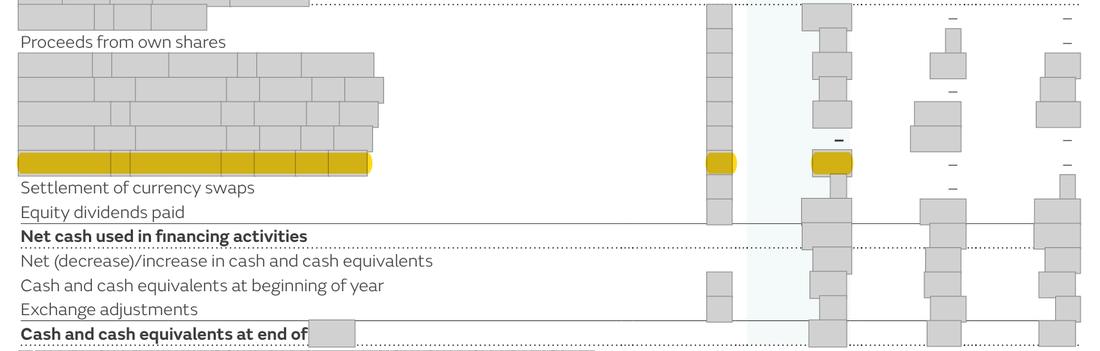
Further pages withheld to protect the company’s identity (two): Annual Report 2025, page 23; Annual Report 2025, page 263. Their wording or layout could lead back to the company even with names and figures masked; the evidence list below records what each page shows.
Names, figures, dates, logos and any wording that could be searched back to the company are boxed out in grey; the point is highlighted in yellow.
What the report shows, and what the rule requires
| What the annual report shows | What the rule requires |
|---|---|
| What the annual report shows 'an overall increase of [amount] [wording masked] [amounts] repurchase of corporate bond' | What the rule requires The increase explained by the share buyback and dividends net of the cash generated; the bond repurchase shown as neutral to net debt, or a [amount] reduction (the gain on repurchase) |
The rule
Companies Act 2006, section 414C(3)
Version relied on: Companies Act 2006, revised text on legislation.gov.uk as in force for the financial year reviewed
The review required is a balanced and comprehensive analysis of— (a)the development and performance of the company’s business during the financial year, and (b)the position of the company’s business at the end of that year
Why it applies here: the sentence lists financing cash outflows as if they all added to net debt; for a debt repurchase that is the wrong direction.
Why it matters
A reader is told that buying back debt pushed net debt up, which misdescribes the drivers of the year's net debt movement and the effect of the capital allocation decisions taken in 2025.
Exposure
Narrative inconsistency; the net debt figures and the reconciliation in the notes are right.
Our workings
the Group repurchased [amount] nominal of its [n]% USD bond for [amount]. The cash flow statement shows [wording masked] of [amount]. The net debt reconciliation shows net cash flow from borrowings of [amount] as a reduction of net debt, and its footnote says other non-cash movements include a [amount] gain on repurchase of the bond.
cash falls by [n] and borrowings fall by [n] in the cash flow lines, so the cash effect on net debt is [n] - [n] = 0; the [amount] gain lowers net debt further, so the repurchase reduced net debt by about [n].
The other reasons given mix bases: the [amount] is the year-on-year increase [wording masked] the [amount] the fall in acquisition outflows, not amounts that moved net debt in 2025.
| Effect of the bond repurchase on net debt | [currency]m |
|---|---|
| Cash paid (net debt up) | +[n] |
| Borrowings settled in the cash flow statement (net debt down) | -90 |
| Gain on repurchase in other non-cash movements (net debt down); net effect [n] - [n] - [n] | -10 |
Management’s best defence, and our reply
Management could say the sentence lists the main financing cash outflows of the year, that the bond repurchase did consume [amount] of cash, and that the net debt reconciliation in the notes shows the exact movement. They could add that 'mainly as a result of' is a loose summary rather than an arithmetic bridge. The answer: net debt already deducts cash from borrowings, so a cash-funded repurchase of borrowings cannot add to it, and the company's own reconciliation shows the repurchase reduced net debt by the [amount] gain; the summary therefore states the direction wrongly, not just loosely.
The fix
- Explain the movement from the net debt reconciliation, for example: 'Net debt increased by [amount]: free cash flow of [amount] was more than absorbed by the [amount] share buyback, [amount] of dividends and the other items in the net debt reconciliation; the repurchase of [amount] of bonds for [amount] reduced gross debt and gave a [amount] gain.'
Evidence relied on
| # | What it shows | Type | Where |
|---|---|---|---|
| 1 | The Financial review names the bond repurchase as a cause of the rise in net debt | Document | Annual Report 2025, page 23 |
| 2 | The offsetting items given are year-on-year changes, not amounts that moved net debt in 2025 | Document | Annual Report 2025, page 23 |
| 3 | [amount] of debt was retired for [amount] of cash | Document | Annual Report 2025, page 23 |
| 4 | Cash flow statement: [amount] of borrowings settled, reducing borrowings by the same amount as cash | Document | Annual Report 2025, page 213 |
| 5 | Net debt reconciliation: the borrowings cash flow reduces net debt | Document | Annual Report 2025, page 263 |
| 6 | The [amount] gain on repurchase is a further reduction of net debt | Document | Annual Report 2025, page 263 |
Prepared by Pramanex from the company’s published annual reports, without the company’s involvement, to show how an annual report review reads. The company is not named, and nothing on this page is a statement about any identifiable company. Observations are not an audit, review or other assurance engagement, and not legal advice. A regulator-style question is a question, not a conclusion.
Want this on your own annual report, before it is published?
Start with three free findings on your latest published annual report, or talk to us about a fixed-fee pre-publication review.
Your annual report will be in draft before the year-end audit.
Have it read before it is published.
Under NDA, with our reviewer on your insider list under UK MAR.